

Endurance Swimmer & @UNEP Patron of the Oceans. Follow @lewispughfdn for more on our work.
Plymouth
Joined April 2010
- Tweets16.9K
- Following1.5K
- Followers55.8K
- Likes11.8K




Pinned Tweet
Today is World Oceans Day.
Take a deep breath and join me underwater for a moment, surrounded by these extraordinary creatures.
The ocean is full of wonders. Let’s keep it that way.
#WorldOceansDay
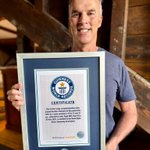
Look what’s just arrived in the post!
Thank you Guinness World Records. 🏊♂️🏆
Swimming around Martha’s Vineyard was mentally one of the toughest swims of my life. 🦈
A huge thank you to my team who kept me safe. I could never have done it without you.

There comes a point when more planning does not make you better prepared.
Before a polar swim, we plan obsessively. But eventually you reach the limit of what you can predict. You cannot write a contingency plan for something you haven’t imagined.
So we prepare the team for what the plan might miss: making decisions with incomplete information, adapting quickly, and understanding the overall objective rather than just their own role.
There is a paradox here: the better prepared you are, the less dependent you become on the plan.

Yesterday I watched Fatima Elfeky swim the final leg of a four-person relay across the English Channel.
The team had covered nearly 33 kilometres. France was right there. But the tide had turned, and a powerful current was sweeping her around Cap Gris-Nez.
She had to find another gear. And then, right at the end, she had to find another gear again.
We tend to measure progress by distance. When we are 90% of the way towards something, we assume we have roughly 10% of the effort left. But life doesn’t work like that. Sometimes the difficulty is increasing at precisely the moment our resources are decreasing.
Distance remaining tells you almost nothing about effort remaining.
Congratulations, Fatima, on an extraordinary finish, and congratulations to Mostafa, Christophe and Hayley on crossing the English Channel.
I’ve been coming to this lake for over 20 years.
It’s where I learnt to swim in very cold water.
Just look at what’s happened to the glacier.
Nigardsbreen, Norway.

Lewis Pugh retweeted

The ocean is one of our planet’s greatest treasures. From today, a landmark international agreement to protect it comes into force in the UK.
This is an important step towards protecting at least 30% of the world’s oceans by 2030.
Find out more: gov.uk/government/news/world…
Lewis Pugh retweeted

Cette photo mérite absolument tous les prix. Elle a même sa place au Louvre.
Elle relate précisément l’inertie de l’individu face à l’effondrement.
Regardez la composition. Un chef-d’œuvre involontaire.
Au premier plan, le sable doré, les tongs abandonnées, la glacière. Le décor ordinaire du bonheur estival. Deux personnages assis, de dos, comme dans un tableau de Caspar David Friedrich. Sauf que Friedrich peignait des hommes contemplant le sublime. Ici, ils contemplent la catastrophe. Et ils ne bougent pas.
Au centre, le parasol. Publicitaire, criard, dérisoire. Un pastis face à l’apocalypse. C’est presque trop parfait : la France qui prend l’apéro pendant que le monde brûle. Aucun scénariste n’aurait osé.
Et puis le ciel. Les deux tiers de l’image. Cette muraille de fumée qui avale la lumière, ce dégradé d’ocre et de noir digne d’un Turner. La nature qui reprend la palette des maîtres pour peindre notre propre fin.
La femme photographie l’incendie avec son téléphone. Mise en abyme totale : nous documentons notre disparition au lieu de l’empêcher.
Cette image dit tout. Le déni, le confort, l’habitude. Nous sommes tous sur cette plage. Nous voyons tous le nuage. Et nous restons assis, parce que l’eau est bonne et qu’on a posé nos congés.
Les historiens de l’art parleront un jour de cette photo comme on parle du Radeau de la Méduse.
Sauf que cette fois, le naufrage, c’est nous qui le regardons depuis la plage.
💔🌍

For nearly 40 years, I’ve swum in some of the world’s most extreme and fragile waters to draw attention to places that are rapidly changing, and to safeguard their future.
That’s why I’m delighted to be joining @11thHourRacing as an ambassador.
We believe that sport can inspire people to take action to protect nature.
Why do some people achieve their dreams while others fall short?
The English Channel offers a fascinating clue.
Last week at the Brilliant Minds conference in Stockholm, I spoke about the four moments when swimmers are most likely to give up.
Most surprising of all, some fail when France is already in sight.
Dreams rarely die because they are impossible. More often, they die because people are unprepared for the predictable moments when every dream is tested.

Lewis Pugh retweeted

One ocean.
From coral reefs to polar ice, from kelp forests to the open sea, the ocean connects us all.
On World Oceans Day, we celebrate the beauty, diversity and wonder of the ocean.
#worldoceansday @UNEP @UNBiodiversity @theGEF
🎥 Lewis Pugh Foundation
Lewis Pugh retweeted

Happy #WorldEnvironmentDay!
Join us in celebrating our planet and recognizing the power we all have to protect it.
Every voice matters. Every move counts. Join the movement.
Together, let’s act #NowForClimate for this generation and the next.
Lewis Pugh retweeted
There are few sights as beautiful as this. Happy #WorldPenguinDay from East Antarctica 🐧💙🇦🇶
🎥: Ben Callahann
Wayne Gretzky once said,
“I don’t skate to where the puck is. I skate to where it is going.”
My friend Slava Fetisov had to defend against him. Imagine that for a moment. The greatest attacker in the game … and you have to stop him.
Slava told me it was never about reacting. It was about reading the game. You had to sense where the puck was going next and get there first. If you were late, even by a second, it was over.
I think about that often.
The world feels unsettled at the moment. A lot is changing, very quickly. In my work, timing has always mattered.
In 2007, I realised that Arctic sea ice was melting fast, so I went to the North Pole and swam across a patch of open water.
A few years later, it became clear that we needed proper protection for our oceans, so I swam the length of the English Channel to call for 30% of the world’s oceans to be protected.
And when river pollution became impossible to ignore, I swam the length of the Hudson River.
None of these swims were random. They came at moments when the world was just beginning to pay attention.
Looking back, I realise how important that was.
These days, I sometimes see campaigns that remind me of what Slava described. Good people working incredibly hard, but focused on where the problem used to be, not where it is going.
When resources are limited, that is a risk we cannot afford.
Slava understood that on the ice. I have had to learn it in the water.
Timing matters.
📸 Lewis Pugh Foundation
(Playing ice hockey with Slava in Antarctica. It’s safe to say he got to the puck before I did.)

After 40 years of swimming, I’ve learnt that risk is rarely a simple choice between safe and dangerous. More often, it is a choice between two different risks.
Take a tanker crossing your path in the middle of a long swim. You have two options.
You can stop and wait, treading water for several minutes, getting cold, and swimming on through the churn it leaves behind.
Or you can go for it, lifting your pace and swimming hard to get safely in front while the water is still calm, at the cost of a burst of energy when you may already be tired.
Neither option is easy.
There's no time for debate. No committee meeting. A decision has to be made, and trusted.
In my world, that responsibility sits with the skipper of the support boat.
The ocean doesn’t forgive poor judgement, which is why the most important decision is made long before the swim: who you trust to make the call.
📸Kelvin Trautman

Lewis Pugh retweeted
Most of what is changing in the ocean isn’t visible.
Heat, chemistry, and declining oxygen levels.
The surface rarely tells the full story.
#acidification #climate #oceanscience
📸 The Lewis Pugh Foundation

ALT A swimmer (Lewis Pugh) is seen from below in deep blue ocean water, reaching one arm toward bright sunlight at the surface above. The surrounding water appears calm and mostly empty. (Red Sea)
Lewis Pugh retweeted

What do you swim for? 🌊
In his latest article, ocean advocate and SwimTrek Ambassador Lewis Pugh shares how every stroke can support something bigger - protecting our oceans 💙
swimtrek.com/blog/the-power-…

The reason many people give up is that they look at how far they still have to go, instead of how far they’ve already come.
Change that perspective, and suddenly the journey feels possible again.

Lewis Pugh retweeted
Calling all ocean champions!
The 2026 #EarthChamps nomination is now open until 15 April.
This year’s award will spotlight those helping to protect and restore ocean health.
Submit your nomination: unep.org/championsofearth/ho…