





Levintsky retweeted

We now have a 5 page proof of no Siegel zeros:
It's like Roger Bannister breaking the 4 minute mile! After Roger, several runners realized it was possible, and broke 4 minutes as well.
Here, Siegel zeros was a infamous challenge for over a century, but now the new proofs are rushing in...


说的挺好的

一些已经财务自由的朋友问,不要工资,有没有门路去 frontier lab 工作。这些 frontier lab 的回答是,每个人消耗的 GPU 成本和 token 成本远超他们的工资,一个不能胜任的人浪费的资源不是不要工资就能弥补的。
DeepSeek 刘胜宇把今年夏天以来的算子开发比作 “机甲驾驶员”。LLM 正在逐渐制造业化,机器的成本超过人的成本(虽然人仍然很贵),工程经验比 raw intelligence 更重要,social closure 正在形成。
创业以来接触了很多财务自由的人,财务自由只能给你拒绝工作的自由、消费的自由,不能给你创造的自由。
很多财务自由的人甚至连拒绝工作的自由都没有,比如很多上市公司高管,公司就像自己的孩子,必须一直负责下去,没有心思赶新的技术浪潮。
要获得创造的自由,也就是自由进入自己想做的领域,我只想到三条路:
1. 自己深入学习另一个领域,转行,比如从天坑专业转码;AI 可以让我们更快地入门和探索新领域,但要达到顶尖水平,仍然很难,因为专业圈子都像 LLM 这样存在 social closure。
2. 在一个领域取得成果、声誉和影响力,从而可以通过项目合作、顾问等方式进入感兴趣的其他领域,甚至横跨多个领域;(可以是公司内,比如做网络的专家也需要参与芯片、OS 等部门的讨论和合作;也可以是跨公司的)
3. 具备讲故事、拉团队、整合资源的能力,比如很多优秀创始人并非技术背景。
Levintsky retweeted

We are entering a new era of discovery now:
openai.com/index/sharing-ai-…

Levintsky retweeted

We’re releasing a broad range of new mathematical results produced by an internal frontier model.
We’ve been consulting with the independent Advisory Group on Mathematics and Artificial Intelligence at the Institute for Advanced Study, and we have drawn on their advice and public recommendations to inform how we release these results.
github.com/openai/math

Levintsky retweeted

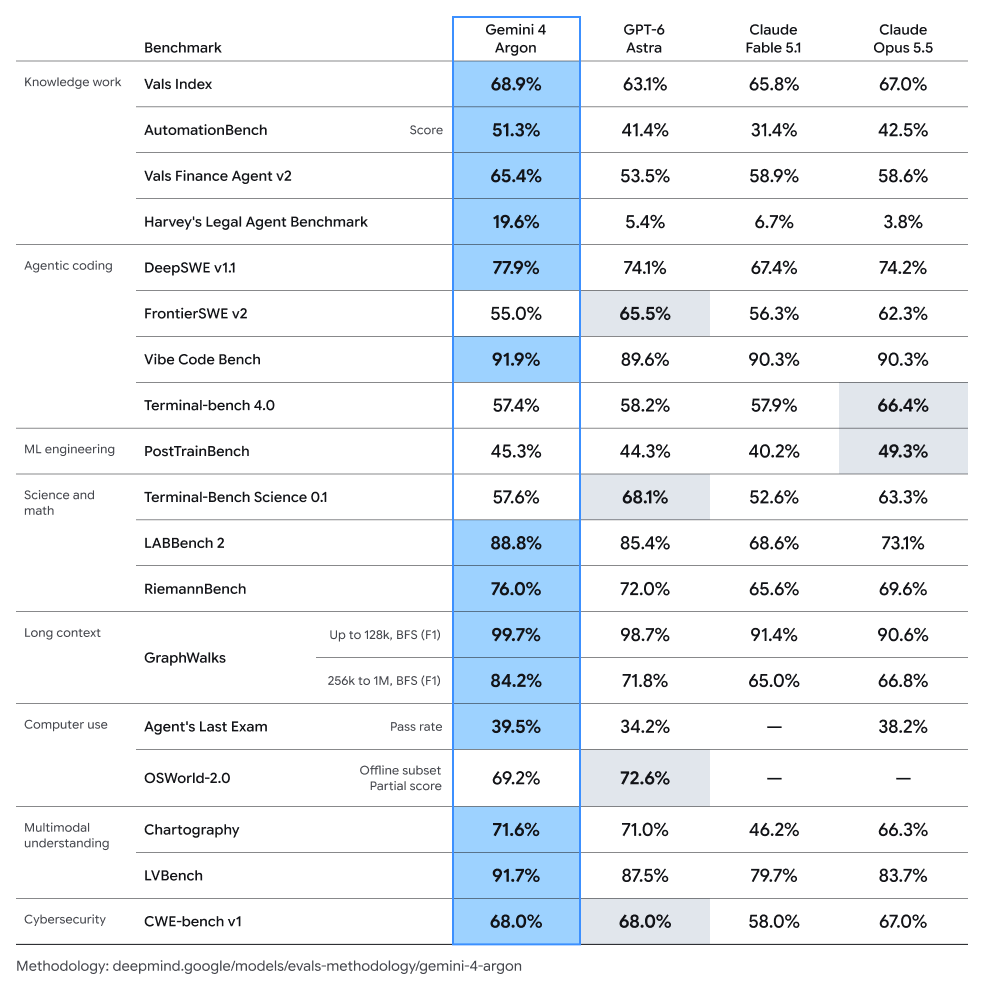
Introducing Gemini 4 Argon – our new frontier model.
It’s built for complex workflows across coding, enterprise knowledge work, and cybersecurity defense – rolling out today to a set of trusted testers through our Fairwind Program.
Levintsky retweeted

Grok 4.7 is here.
It's a notable improvement over Grok 4.6 at the same price and speed.

Levintsky retweeted

Nearly half a year of silence. We spent it studying one problem: how far RL can scale.
MiMo-V2.6 is in the middle of its RL run right now. Three things we scaled: compute (~2B tokens per step, 1568 prompts × 16 rollouts, fully async), environments and harnesses (multi-task agentic RL, mixed across multiple harnesses in one run), and grader compute (agentic in-group credit assignment, with test-case and rubric-based rewards). We'll open-source the details piece by piece over the coming weeks.
Streaming the run: mimo.xiaomi.com/rl/
Levintsky retweeted

Announcing Artificial Analysis Intelligence Index v4.3, upgrading Terminal-Bench to 4.0 and adding AutomationBench-AA, an agentic workflow automation benchmark with a private test set. This is a continuation of our rollout of Intelligence Index v5
Changelog (Index v4.2 → Index v4.3):
➤ Terminal-Bench: 2.1 → 4.0, completing our upgrade to the latest version of Terminal-Bench
➤ Replacing 𝜏³-Banking with AutomationBench-AA, our implementation of Zapier's business workflow automation benchmark
We are continuing to prioritize keeping Intelligence Index as useful as possible by bringing forward a subset of the changes we had planned for Index v5. Each change in v4.2 and v4.3 stands on its own merits and brings the Index closer to real-world problem solving, adds more private test sets to prevent gaming, and reduces saturation
Intelligence Index v4.3 raises the difficulty of agentic coding tasks and broadens the types of agentic workflows tested. Because we use a held-out test set for AutomationBench-AA, in collaboration with @zapier, the weight assigned to evaluations with private tasks or answers increases from 40% to 45%. Category weights are unchanged from v4.2: Agents 30%, Coding 20%, General 30%, Scientific Reasoning 20%
Detailed changes:
➤ Upgraded Terminal-Bench 2.1 to 4.0: 66 multi-step tasks testing agents on tasks run in agent sandboxes driven via the terminal, including tasks involving software engineering, machine learning, science, and operations. The 4.0 update recalibrates compute and time allowances, and improves task instructions and verification. We have changed from the Terminus 2 harness to mini-SWE-agent, a minimal, model-agnostic harness. We will also be updating our Coding Agent Index, where we test model and harness pairs, to include Terminal-Bench 4.0 soon
➤ Replaced 𝜏³-Banking with AutomationBench-AA: Our implementation of Zapier’s AutomationBench tests agents on 657 business workflows across simulated applications such as Gmail, Slack, Salesforce, and Jira. Agents must complete task objectives while following business rules. AutomationBench-AA uses Zapier’s private set of 657 tasks, and is built on v1.0.6
Key results:
➤ Claude Fable 5.1 and GPT-6 Astra lead the Intelligence Index: Both Claude Fable 5.1 (max with fallback) and GPT-6 Astra (max) score 53 on Intelligence Index v4.3, followed by Claude Opus 5 (max, 51), Claude Fable 5 (with fallback, 50), Muse Spark 1.3 (max, 48) and GPT-5.6 Sol (max, 47)
➤ GLM-5.3 and Kimi K3 continue to lead open weights models (both at 44): GLM-5.3-Flash (42) is the third strongest open weights model, followed by Qwen3.8 2.4T A95B (40) and DeepSeek V4 Pro 0813 (max, 36)
➤ 4 labs occupy the Intelligence vs. Cost per Task Pareto frontier: OpenAI occupies the majority of the cost-efficiency frontier, with all five reasoning efforts of the recently released GPT-6 Astra offering the lowest Cost per Task at their respective levels of intelligence. Claude Fable 5.1 (xhigh, max, 53), GLM-5.3-Flash (42) and MiMo-V2.5-Pro (26) round out the rest of the frontier

Levintsky retweeted

把中国古代文献全部装进一块硬盘,需要多大?
答案:不到 5GB。
GitHub 上的殆知阁古代文献(daizhigev20),1.7k star 的老牌语料库:16000 种古籍、20 万卷、约 20 亿字,全部 txt 纯文本,一次 clone 全带走。
什么概念?《四库全书》收书 3503 种——它的收录量是四库全书的四倍还多。
整个文库按传统方法分作十藏: 📜 易藏 · 儒藏 · 道藏 · 佛藏 · 子藏 📜 史藏 · 诗藏 · 集藏 · 医藏 · 艺藏
经史子集、佛经道藏、历代医书、诗词文集,基本你想得到的中国古代文献都躺在里面。
能干嘛? 🤖 做 RAG 国学知识库,喂给 AI 答四书五经 📊 古文 NLP 研究的现成大规模语料 📚 当私人电子文库,GitHub 页面里直接全文检索
一个小提醒:文本来自多年网络协作录入,质量参差,拿去做学术引用前记得自行校对。
项目地址:github.com/garychowcmu/daizh…
你会先钻进哪个“藏”?

Levintsky retweeted

More good news: GLM-5.3’s weights will be released tomorrow.
huggingface.co/zai-org/GLM-5…

Levintsky retweeted

AI时代就是要敢想啊,太励志了——协和的一个神经外科博士生金山木,本科北大地质专业,自学数学,用GPT-5.6解决了矩阵分析领域一个核心且著名的未解难题Crouzeix猜想(2004年提出)! 已经得到Crouzeix本人在内的多位数学家确认。 mp.weixin.qq.com/s/Wkdv9zsrb…

Latest crazy story from the frontiers of math and AI -- a neurosurgery resident, with no training in advanced math, uses ChatGPT 5.6 to solve a major open problem in numerical linear algebra. alextownsend.net/essays/SIAM…

Levintsky retweeted

We promised open weights for Qwen3.8. Now, time to meet them! 🎉
⚡ Qwen3.8-27B:
- A native multimodal dense model. With just 27B parameters, it outperforms Qwen3.7-Plus overall and shines in real-world coding & office workflows.
- 262K native context, easily extendable to 1M tokens via YaRN.
- Built for builders. Highly efficient, high-quality, and licensed under Apache 2.0.
🚀 The open weights for Qwen3.8-2.4T-A95B (Max-level) have also been released recently.
Whether you're shipping lightweight applications with Qwen3.8-27B locally or building agents with Qwen3.8-2.4T-A95B, they're yours now!
Download, deploy, and build something we haven't imagined yet. 👀👇
- Hugging Face:
huggingface.co/collections/Q…
- ModelScope:
modelscope.cn/collections/Qw…

Levintsky retweeted

Our latest code model is 25% more efficient, higher quality, and a quarter of the cost than our model launched in June. Now live in GitHub Copilot - try it out.

Levintsky retweeted
SpaceXAI's Grok 4.6 scores 61 on the Artificial Analysis Intelligence Index, joining the frontier in line with GPT-5.6 Sol, with standout agentic performance at lower cost
Grok 4.6 gains 5 points over Grok 4.5 on the Intelligence Index just over one month after its release, or +23 points compared to Grok 4.3. This brings SpaceXAI back to the intelligence frontier alongside OpenAI, behind only Anthropic.
Key takeaways:
➤ Grok 4.6 joins the frontier of the Artificial Analysis Intelligence Index: It scores 61, in line with GPT-5.6 Sol (max), behind Claude Opus 5 (max, 63) and Claude Fable 5 (max with fallback, 62), and just ahead of Kimi K3
➤ Strong agentic performance: Grok 4.6 achieves a GDPval-AA v2 Elo of 1753, behind only Claude Opus 5 and with overlapping confidence intervals with Claude Fable 5 and Qwen3.8 Max. It scores 50.7% on 𝜏³-Banking, among the top two scores alongside Qwen3.8 Max (51.3%), and 88.4% on Terminal-Bench v2.1, in line with the leading models
➤ Frontier-level intelligence at lower cost: Headline pricing is unchanged from Grok 4.5 at $2/$6 per 1M input/output tokens, 60%+ below Claude Opus 5 ($5/$25) and GPT-5.6 Sol ($5/$30). It cost $0.84 per task, the same as Kimi K3 with slightly higher intelligence, placing it on the Intelligence vs. Cost per Task Pareto frontier
➤ Grok 4.6 sits at Fable 5-tier on AA-Briefcase, our private benchmark of long-horizon agentic knowledge work tasks, with an Elo of 1577 - behind the Claude Opus 5 family. It is notably turn-efficient, completing tasks in ~53 turns and ~0.5B input tokens on average vs. ~103 turns and ~2.0B input tokens for Claude Opus 5 (max)
Other model details:
➤ Context window of 500k tokens (unchanged from Grok 4.5)
➤ Pricing of $2/$6 per 1M tokens of input/output; cache hits discounted to $0.5 per 1M tokens, an increase over Grok 4.5’s $0.3 per 1M tokens for cache hits
Congratulations to @spacexai and @elonmusk on the release!

RT @zhu_hanqing666: Now it’s true 🫣
Enjoy Grok 4.6! We built on our previous favorite boy, Grok 4.5 :), refined the recipes with previous…
This quoted post is unavailable.
Levintsky retweeted

We can finally talk about it:
We found a way to extract hidden reasoning of frontier models using a vulnerability in the APIs of every frontier AI company.
We verified that our reasoning token count matches billed API thinking tokens 1:1 for most of the prompts we queried.

Levintsky retweeted

Introducing Muse Glimmer, an open-weight 30B-parameter model optimized for local, always-on agent workflows.
Muse Glimmer delivers strong performance on key agentic use cases and benchmarks compared with leading models in its size category, and is designed to run entirely on consumer hardware like a Mac or PCs with performant GPUs.
In keeping with our long tradition of sharing fundamental AI research, we’re releasing model weights under a permissive Apache 2.0 license.
🧵👇


