




the document that breaks an AI bookkeeping workflow often isn't the missing one. it's the second version.
a supplier sends an invoice. two days later, a corrected one. or a client re-sends a bank statement because the first export cut off a page.
treat every file as new and you count it twice. match on the file name and you keep the old one. either way the folder looks complete.
my check: send v1, then a corrected v2. does it replace v1, flag the conflict, or count both?
what i don't know yet: how often a correction is actually labeled as one, instead of just arriving as another pdf.

1
28
Most AI for accounting offices is just another chat window.
Reading the document was never the problem.
Knowing whose it is, where it goes, and what's still missing is.
That's the part worth solving.
1
17
the risky match in an accounting workflow usually isn't the amount. it's the name.
two clients both called cohen. a company that changed its name last year. an invoice with the right person and the wrong entity.
match on the name and the agent files it confidently, in the wrong file.
my check: give it an invoice with the right name and someone else's VAT or company number. does it file it, or stop and ask?
what i don't know yet: how often that number is missing or unreadable on real client documents.

13
when an accounting agent asks for approval, i want to see what the reviewer actually saw.
which source documents, which version of the draft, which rule it applied.
an approval without that is a name and a timestamp, not review evidence.
my check: change one source after it's approved. does the approval go stale, or does it still say "approved"?
what i don't know yet: how much of that evidence a busy reviewer will actually open.

17
a useful AI agent in an accounting office works like a new hire: it gets a task in email, WhatsApp, the client folders or the ledger software, prepares the work, and waits for the team before anything is sent or posted.
agente.dev/ai-agents-for-cpa…

17
my least glamorous test for an accounting agent: the connection drops right after it writes.
now run it again.
if nobody can tell whether the first attempt landed, the office ends up with a duplicate entry or a missing one. that's a reconciliation problem, not a prompting problem.
my check: before any retry, the agent looks up whether the first write exists. "done" is a state you can verify, not a message.

11
i don't want an office agent to remember everything. i want it to know which rule applies here.
this client, this process, this version.
a correction for one client should not quietly become policy for the whole firm.
my check: ask the agent where a rule came from, who it covers, and what it replaced. if it can't say, that's memory, not knowledge.

14
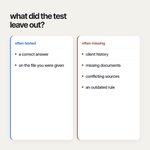
i read accounting AI benchmarks with a second question: what did the test leave out?
client history, missing documents, conflicting sources, an outdated rule.
a correct answer matters. so does knowing when the file isn't ready for one.

10

when i look at an AI document workflow, i want the reporting period next to the source.
a bank statement can be perfectly readable and still be the wrong month.
OCR quality and accounting readiness are different tests.

18 years writing software. the last 2+ i haven't written code by hand.
the surprise wasn't that building got easy. it's what got hard instead.
knowing the work. which client, which folder, who signs off on what. none of that lives in a repo.
the bottleneck moved from code to context. and context lives inside the businesses already doing the work.

1
22
in a services business the loop is the same, with one twist.
the agents do the work between the tools. but the human isn't called like an api. the human is the one who signs.
that signature is what the client pays for. everything before it is getting cheap, fast.
the firms that win won't have fewer humans in the loop. they'll bring their humans only the yes.
xitter.cf/gregisenberg/status/21…


building a company these days is basically a loop:
acquire valuable context
orchestrate agents to build on it
feed the data back in
call humans like an api
repeat
the best context/faster loop wins
11
8:00. the office opens.
overnight, clients sent whatsapps, emails, receipt photos, and one "URGENT!! call me" with no context.
someone used to spend the first hour just sorting that. who sent it, which client, is it urgent or just loud.
that hour isn't accounting. it's the work between the tools.
now the agent sorts it before anyone sits down. files the documents to the right client, drafts the replies. the team starts the day with a list of yeses.
10
the interface of an ai-native office isn't a new dashboard.
it's the whatsapp the office already lives in. the accountant sends a voice note, "remind the client about the vat report and prep the draft", and the agent picks it up.
nobody learns a new app. the work just starts.

12
my bet for this list: the accounting office down the street.
every time ai gets better, the work between the tools gets cheaper. the trust doesn't. clients still want their accountant to sign.
cheaper work, same trust. that's a business that gets stronger, not weaker.
the office just has to let the agents in.
xitter.cf/gregisenberg/status/21…

One of the most important questions of our time:
"If AI can build almost anything, what should I build?"
It's the question behind most of the anxiety I hear about AI right now
I broke down the 8 kinds of businesses I think get stronger as AI gets better
1
15
dana is out this week.
a client whatsapps the office: "where are we with my annual report?"
orit checks. "only dana knows that one."
every office has a dana. the person the whole client history lives in.
that's not a people problem. it's a storage problem. the knowledge sits in one head instead of in the office.
an agent that learned the office finds dana's notes in the client folder, says what's still missing, drafts the reply. orit says yes.
20
we don't replace the office's software.
hashavshevet stays. the email stays. the whatsapp groups with clients stay.
the agent works between them. the part where a human used to copy, paste, rename and file.
nobody in the office has to learn a new system. that's the point.

13
in accounting offices it looks a bit different.
the agents don't replace talking to the team. they take the work nobody wants to talk about. chasing docs, renaming files, moving numbers from one system to the next.
the team still decides. the agent asks for a yes.
less work between software, more time for the humans.
xitter.cf/gregisenberg/status/21…

running a company nowadays feels kinda dystopian
my team is 50+ people in 12 countries, but i talk to my agents more than my human teammates
- voice note to grokbot
- mattpocock/skills /grill-me so the agent interrogates the idea before anything gets built
- spec drops into linear through the linear mcp
- exa + firecrawl agent reads every competitor site, pricing page and changelog
- ideabrowser.com to find ideas and trends
- apify pulls g2, reddit and app store reviews
- prompt: "find the 10 complaints that show up most and quote the users"
- context7 so the agent reads the latest docs before it touches any api
the design
- claude code + paper mcp
- 4 versions of every screen before a single line of code
- pick pieces from 2, it merges them. diverge then converge
- frontend-design skill from anthropic/skills + our own design system skill
- cleanshot screenshots of any ui i like go straight in with "make it feel like this"
the build
- pingdotgg/t3code as the control surface for every agent, from my phone too
- stablyai/orca runs a fleet of agents in parallel, each in its own git worktree
- graphify maps the whole codebase into a knowledge graph so agents navigate instead of guess
- headroom compresses tool outputs before they hit the model, so tokens go 20-95% further
- lsp plugins so the agent sees types and errors like an ide does
- security guidance hook flags risky edits before they land
- supabase mcp for the database, stripe for billing
- github mcp opens the pr, vercel spins up a preview
- loops run overnight, i check what shipped over coffee
the user testing
- lightpanda as the headless browser, way lighter than chromium so you can run hundreds at once
- agents click every flow on the preview like a first-time user
- one persona is impatient, one is confused, one is on a phone
- playwright + chrome devtools mcp for regression tests
the bugs
- sentry mcp catches the error
- agent reads the stack trace and opens a fix pr in under 10 minutes
- human just approves
the data
- posthog mcp cron at 7am on yesterday's funnel
- any step that drops more than 10%, the agent watches 20 session replays and tells me why
- stripe mcp pulls every cancellation reason into one doc every monday
the agents' tools
- orgo so every agent gets its own computer
- agentmail so every agent gets its own inbox
- agentphone so i can call them from the car
- composio connect-apps for every other connector
- akitaonrails/ai-memory, a git-backed markdown wiki so they remember what we decided last week
the skills
- wshobson/agents so skills work across claude code, codex and opencode
- my writing voice
- our design system
- how we write specs
- skill creator so the agents write new skills themselves
some helpful tricks
- one agent per platform. the x agent never touches email
- cheap model for triage, opus for anything that ships
- every output gets scored 1-10 by an llm judge. under 8 goes back
- every agent writes a 5-line log at night so i can read the whole company in 2 minutes
- every agent mistake becomes a new skill, so it only happens once
the team
- humans get version 5, not my voice note which they are happy about lol
- their job is creative feedback, relationships and telling the agents what they got wrong
a human pm reviews the funnel once a week. this reviews it every morning
running a company is now voice notes and inference
7
a client emails the office on sunday. the bank needs a letter by thursday.
two people see it. each one thinks the other took it.
thursday comes. nobody did anything wrong. it just fell between them.
that's the real pain in accounting offices. not the hard work. the stuff that falls between people.
an agent picks it up the minute it lands, opens the task, prepares the draft and asks the accountant for a yes.
the computer files. the human approves.

7
