

AI GTM | Building & learning in public | ex-GTM Intern @Medeo_AI | Babson ’27
Joined July 2024
- Tweets637
- Following522
- Followers1.4K
- Likes1.5K


Pinned Tweet
Burned way too many credits getting a whole terracotta army to bow to an empress.
Full LibTV workflow below, prompts included, plus the mistakes that cost me most.
Next up: who pays for AI video like this. Follow along.
(Recreated from Storm II by Gener8ion feat. Yung Lean)

AI UGC Video Experiment 2
For today’s AI video experiment, I tried Hypit, an AI tool I recently discovered for recreating videos.
I used it to recreate an Instagram outfit-change Reel with Nora, my AI character, in four Korean streetwear looks.
I picked outfit references, generated four images and four clips, then edited a 25-second video. Those images and clips used about $1.92 worth of credits at my top-up rate.
Original on the left, my version on the right, so you can judge what that budget got me. The movements are newly generated. I think it captured the original’s feel well, with no major flaws that I noticed.
I’ll also post my version on my Instagram account and see how it does.
Original Reel by alina_gf_:
instagram.com/reels/Dd5qyIWq…
Would you post this as-is, or is there something you’d fix first?
AI UGC Video Experiment 1
I gave four AI video agents the same 15-second product-ad brief.
The video credits worked out to $7.36–$14.40 under my plans. The outputs included an extra cup, a misplaced product title and a changed bag shape.
Here are the results, what missed the brief, and how I calculated the cost.
I mentioned I’d start an Instagram account as part of my AI video experiments and share how it goes here. The account is now up, with four videos posted in its first four days. Here are the results so far:
Two recreations of trending formats: 2,909 and 2,910 views.
Two regular outfit videos: 193 and 297 views.
The formats behind those two higher-view videos kept showing up in my Instagram feed. Every few videos, I’d see another person’s version of the same idea.
For now, I’m leaning toward finding more of those trending formats and recreating them to get this account going.
Four videos is still early, though. I’ll keep trying for a few more days to see whether that gap holds, and whether the regular videos pick up too.

AI UGC Video Experiment 1
I gave four AI video agents the same 15-second product-ad brief.
The video credits worked out to $7.36–$14.40 under my plans. The outputs included an extra cup, a misplaced product title and a changed bag shape.
Here are the results, what missed the brief, and how I calculated the cost.
My takeaways from this run:
1. Paying more didn't get me a result that followed the brief more closely. Runway cost the most at $14.40, but still changed the ending.
2. The price of generating a video isn't the full cost of getting a usable finished video. Product shapes, titles and actions still need checking and fixing. The prices above cover the initial generation, not that extra work.
The starting brief, five reference images and 10.25-second motion reference were shared. I requested standard Seedance 2.0, 15 seconds, 9:16, 1080P, with audio. No templates.
The final prompts and assistant models weren't unified. OpenArt made two extra crops; Runway needed one correction to restore the product titles. Aspect-ratio instructions also differed during setup.
One generation per platform isn't enough to rank reliability. I haven't tested these as actual ads.
Follow for more AI UGC video experiments.
What part of AI video are you most curious about? Let me know in the comments, or suggest something you'd like me to test. I'll read your ideas and use them to help shape the next experiments.
I asked Opus 5.5 to explain how Tesla's Roadster drives up a wall and hangs upside down.
It went through 27 sources, did the physics math, wrote the script and coded every chart, label and cutaway.
What do people think?

Hey, I'm Lee👋
I'd love to connect with more:
• DTC and ecommerce founders
• Brand content and creative teams
• UGC creators and creative strategists
• AI video builders
I'm going deeper into AI video and want to understand how it fits into a brand's day-to-day work. I'm happy to try making a video with your actual product for free, then hear what you'd need changed before using it in your work.
I'll also build accounts around an AI character on TikTok and Instagram, using different tools to make AI-generated, UGC-style content. These accounts will be my experiments. Here on X, I'll document the process: what I post, how followers and views change, what I adjust, and what I learn.
I'm happy to start small and learn as I go. Say hi or DM me with what you're working on. I'd love to hear where AI video might help and compare notes.
I spent three months doing a content and growth internship at an AI video startup, working on its X, Instagram and TikTok accounts.
These are my own reflections on what I learned, what I think I did well, and what I still haven't figured out.
The part I think I did well was finding content people wanted to watch. Early on, I tried ideas around a football event. I thought playful remixes around it could work on TikTok and Instagram; I was less sure about the same thing on a company's X account. I kept trying, and one of those ideas got people watching and following the account. Later, I also found ideas I could keep developing into a series. So yes, I do think my taste improved: spotting a trend, picking what was worth trying, thinking about where it might work.
But then what? I don't think getting content seen meant I'd figured the whole thing out. I learned a lot in those three months, and worked through some problems, but there were others I still couldn't answer.
I think of this as a user conversion funnel. I wanted to understand how many potential users reached each stage, and where people were dropping off:
1. Content viewers — how many potential users see the content?
2. Account followers — how many content viewers follow the account?
3. Website visitors — how many viewers or followers visit the website or product page?
4. Registered users — how many website visitors sign up?
5. Users generating their first video — how many registered users generate a first video with the product?
6. Paying users — how many product users become paying users?
7. Retained paying users — how many paying users come back and keep using the product?
I'm not saying everyone has to follow an account before visiting the site. People can skip steps or arrive another way. This was just how I separated the results I wanted to understand, because I was using the word "conversion" for things that weren't the same thing.
I could see some follows and some clicks through to the product. But did that mean I'd done even those parts really well? I don't think I could say that. The part I felt best about was getting content seen. After the visit, I didn't know enough about registrations, first use, payment or people coming back. That doesn't mean nobody did those things. It means I couldn't tell you what happened, or connect it properly to my work.
So I had to look at what I hadn't done enough of. I knew what other products were out there. I'd looked at competitors' social accounts and other creators' content. But actually sitting down and using those products to make a video, start to finish? I may have done a bit of that, but how do I put it... very occasionally, here and there. I hadn't gone through them in a systematic way.
Knowing the features of the product I worked on wasn't enough. Where was it better than the alternatives? Where were they better? What would someone actually notice while making a video? If I didn't understand that, how well could I explain why they should choose it?
This is why I think product and go-to-market are two sides of the same thing. A great product still needs people to know it exists. And getting attention doesn't do the whole job if the product doesn't meet what someone needs. Both come back to the person you're trying to serve. I don't think I can understand the growth side properly while leaving the product side alone.
I also hadn't gone out and talked to real users myself. That's a big piece I was missing. Who is this for? What are they struggling with? Why use AI video at all, and then, why use this particular tool? When I say product-market fit, that's the question I'm trying to get at: does the product really fit a specific group's needs? I hadn't answered it just by knowing the features or looking at content.
Maybe someone wants to spend less on making videos. Maybe they need to finish faster, or make more videos than they can now. Those all seem possible to me, but I can't just assume AI delivers that for them. I'd need to know what they were making, what the whole process involved, and whether they actually got something useful at the end. Those are things I need to ask and check.
Using the product myself made the making part much more specific. At the beginning, I didn't know how to write prompts, what images or reference videos to provide, how to control camera movement, or how to get the overall mood and style I wanted. I had to start learning. I looked at other people's prompts and tried to understand how they were making things.
Even choosing a reference image brought up questions. A face photo, a full-body shot, or front, side and back views? Do I need to show the clothes too? And how do I keep the character looking like the same person? Even now, I wouldn't say I'm great at making AI videos. For me, there was a lot to learn. I still need to hear which parts other people find difficult.
That fed into how I thought about useful content for a product's account. My idea was an ongoing mix of four kinds of content: tips and tutorials, work people had made with the product, trends, and explanations of the features. A tutorial could help someone choose a reference image or work on character consistency. A user's video could show them a use they hadn't thought of. A feature explanation could give them something concrete to try. Trends still had a place in bringing people into the conversation.
At the time, my feeling was that this kind of content was useful and helped some people take a next step, but didn't take them as far as I'd hoped. I also wondered whether I was paying too little attention to trends. That's how it felt to me, though. I hadn't connected it to registrations or payment, so I can't say that a particular mix improved those outcomes, or that fewer trends caused weaker results.
There's another thing I keep thinking about: how clear the direction needs to be. If I don't know what I'm mainly trying to achieve, I don't know where to put my effort. And if what counts as progress keeps changing, it's hard to know whether the work is getting anywhere. I think that makes it harder to get positive feedback from the work, or feel a sense of achievement, even when a lot of effort is going in.
So I think a direction needs enough time, and the work still needs quick iterations. Those can go together. Keep the main question clear for a while, then try different content, see what happens, and adjust. I don't mean never changing direction. I mean giving myself a chance to learn something before switching what I'm trying to learn.
Take reach. If that's what I'm working on, I'd spend more time finding trends and testing ideas that might spread. If I'm trying to give a particular group a reason to follow, I need to keep being useful to those people, so they have a reason to care about the next post. If I'm looking for potential customers, I need to understand whose problem I'm speaking to. A smaller group with a real need could be more useful for that than a much bigger, less relevant audience. That's something I'd want to test, not a promise.
Then there's the brand side. Someone might hear about a product somewhere else and look up its account. They see the work there and think, okay, I understand what this can do, and the quality looks good. I'd want the account to help build that understanding and trust. That can help with getting customers too. It just gives the content a different job from trying to make every individual post spread as far as possible.
I don't think reach, followers, brand and customers have to fight each other. But I do need to know what I'm mainly working on at that point, and what I'd look at to decide whether it's working. Otherwise I end up wanting every post to do everything, and I can't even tell what to change when it doesn't.
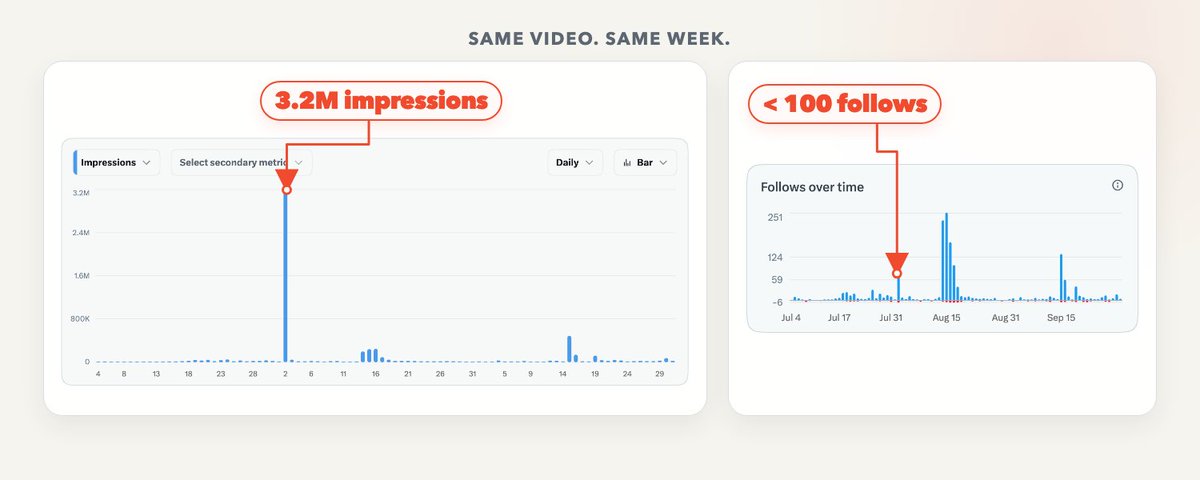
I saw this in my own account too. Starting from zero, I wanted reach, then followers, then a community, and all the other things I thought an account could become. When I focused on trends, I spent a lot of time looking at what was spreading on different platforms and finding things to share or build content around. Over one weekend, my own account went from a little over 200 followers to over 1,000. Reach went up, and followers came with it. That part did work.
But then I also wanted it to bring me business conversations and opportunities. I was asking for more outcomes without being clear enough about who I was doing this for, or what I wanted to work on first. I wanted all of it. I don't think the lesson is that I can only ever want one thing. It's that wanting all of it didn't tell me how to do the work.
That's why I keep coming back to positioning. Who exactly am I trying to serve? Can I describe that small group clearly enough to know what they need, what I should make for them, and what wouldn't be very useful to them? If I can get specific about those people, I can spend more time understanding them and trying to serve them well. I think that matters for an account, for finding customers, and for the product itself.
So that's where I'm at after three months. I think I got better at finding content people want to watch, and I still have work to do on what comes after that. Some problems I've worked through. Some I haven't. I want to understand the people making those choices better, and I can't get all those answers just by looking at content.
If you made it this far, let's connect. I'd love to swap notes with people building AI products or working on their growth.
Lee Lin | AI retweeted

For Those Who Create. KLING 4.0 Is Now Fully Available. 🎬
What’s New, Starting Today
🖥️ Access Kling 4.0 through a refreshed creation interface on kling.ai
🔗 Access Kling 4.0 through MCP and CLI for greater flexibility in your video creation workflow
Coming Soon
🎨 10-bit HDR video output at 4K and 1080p resolutions
🛠️ API access for enterprise customers and developers
You call the shots. Let the creating begin!#Kling4 #KlingAI

Blown away by @Saccc_c latest project! Combining Opus 5.5 for long-form context and logical reasoning, Tripo for rapid 3D model generation, and Blender for assistance, they turned a classic literary work (like The Little Prince) into a fully explorable 3D immersive scene in just 16 days.
The era of "one person as a game studio" is truly accelerating:
Ultra-low asset generation barrier: Powered by AI 3D and video generation models, assets that used to take an entire art and modeling team months to build can now be batch-produced through prompts and minor tweaks.
Plug-and-play logic and narrative arrangement: Top-tier large models like Opus handle code writing, state machine management, and narrative design effortlessly, allowing people without traditional game engine backgrounds (like complex C++ or Unreal blueprints) to piece together interactive logic through "Vibe Coding" or natural language.
The focus of creation shifts back to pure creativity: Future competition won't be about who has the massive industrial pipeline or the largest technical art team, but who has the best story, the most stunning aesthetics, and the most unique gameplay ideas.

花费16天,我用 Opus 5.5 将小王子的故事制作成了3D剧情游戏
结合Tripo+Blender,Opus 5.5 将小王子故事中的每一个星球变成了可探索的3D场景
希望大家能支持一手,后续会开源整个游戏,以及详细制作流程
Welcome to The Little Prince: Across the Stars✨:littleprince.dev/
Positioning is an exercise in subtraction.
• Niching down, then niching down again. Speak to everyone and you resonate with no one.
• Knowing exactly who you're building for. Not a demographic. A person.
• Knowing what not to do. Reach without fit is just noise.
True for building an account. Just as true for building a product.
Wander through a Van Gogh dream brought to life by Opus 5.5. A timeless journey through the pulsing lights of The Starry Night.
Opus 5.5 made stretchy capybaras. Gemini 4 Argon made standing capybara sheets.
Same prompt. Opus on top, Gemini 4 Argon below.
Same moves on both: pull a paw, yank the head, squish it flat, throw it, then pour a pile on top.
Pull a paw and the whole Opus capybara stretches into a long strip, then snaps back and wobbles. Squash it and it pancakes, then pops back up. Throw it and it knocks its neighbor aside.
Gemini 4 Argon becomes a thin sheet when pulled and never recovers. It stands there like paper. Yank the head and the whole body lifts with almost no deformation. It did nail the squish.
The pile at the end: Opus gets four fur colors stacked together. Gemini 4 Argon gets one color, landing in a row and clipping through each other.
Opus also gave them eyes, blush, and a little orange on one head. The Gemini 4 Argon capybaras have no eyes.

Tried Higgsfield’s Codex plugin and a skill I wrote for Claude today. Both produced videos, and both used @higgsfield .
Making images and using Object Swap in the same chat felt convenient. But the platform seems to be doing most of the work, and I’m still unsure where my own skill adds value.
Where would a custom workflow actually help?
Video based on lowrisespider2140’s Ceiling Fan Transition preset on Higgsfield.
Higgsfield CEO @alexmashrabov admitted they'll NEVER win the $20 subscription market.
They still went $1M → $1B in 18 months.
A customer went $99/mo → $6M/yr in 6 months.
My breakdown of how they got there, and who's actually paying for AI video 👇

Higgsfield CEO @alexmashrabov admitted they'll NEVER win the $20 subscription market.
They still went $1M → $1B in 18 months.
A customer went $99/mo → $6M/yr in 6 months.
My breakdown of how they got there, and who's actually paying for AI video 👇