

I'm reading through Google's Gemini Embedding 2 release and here's what I think it actually opens up for anyone building AI systems.
Embedding models are what let AI systems search through data by meaning instead of keywords.
They turn your text/images/videos into numbers (vectors) that AI can compare.
Before this, if you were building an AI system (like a chatbot that answers questions using your company's documents, videos, and images) you needed separate embedding models for each type of data.
You'd embed all your text with one model. Images with a different one. Videos with another. Audio with yet another.
Four different embedding spaces. Four different systems to maintain.
Gemini Embedding 2 collapses all of that into one model.
Which (if I'm understanding this correctly) means if you're building an AI assistant and someone asks about "labradoodle," the system can now pull from:
- Text documents mentioning labradoodles
- Photos of labradoodles
- Videos of them playing
- Audio of them barking
All from one unified embedding space.
My dog is sitting behind me as I'm writing this (hence the labradoodle reference). When I think about him, I don't separate "visual memory" from "audio memory" from "text description." I just think about him, all of it at once.
Gemini Embedding 2 treats text, images, video, and audio as different expressions of the same underlying meaning.
Which is how humans have always thought.
We just accepted for years that AI systems couldn't work that way. That you had to build separate infrastructure for each modality. Separate pipelines. Separate teams.
I'm reading this thinking, we don't have to do that anymore? 😅
I don't know where this goes, but it feels like we just removed a pretty fundamental limitation in how we build AI systems.

Calling all AI automation builders
If you've built workflows on n8n, LangChain, or Make then we want to work with you!
Create templates on @origon, get paid, and get published in our marketplace with full credit + promotion
Interested? Repost + comment what you've built 👇🏼
I’m looking for a Motion Designer to help us scale @origon 🚀
We need someone to turn our Figma designs into promo and animations for tutorial content.
Think ElevenLabs, Linear, or Framer aesthetic.
Interested? Drop your portfolio/showreel below! 👇
Figma proficiency is a must. You’ll be working directly with our UI designs to build motion assets
Animation: We currently use Jitter, but we’re open to After Effects, Blender, Spline, or whatever you use
Lauren Smith retweeted

He’s wrong.
AI isn’t a tool — it’s a replacement layer.
Software needed human intelligence.
AI is the intelligence — and the system.
That line is already crossed.

I'm biased, but I wish I could give this 100 likes.
The idea that really hit home for me:
If we had the ultimate AI, would it go and reinvent ServiceNow or SAP or other software tools? Or would it just use the proven tools out there because that's the most efficient way for it to achieve its goals? It would use the proven tools.
I also like that he framed "tool use" as one of the biggest advancements in AI. He's totally right. Once we started giving AI access to tools, it became much more effective.
<rant>
If I have an AI agent working in my GTM team, and I ask it how many customers we signed up last month, I don't want it to reason over a bunch of the Internet, read reddit comments and scan internal emails and make its best guess at the answer. I want it to just ask the CRM (like @HubSpot) that was specifically built for that purpose and give me the definitive answer.
If I had a 200+ IQ human join my team and I asked them to summarize sales in Europe last quarter, I want them to access the system of record, not start vibe coding its own CRM.
</rant>
We're witnessing the unbundling of software development itself.
Every company that survives the next decade will operate AI systems in production. Right now, most are building on sand. For them, I say good luck.
Lauren Smith retweeted
i left x like a decade ago, came back recently to keep up with all the ai news...now i'm thinking about leaving again bc of the ai reply guys
@nikitabier
is there a fix in the works?
mentally prepare yourself for when agents come. find meaning outside of work.
^
^
^
^
i keep seeing this sentiment everywhere. pretty grim.
anyone have a better perspective to offer?
the industry has moved past proof-of-concepts.
one month into 2026 and there are two types of AI organizations:
- those building with frameworks and hoping they scale - those building on an Agentic OS from day one.
the question isn't whether you'll hit production constraints. it's whether you'll discover them at 10 users or 10,000.
Lauren Smith retweeted

Your support runs on systems.
So should your AI.
Every customer question, every employee request, every supplier inquiry — they all end the same way.
Someone logs into Salesforce. Or SAP. Or Workday.
They check status, verify data, execute an action, return an answer.
We've automated the greeting.
We haven't automated the work.
That's the problem with most support AI today — it stops at conversation.
Let me know what videos you'd like next!!

We've heard the feedback. Configuration shouldn't be a barrier.
We're creating setup guides for every Origon tool. Starting with the most-used: Chat, Email, and SIP.
First—Chat.
One node supports four deployment modes. Public URL for instant sharing. Embedded widget for your site. Full-screen app on your domain. Or SDK for custom builds. All voice-enabled by default.
Docker is overkill for 90% of local dev work
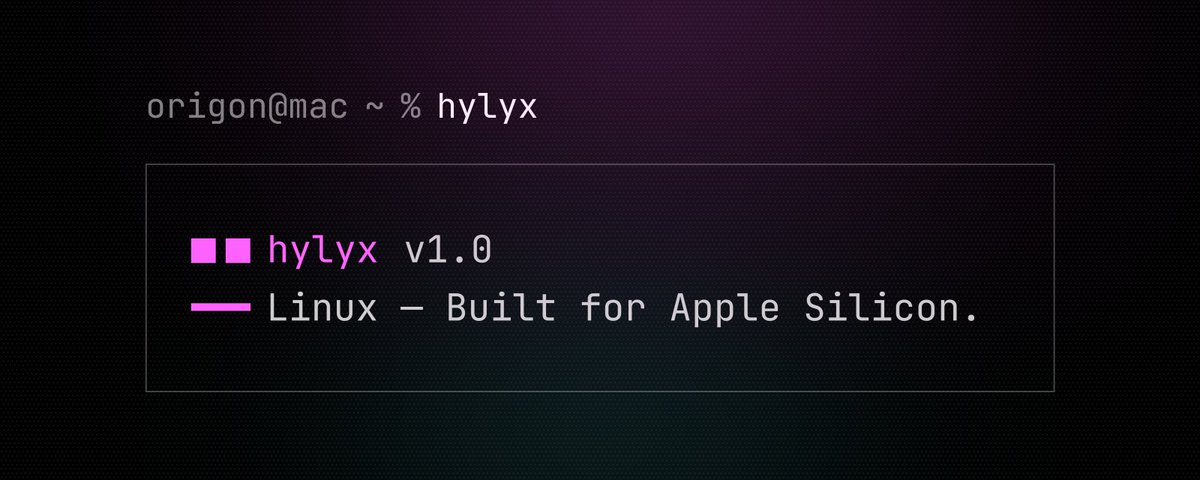
Hylyx: 78 MB Ubuntu VMs, 30-second boot on Apple Silicon
faster than Docker containers, fully open source
here's the architecture:
runs on Apple's native Virtualization.framework (not QEMU)
kernel: 700 lines of config vs 10k+ standard
no bootloader, no initramfs — single binary
real ext4 on macOS filesystem (no FUSE)
raw ARM64 performance, zero emulation
curl install → SSH-ready shell in 30 seconds
Ubuntu: 78 MB
Fedora: 65 MB
Alpine: 13 MB
for ephemeral test envs, this is cleaner than containers
origon.ai/hylyx