

Quarterly journal publishing scholarship on economic aspects of natural and environmental resources. Celebrating our 100th anniversary. Published by @UWiscPress
- Tweets266
- Following564
- Followers1.1K
- Likes94





ALT Front cover for The Journal of Land & Public Utility Economics Vol. 1 (1), published January 1925.

ALT Front cover for Land Economics Vol. 101 (1), published February 2025.

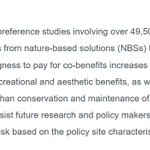
ALT Abstract: This meta-analysis of stated preference studies involving over 49,500 respondents quantifies the economic value of co-benefits from nature-based solutions (NBSs) that address climate risks. The results indicate that the willingness to pay for co-benefits increases with GDP per capita and decreases with NBS size. Recreational and aesthetic benefits, as well as NBSs developed in urban gray areas, are more valued than conservation and maintenance of current nature sites. The novel value transfer function can assist future research and policy makers in assessing the economic co-benefits of NBSs for climate risk based on the policy site characteristics.


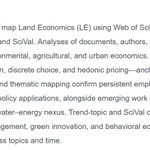
ALT Abstract: Spanning 1925–2024, we map Land Economics (LE) using Web of Science and Scopus with VOSviewer, bibliometrix, and SciVal. Analyses of documents, authors, and themes show LE as a central node linking environmental, agricultural, and urban economics. Seminal strands—property rights, contingent valuation, discrete choice, and hedonic pricing—anchor long-run influence. Keyword co-occurrence and thematic mapping confirm persistent emphases on valuation models, impact assessment, and policy applications, alongside emerging work on ecosystem services, climate change, and the water–energy nexus. Trend-topic and SciVal clusters reveal growing attention to disaster management, green innovation, and behavioral economics with uneven recent citation performance across topics and time.

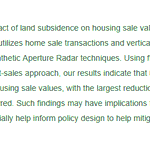
ALT Abstract: This study assesses the impact of land subsidence on housing sale values in the San Joaquin Valley, California. The study utilizes home sale transactions and vertical land-surface displacement data from Interferometric Synthetic Aperture Radar techniques. Using fine-scale fixed effects, matching, as well as a repeat-sales approach, our results indicate that land subsidence resulted in a 2.4% to 5.8% reduction in housing sale values, with the largest reductions occurring in areas where substantial subsidence occurred. Such findings may have implications for groundwater management and can potentially help inform policy design to help mitigate the causes and impacts of land subsidence.

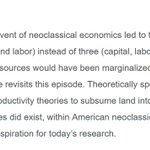
ALT Abstract: It is usually argued that the advent of neoclassical economics led to the consideration of only two factors of production (capital and labor) instead of three (capital, labor and land). From the 1880s to the 1920s, land and natural resources would have been marginalized and left to applied fields such as land economics. This article revisits this episode. Theoretically speaking, it shows that there was no requirement in marginal productivity theories to subsume land into capital. Historically speaking, it demonstrates that alternatives did exist, within American neoclassicism, to the neglect of land and natural resources, providing inspiration for today’s research.

ALT Abstract: We conduct a randomized controlled trial to evaluate the impact of training university students in Bogotá to use a smartphone app that displays real-time location-specific air quality data. The training increased participants’ acquisition of information about air quality, their knowledge about avoidance behavior, and most important, their reported avoidance behavior. Back-of-the-envelope calculations suggest that if scaled to the entire city of Bogotá, the training could reduce premature cardiovascular, cerebrovascular, and respiratory deaths among the additional 3–8 percent of the city’s population incentivized to undertake avoidance behavior by 51–61 percent per year, a benefit valued at US$11–13 million.

ALT Abstract: This study assesses the impact of land subsidence on housing sale values in the San Joaquin Valley, California. The study utilizes home sale transactions and vertical land-surface displacement data from Interferometric Synthetic Aperture Radar techniques. Using fine-scale fixed effects, matching, as well as a repeat-sales approach, our results indicate that land subsidence resulted in a 2.4% to 5.8% reduction in housing sale values, with the largest reductions occurring in areas where substantial subsidence occurred. Such findings may have implications for groundwater management and can potentially help inform policy design to help mitigate the causes and impacts of land subsidence.
ALT Abstract: Spanning 1925–2024, we map Land Economics (LE) using Web of Science and Scopus with VOSviewer, bibliometrix, and SciVal. Analyses of documents, authors, and themes show LE as a central node linking environmental, agricultural, and urban economics. Seminal strands—property rights, contingent valuation, discrete choice, and hedonic pricing—anchor long-run influence. Keyword co-occurrence and thematic mapping confirm persistent emphases on valuation models, impact assessment, and policy applications, alongside emerging work on ecosystem services, climate change, and the water–energy nexus. Trend-topic and SciVal clusters reveal growing attention to disaster management, green innovation, and behavioral economics with uneven recent citation performance across topics and time.

ALT Abstract: Various policy interventions can be implemented to motivate individuals to adopt pro-environmental landscaping behaviours. Here we compare the influence of economic incentives and social norms on urban landowners’ adoption of native gardens. First, we model the relationship between social norms and landowners’ actual land-use decisions. We then estimate adoption intention under different support programs using a choice experiment, also considering social norms. We find social norms can play a significant role in the adoption of native gardens, comparable to relatively expensive financial incentives. Therefore, social norms may enhance the performance of incentives to increase rates of land conservation.
ALT Abstract: It is usually argued that the advent of neoclassical economics led to the consideration of only two factors of production (capital and labor) instead of three (capital, labor and land). From the 1880s to the 1920s, land and natural resources would have been marginalized and left to applied fields such as land economics. This article revisits this episode. Theoretically speaking, it shows that there was no requirement in marginal productivity theories to subsume land into capital. Historically speaking, it demonstrates that alternatives did exist, within American neoclassicism, to the neglect of land and natural resources, providing inspiration for today’s research.
ALT Abstract: We conduct a randomized controlled trial to evaluate the impact of training university students in Bogotá to use a smartphone app that displays real-time location-specific air quality data. The training increased participants’ acquisition of information about air quality, their knowledge about avoidance behavior, and most important, their reported avoidance behavior. Back-of-the-envelope calculations suggest that if scaled to the entire city of Bogotá, the training could reduce premature cardiovascular, cerebrovascular, and respiratory deaths among the additional 3–8 percent of the city’s population incentivized to undertake avoidance behavior by 51–61 percent per year, a benefit valued at US$11–13 million.
