
Le CEntre de REcherche en GEstion (CEREGE) est une équipe de recherche de l’Université de Poitiers, habilitée sous le label Unité de Recherche (UR 13564).
Joined November 2016
- Tweets271
- Following180
- Followers87
- Likes336
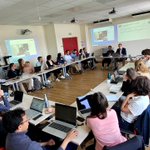


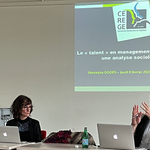
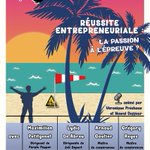
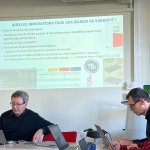

Moment fort de la vie du laboratoire aujourd'hui : l'Assemblée Generale avec un bilan intéressant de l'année écoulée
#sciencesdegestion #vienotreviedelaboratoire
@UnivPoitiers - @IAEPoitiers


... le travail des métiers peu qualifiés et la réaction des entreprises. Beaucoup de concepts ont été abordés : matérialité du travail, surveillance, ‘riotporn’ (vidéos d’émeutes) et les courants philosophiques.
Séminaire donc très intéressant, échanges prolongées, et pour certains, l'envie de lire son livre :-).
#séminairetransversal #sciencesdegestion #vienotreviedelaboratoire
@IAEPoitiers - @UnivPoitiers
Pour en savoir plus sur l'axe de recherche COMIN-> lnkd.in/d7u9CHEr
Hier, à l'atelier doctoral, lorsque nous avons parlé de l'épistémologie & de méthodologie, un certain Paul Otlet fut mentionné. Voici un aperçu de ses travaux ⤵️
Et qqs infos en français ici ➡️ fr.wikipedia.org/wiki/Paul_O…
#VendrediDécouvertes #pratiques2recherche #sciencesdegestion

The Precursor to the World Wide Web: celebrating the legacy of the Mundaneum.
(8min read, bookmark)
So, way before we all got hooked on the internet and started Googling everything, these two Belgian dudes, Paul Otlet and Henri La Fontaine, had this wild idea.
They wanted to gather all human knowledge in one spot – think of it as the OG Wikipedia or the ultimate knowledge hub.
Otlet was all about sorting info like a boss, and La Fontaine, who even snagged a Nobel Peace Prize, teamed up to create what they called the Mundaneum.
This wasn't just some dusty old library; it was meant to be a game-changer, connecting people with info from all around the globe, kinda like the internet does now.
So, basically, these guys were way ahead of their time, dreaming up a world where knowledge was interconnected long before we could even imagine something like the World Wide Web.
The plan was to tag all this info with something called the Universal Decimal Classification – that's Otlet's brainchild, making it super easy to find whatever you needed.
Picture walking into a place with rows upon rows of index cards, but also with screens and phones so you could hit up experts from anywhere in the world with your questions.
And get this, they actually started building this epic knowledge fortress in Mons, Belgium, taking over 150 rooms in the Palais du Cinquantenaire, all thanks to the Belgian government playing ball.
It was like the ultimate blend of old-school library vibes with the beginnings of a global information network.
He sketched out these cool octagonal cells that could link up with each other, each side packed with info and visuals.
This wasn't just about looking fancy; it was all about making complex info easy to get just by looking at pictures.
Otlet had been digging into how images can tell stories or explain complicated stuff straight up, and he wanted the Mundaneum's design to do just that.
Otlet wasn’t playing small; he reached out to some big-name architects to bring his vision to life.
He even chatted with Le Corbusier, who came up with this wild idea of a ziggurat (that's a massive step pyramid) near Geneva. But then, Belgian modernist Maurice Heymans stepped in and worked directly with Otlet.
Between 1934 and 1938, they hashed out three versions of the design, making sure the building itself reflected Otlet's big brain ideas about sorting knowledge.
Sadly, Otlet's grand plans never fully came to life. His treasure trove of books and index cards, the heart of the Mundaneum, got wrecked by Nazi forces in 1940.
But there's a silver lining – today, there's a non-profit in Mons, Belgium, keeping the dream alive. They run an archive and a spot where you can check out exhibits, all dedicated to celebrating what the original Mundaneum was all about.
It's a way to remember Otlet's vision and the early efforts to gather all human knowledge in one place..


L'appel à communication ici 👇
cerege.sciencesconf.org/
#sciencesdegestion #management
@IAEPoitiers - @UnivPoitiers
CEREGE retweeted

[Call for communications] 🔊
With my colleagues, we are happy to announce a research seminar on online content creation! It will take place on 17th and 18th October in Paris and online.
You can submit your proposal on the dedicated website for the event: 20ansvideoweb.sciencesconf.o…

Sous le regard de Grégory Reyes, @corentincurchod, enseignant-chercheur à @EdinburghUni a présenté un papier en cours pendant le dernier séminaire transversal - papier co-écrit avec Gerardo Patriotta (@UniofBath) et @Reyesgregory3, membre de notre laboratoire.

mobilisation locale par les administrations et modification de leur attitude envers eux; les pairs, passés de concurrent aux confrères ; le public, jadis qui les considérait comme de ‘riches pharmaciens’ les a estimés comme des interlocuteurs de grande utilité et de proximité.
Le pharmacien, à la fois par son action et sa réflexion a pu forger une identité renouvelée, plus affirmée, durant et après cette période cosmologique où les individus ressentent un sentiment de perte de sens, mais qui s'avère transformateur avec le temps.
#sciencesdegestion
