

Advancing bionic technologies and systems to improve the ability of individuals to move and live independently.
Salt Lake City, UT
Joined August 2018
- Tweets163
- Following563
- Followers1K
- Likes857





HGN Lab for Bionic Engineering retweeted

Pleased to announce our upcoming @ieee_ras_icra workshop "State of the Art in Lower-Limb Exoskeletons: Exploring Specificity vs. Generalizability Across Users and Activities", co-organized with @GT_EPIC_Lab and @LabBionic
Congratulations to the U-Build Bionic Knee for winning the #NCMRR @NICHD_NIH @NIBIB DEBUT Competition🎊😍!!!
They build a low-cost powered knee #prosthesis🦿 and made the design #opensource for everyone!
youtube.com/watch?v=xS9t9RJg…
@UUtah @UtahCoE @UofUNews @UtahMech @UtahBME
HGN Lab for Bionic Engineering retweeted

Kai Pruyn, a @utahmech Ph.D. candidate, is using powered assistive devices to improve mobility for stroke survivors. Read this feature from “Student Innovation @ the U” 2024: lassonde.utah.edu/changing-l…

HGN Lab for Bionic Engineering retweeted

A top prosthetics researcher, an environmental & public health expert, a prominent neuroscientist, and a distinguished leader in the field of chronic diseases in vulnerable populations have been selected as our new cohort of Presidential Scholars. 👏
📰 attheu.utah.edu/facultystaff…

ALT Photo collage of Presidential Scholar winners. From top left, clockwise: Sophie Caron, Neng Wan, Nancy Allen and Tomasso Lenzi.
HGN Lab for Bionic Engineering retweeted
A top researcher in prosthetics, an expert in environmental health & public health challenges, a prominent neuroscientist, & a distinguished leader in the study of chronic diseases in vulnerable populations have been selected as Presidential Scholars.
📰 attheu.utah.edu/facultystaff…

ALT Photo of Nancy Allen

ALT Photo of Tomasso Lenzi

ALT Photo of Sophie Caron

ALT Photo of Neng Wan
HGN Lab for Bionic Engineering retweeted

Tommaso Lenzi, a @UUtah mechanical engineering professor, combined his background in robotics with physical medicine and rehabilitation in his lab where they are developing technologies that help people move and live more independently.
technologylicensing.utah.edu…

ALT Quote from Tommaso Lenzi: There's a lot more outside of our small bubble of academia, and so engaging with the tech transfer office, engaging with industry, and even sometimes just going out at conferences and conventions that are not scientific and more industry, technology or development focused can be eye opening.

HGN Lab for Bionic Engineering retweeted

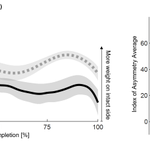
An Editor's Choice piece highlights a study in the Journal of NeuroEngineering and Rehabilitation showing how a powered #prosthesis device was capable of improving weight-bearing symmetry during stand-to-sit transitions in above-knee #amputees.
scim.ag/4Gb

Super excited that our recent paper about #amputee #biomechanics with our #robotic #prosthetic leg was featured as Editor's Choice in @SciRobotics this month!🦿🤩🥳
Check it out: "A powered prosthesis supports weight-bearing stand-to-sit transitions"
science.org/doi/full/10.1126…

We made the TIME's 2023 Best Inventions list 😍🦿🎊!
Honored, excited, proud, and grateful for all the fantastic students who worked on this project and made this possible!
@UtahCoE @UtahMech @UPIVOTCenter #amputee #Robotic #phdlife #Engineering

This new bionic leg is capable of movement that’s much closer to a natural leg and knee, and can make it easier to move around ti.me/3Qc29rq
8) Thanks for reading! Full paper here: doi.org/10.1109/TBME.2023.32… (open access)
Congrats to authors @Joel__Mz, Rosie Murray, @GabertLukas, and Tommaso Lenzi.
Thank you to our collaborators: @therealbigfey and Honghai Liu. And thanks to @NIH @NSF @UofUOEH for funding this study!
7) Significance: This evaluation of A-mode ultrasound helps us understand its strengths and limitations across different activities, which is necessary in developing safe and intuitive ultrasound-based powered prosthesis controllers. #powered_prosthesis #volitional_control
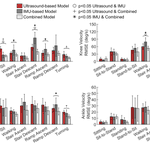
6) Next, we trained 2 more models: an IMU-based Model, and a Combined Model trained on both IMU and A-mode ultrasound.
The Combined Model had the lowest errors in most cases. Therefore, A-mode ultrasound adds important information about the user’s intent that IMU can’t capture!

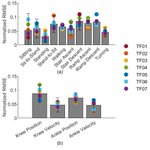
5) Here is the kinematic prediction error (difference between predicted and measured kinematics).
Top: Average error for each activity. Bottom: Average error for each variable across activities (bottom)
Our accuracy is similar to previous work using #EMG and B-Mode ultrasound!

4) We used the ultrasound-based model to predict the kinematics of the prosthesis knee and ankle.
Comparing the predicted kinematics (blue line) to the measured kinematics (black), we can evaluate accuracy. Overall, it did pretty well!

3) Our #machineLearning model was trained on all ambulation circuit activities: walking, stairs ascent, stair descent, ramp ascent, ramp descent, sit-to-stand, stand-to-sit, turning, standing, standing up, and sitting down
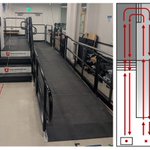
2) Seven #transfemoral amputee subjects performed 20 trials of our “ambulation circuit” using their prescribed passive #prosthesis.
We recorded lower-limb kinematics from both legs using #xsens #IMU, and we recorded A-mode #ultrasound data from 4 sensors on their residual limb

1) In our newest paper, we used A-Mode ultrasound and machine learning to predict lower-limb kinematics while above-knee amputees performed various activities in our recently published paper in IEEE-TBME doi.org/10.1109/TBME.2023.32…
🧵
#academicTwitter #SciComm #PhDchat
