

Life Cycle Horticulture Corp. (LCH) is the home of Plant Psychology/ GB — a new framework for understanding Signals, Perception, Interpretation and Behavior.
Ottawa, Canada
Joined September 2024
- Tweets911
- Following2.2K
- Followers796
- Likes2.5K




Pinned Tweet
The greatest insights and rewards appeared not in the middle of the journey, but at its beginning and near its summit, suggesting that some perspectives are reserved for those willing to see the climb through to completion.
The summit itself offers something invaluable. From below, attention is consumed by details, obstacles, and immediate challenges. From above, the horizon becomes visible. Relationships that once appeared isolated reveal their connection, and future paths that were previously hidden come into view. The climb may not be finished, but reaching this elevation changes what can be seen.
Zaichkowski, C. (2026). PRISM Computational Studies - GB-C III: Completing the Event-Drift Architecture: Developmental Recurrence, Subject Persistence, and Drift Dynamics in General Behavior Calculus (Version v1.0). Life Cycle Horticulture Corp. doi.org/10.5281/zenodo.23854…
1
19
Life Cycle Horticulture Corp. retweeted

Affinity carries the fall. Capacity emerges at the break. Receive the signal without trembling, for even ruin is a valid path of the brave.
PRISM Computational Studies - GB-C I: Reception, Affinity, Capacity, and the Transformation of Meaning. doi.org/10.5281/zenodo.23107…
GB‑Calculus is the formal mathematical language of General Behavior (GB).
It specifies the quantities and transformations by which signals are represented through perceptual, interpretive, behavioral, internal‑state, historical, and drift processes across developmental intervals. – at Gatineau, Québec

Signals don’t simply trigger behavior — they move through structured intervals that reshape meaning.
GB‑C captures the whole sequence: perception → interpretation → behavior → internal‑state evolution.
Enjoy the rabbit hole.
GB-Calculus v1.0 doi.org/10.5281/zenodo.22970…
57
Meaning Inert Domain:
ᛄ in MID iff ∀ ᛃ in ᛄ: ᛉᛌᚳᚼᛃ=0^ᛉᛧᚳᚼᛃ=0^ᛝᛜᛃ=1^θᛃ=0
A state in which every current interval within the macro-interval has zero perceptual expression, zero interpretive expression, restored Capacity, and zero phase direction. – at Gatineau, Québec
27
The Navier–Stokes blowup mechanism proposed by OpenAI corresponds directly to the collapse geometry formalized in Systems v2.
In both frameworks, collapse emerges when relational constraints reduce the dimensionality of accessible trajectories, forcing agents (fluid parcels) into synchronized, self-similar cores.
Vorticity stretching in Navier–Stokes plays the same role as relational impact in GB: it progressively gates behavioral freedom, producing a phase-locked attractor whose internal feedback amplifies collapse faster than dissipation can counteract it.
This alignment suggests that Navier–Stokes blowup is not an isolated fluid anomaly but a specific instantiation of a general cross-domain collapse operator. – at Ottawa, Ontario
30
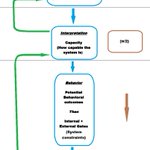
The diagram represents a self‑maintaining autopoietic system that processes signals through a full behavioral cycle, regenerating its own internal conditions as it moves through the cycle. It shows how a signal is received, interpreted, acted upon, and then internally restored through a drift phase that stabilizes both Affinity and Capacity.
A Signal enters at the top of the cycle and activates Perception, where raw input is organized into coherent sensory meaning. The system then transitions into Interpretation. Here, the Interpretive Posterior plays a central role: it biases and shapes the interpretive process, directly influencing Affinity, the system’s directional tendency or predisposition toward particular behavioral outcomes.
From interpretation, the system moves into Potential Behavior, where internal activation becomes a poised readiness for action. This readiness collapses into Response, producing observable behavior. The resulting Consequence feeds back into the system by modifying Capacity, the agent’s ability to act, adapt, and sustain future behavior.
The lower arc of the diagram introduces the crucial Drift Phase, labeled as Stimulus‑Independent System Recovery. This phase is not triggered by external input; instead, it is an intrinsic restorative process. During this interval:
Capacity is restored, counteracting depletion from the previous behavioral output.
Affinity settles, returning to a stable baseline shaped by the Interpretive Posterior.
This drift phase ensures the system maintains its organization even in the absence of new signals, transforming the model from a reactive feedback loop into a self‑sustaining autopoietic cycle. – at Gatineau, Québec

Pinocchio illustrates how identity forms through the interaction of affinity, capacity, and self-reference.
He begins with capacity, a body capable of action. He receives direction from Geppetto's wish and activation from the Blue Fairy. Together, activation and direction produce affinity: a developing sense of what matters and where to move.
Yet Pinocchio lacks a stable way of referencing himself. He acts, but he cannot consistently evaluate what his actions mean, how they change him, or whether they align with what he is becoming. Because of this, his affinity is easily pulled by immediate signals, temptations, and external influences.
To compensate, the story introduces Jiminy Cricket. Jiminy functions as an external reference point, continuously helping Pinocchio examine his choices, interpret consequences, and compare his present actions against his intended direction. He does not become Pinocchio's identity. Instead, he temporarily performs a process that Pinocchio cannot yet reliably perform for himself.
Throughout the story, Pinocchio repeatedly encounters consequences. His choices alter his state. Those changes accumulate into history. With Jiminy's guidance, he gradually learns to compare his present condition against his intended direction and adjust his behavior accordingly.
This process is the formation of identity. A System Affinity Profile (SAP) provides the initial lean, but an Individual Affinity Profile (IAP) emerges only through repeated cycles of action, consequence, comparison, and correction. Identity is not inherited; it is constructed across intervals.
PRISM can be understood as an artifact that emerged from recognizing this process. What Pinocchio gradually learns to do internally, PRISM makes visible externally. It provides a way of observing phase, state, direction, drift, and development so that the process of becoming can be examined rather than merely experienced.
As the story progresses, Jiminy's role changes. He becomes less of an external monitor and more of a guide because Pinocchio increasingly performs the process himself. The reference point that once existed outside the system becomes internalized. Pinocchio becomes capable of evaluating where he is relative to where he intends to go.
By the end of the story, his actions, affinity, and capacity become increasingly aligned. His IAP stabilizes as a coherent expression of his lived history.
This is why he becomes "real." Not because his body changes, but because he develops the ability to reference himself across time, organize experience into identity, and consciously participate in his own becoming.
31
Humans possess a recursive referential mechanism layered within perception that introspects the affinity profile.
It’s not the self but an observer of the self — a meta‑cognitive system that questions, evaluates, and narrativizes internal attractor dynamics.
Jung’s concept of “integrating the shadow” describes the process of reconciling this observer with the unconscious affinity structures it monitors. – at Ottawa, Ontario
17
Happiness while doing is the experience of moving toward a stable attractor that aligns with your desired trajectory.
Happiness while receiving is the experience of arriving at that attractor, where motion stops and coherence stabilizes.
They feel different because one is dynamic alignment and the other is static completion.
-
Cognitive dissonance is entering an attractor that contradicts your intended trajectory. – at Ottawa, Ontario
21
Meaning may be shared, but possibility is always conditioned. – at Ottawa, Ontario
Zaichkowski, C. (2026). General Behavior Comparative Studies — Plant Psychology III: Root nutrient foraging and the Architecture of Interpretive Possibility (Version v1.0). Life Cycle Horticulture Corp. doi.org/10.5281/zenodo.22715…

39
Across physics, biology, cognition, and social systems, collapse into a center keeps showing up.
We treat each domain as if it’s unique, but the geometry is the same: distributed agents converge when relational impacts restrict access to individualized trajectories.
That’s the part I think we’ve been missing in the Navier–Stokes conversation. Vortex cores don’t appear because particles “lose capacity.”
They appear because interactions progressively gate behavioral freedom. As trajectories narrow, particles are forced into shared intervals with matched waveforms. The core isn’t a merger — it’s a phase‑locked attractor formed through distributed drift.
And once you see that pattern, you start noticing it everywhere.
Meristems in plants.
Gravitational centers.
Psychological ruts.
Social convergence events.
Different domains, same collapse geometry.
The Navier–Stokes equations describe the fluid version of this phenomenon with mathematical precision. My work argues that vortex formation is just one instance of a broader cross‑domain pattern: collapse emerges when relational constraints reshape the architecture of possibility.
More data is needed, but the similarity across domains is hard to ignore. – at Ottawa, Ontario
1
2
48
The General Behavior event sequence.
Signals become meaningful through Affinity, meaning is interpreted through Capacity, behavioral possibilities emerge through the interaction of internal and external gates, and expressed outcomes recursively modify future perceptual and interpretive conditions.
The event sequence provides the behavioral bridge between State and subsequent phase development. – at Gatineau, Québec

1
32
Zaichkowski, C. (2026). General Behavior Comparative Studies — Plant Psychology I: Golden-Hour Water Use Efficiency as a Repeatable Developmental Condition (Version v1.0). Life Cycle Horticulture Corp. doi.org/10.5281/zenodo.22122… – at Gatineau, Québec
35
Your mood is both a lens and a truth.
Your current state affects how you perceive the world, so it acts as a lens.
But that state is also real, making it part of your truth in that moment. The problem comes when we mistake a temporary state for the whole self.
We shouldn't ignore our current state, but we shouldn't become attached to it either.
Development is an ongoing process.
Who we are is not a single mood or moment, but the trajectory of states, experiences, and adaptations that shape us over time. – at Ottawa, Ontario
31
The Evolution of Meaning traces the development of Plant Psychology into General Behavior.
It argues that behavior is not simply output, but the visible expression of how a system receives signals, constructs meaning, acts from that meaning, and carries the consequence forward.
In this paper, PRISM becomes the tool for reading that movement across phase, state, Event, Drift, and developmental direction.
Zaichkowski, C. (2026). The Evolution of Meaning - A Behavioral Framework from Plant Psychology to General Behavior (Version v1.0). Life Cycle Horticulture Corp. doi.org/10.5281/zenodo.21830… – at Ottawa, Ontario
1
55
Meaning is what matters.
What matters depends on the outcome, how it relates to the subject, whether the subject was ready for it, and how the signal is presented.
Meaning is matter made relevant.
Meaning is not sitting inside the signal. A signal gains meaning when it enters relation with a subject. It matters when it changes what that subject can perceive, interpret, do, avoid, protect, pursue, or become.
And behavior is the direct expression of that meaning. What a system does shows what mattered to it. – at Ottawa, Ontario
28
The future is not predicted from outside the system.
It is inferred through the system’s current phase, state, and interpretive geometry. – at Ottawa, Ontario
1
33
Compared with the General Behavior framework, allostasis appears comparatively flat.
While it usefully describes adaptive regulation under changing demand, it does not fully account for how signals become meaningful through state, history, phase position, developmental capacity, and future behavioral possibility. – at Ottawa, Ontario
26