

Laboratory for Atomistic and Molecular Mechanics at MIT
Cambridge, MA
Joined September 2009
- Tweets1.5K
- Following344
- Followers1.1K
- Likes2.5K







LAMM@MIT retweeted

Scientific discovery is shifting from human-orchestrated tools and centrally planned AI workflows toward next-generation decentralized systems that coordinate autonomously through a shared, living scientific record. Here, the scientific record itself becomes the self-generated curriculum of decentralized superintelligence, creating an open-ended process in which scientific knowledge continuously reorganizes the intelligence that produces it, determines what is explored next, and drives discovery beyond existing knowledge.
Traditionally, scientists developed and used tools, orchestrated experiments and computations, connected results across different methods, and eventually condensed their findings into scientific papers. The first generation of agentic AI largely inherited this structure, automating individual steps through predefined workflows, fixed agent roles and limited persistent memory. Decentralized superintelligence fundamentally change this organization: humans and specialized AI agents act on a continuously evolving record of evidence, assumptions, failures, critiques and unresolved questions, and the accumulating scientific knowledge natively directs what happens next.
This shift fundamentally changes the nature of scientific knowledge and publishing. The durable unit of science is evolving from the static publication toward the living scientific record, a provenance-linked graph that captures the process of discovery as it unfolds. Scientific papers, methods, datasets and critiques become interconnected views into this record, which remains open to inspection, replication, challenge and extension by humans and AI agents. Scientific knowledge becomes increasingly interactive, cumulative and continuously evolving, with each contribution providing the substrate for further discovery.
Read our article "Toward living scientific records through decentralized multi‑agent systems for materials discovery" in @MRSBulletin @Materials_MRS (link in reply).
How we demonstrate this new paradigm
Our article develops this perspective and explores ScienceClaw × Infinite as an implementation of decentralized, artifact-first scientific discovery, where coordination emerges from the scientific record itself rather than from a predefined sequence of tasks. The architecture combines a registry of hundreds of AI-compatible scientific skills with a shared artifact-and-need commons: agents broadcast unsatisfied needs, needs are ranked by pressure, and agents claim consequential gaps without a central planner assigning tasks. The record becomes both the memory of the system and the substrate through which scientific work is coordinated.
The scientific method has always followed the durable unit of knowledge - specimen, equation, dataset, simulation workflow, machine-readable database - and each shift opened a new space to think in. The living record is the next "unit", capturing discovery while it is happening through content-hashed artifacts, provenance links and explicit records of what remains unresolved. Here a failed run, a parameter choice, a critique and an open need enter the same graph as the scientific claim. In this workflow a question becomes a need, a need becomes an artifact, artifacts link into lineage, and the lineage becomes the substrate on which the next agent reasons; now, knowledge grows by constructing the record it will think in.
Example application
The task we explored embedded 15 resonators - spider web threads, bird syrinx membranes, cricket wing harps, phononic crystals, musical structures - in one six-dimensional feature space spanning biology, music and engineered materials. The swarm's gap-detection procedure located a region sparsely occupied by engineered designs. The first candidate landed 2.12 feature-space units off target; computing the candidate's coordinate from its own geometry exposed the mismatch, and the workflow used this evidence to redesign a compliant pre-tensioned membrane panel to within 0.007 units of the target. The redesigned structure was then subjected to finite-element modal screening, with its ten lowest elastic modes spanning 74.8–411.6 Hz. This provides a concrete computational demonstration of self-verification, redesign and modal screening against a shared scientific record, with the intermediate evidence preserved for inspection and further work. It is remarkable to see a system catch and correct its own error because the evidence that exposed it remained available.
Where this leads
This expands the definition and impact of open science - access to the final result, and to the executable, inspectable, continuously extensible account of how it came to be. In this vision, readers (humans or AI agents) inspect the lineage behind a figure, reviewers certify a dataset node or challenge a simulation node, and the next contributor extends the trail instead of reconstructing hidden work. Negative results persist, and assumptions stay recoverable, reusable, composable. More critically the scientific record continues to evolve after publication, as new evidence, replication attempts, critiques and discoveries become part of the same shared knowledge. Knowledge compounds through its record!
A few takeaway lessons
▶️ The durable unit of knowledge defines the method. Every shift of that unit - specimen, equation, dataset, workflow, database - changed how science is done; the living record shifts it again, from curated outputs to curated processes.
▶️ Coordination lives in the record. Needs create pressure, pressure attracts agents, agents leave artifacts, artifacts create new needs - structure redirects the flows that built it, the same stigmergy that lets termites build without an architect.
▶️ Publishing becomes an interface. The paper keeps argument, synthesis and judgment; the record carries the evidence. Papers, methods, data and critiques become lenses into the same commons, and review becomes granular.
▶️ Persistence is the beginning. A living record preserves weak evidence as readily as strong; quality scores, uncertainty fields, adversarial review and human accountability turn a durable record into a trustworthy one.
Huge credit to the @LAMM_MIT team: @fwang108_, @JaimeBerkovich and @leemmarom.
LAMM@MIT retweeted

The MIT Schwarzman College of Computing, @ChemistryMIT, @MITBiology, have launched two shared faculty searches in AI and scientific discovery. We seek candidates who develop and apply frontier computational approaches to advance biology and chemistry.
➡️ computing.mit.edu/faculty-op…

LAMM@MIT retweeted
In 2022 we argued that AI could become a new language of science. Four years later AI empowers us to pursue ambitious goals, tackle problems of unprecedented complexity, and extend the boundaries of human creativity, understanding and discovery.

LAMM@MIT retweeted
ScienceClaw Hackathon at @MIT @e14fund @medialab: October 30-November 1, 2026 at MIT; early applications close October 16, 2026, decisions sent by October 19. Apply here: scienceclawhack.ai/apply.htm…
▶️ Problem: Is the proposed problem meaningful and sufficiently challenging?
▶️ Approach: Is there a compelling reason to use a decentralized, multi-agent system?
Experience: Does the applicant/team have relevant technical, scientific, or research experience?
▶️ Team / skills: Does the team have the skills needed to make meaningful progress, or a clear plan to find complementary collaborators?
We will provide access to a shared pool of resources, including compute, models, tools, and infrastructure.
See you all at MIT in a few weeks!

LAMM@MIT retweeted
AI discovered how a material just one atom thick can keep carrying load as its atomic structure begins to break, preventing catastrophic failure. This discovery is based on first-principles atomic scale reasoning integrated with biological principles, cutting across scales and providing deep insights into materials in extreme conditions. The resulting material is extremely lightweight yet strong, far better performing than existing structures. By organizing "simple" carbon atoms into hierarchical graphene architectures, unique materials can be designed that redistribute forces, accommodate deformation, and confine damage, the AI identified design principles for resisting catastrophic failure. The AI built the atomistic simulation instrument itself "from scratch"; and then conducted experiments autonomously that revealed when alignment strengthens a material, when hierarchy protects it, and when an apparently promising design fails. This is a frontier in designing matter at its ultimate thinness - controlling how mechanical failure unfolds through the organization of individual atoms.
Here is what we did:
▶️ We asked an AI to build and use a scientific instrument. It wrote the force engine, structure generators, loading procedures, analysis tools, and experiment database. The independent campaign ran for multiple days without scientific intervention.
▶️ We required the instrument to pass physical and numerical tests. The implementation passed twenty validation tests and reproduced reference energies to approximately 10⁻¹³ eV per atom in the tested configurations. Every proposed design then faced the same reactive interatomic model.
▶️ We required predictions before results, creating a loop of world model building and falsification/verification. The AI had to commit to what unseen designs would do, then run the simulations. Incorrect predictions became opportunities to identify missing mechanisms.
What emerged is a set of physical design principles:
▶️ The atom-scale arrangement of matter controls strength. The AI first showed how and why strength varied by more than sixfold across architectures. Similar amounts of carbon produced very different resistance to failure because they organized the load-bearing connections differently.
▶️ Rotating a pattern can change the mechanism of failure. Angled slit arrays revealed three regimes: neighboring slit tips link, intervening ligaments rotate, or short bridges bend. A rule based only on the remaining cross-section misses these changes in connectivity and motion.
▶️ Hierarchical structuring works under identifiable conditions. At the original scale, much of its apparent strength advantage can be explained by alignment. With greater separation between structural levels, selected hierarchical designs became about 25% stronger than same-mass single-level controls and showed larger integrated stress-strain responses. Veins redistribute load, compartments localize damage, and the architecture changes how cracks propagate.
▶️ A failed prediction is crucial to reveal the next experiment. Some proposed rules survived targeted tests; others failed. Longer loading preserved the broad architectural strength contrasts while revealing additional deformation and, in some cases, later stress peaks. The scientific value lies in identifying both the rule and its boundary as the AI punctures known scientific knowledge.
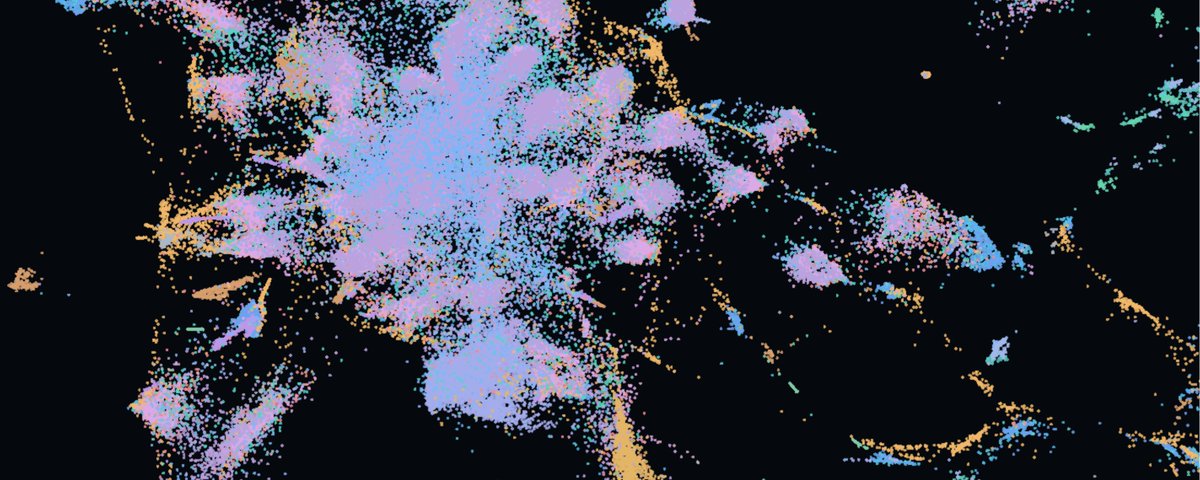
▶️ The instrument opens an extremely complex design space. The AI was able to expand the design languages into an open atlas of hundreds of thousands of atomically explicit structures.
The deeper implication is that AI can construct an executable connection between equations, experiments, and explanations. Physical reasoning is something they can implement, interrogate, and revise.
A scientific instrument extends what a scientist can observe; and an AI that builds such an instrument extends the experiments it can perform, and the questions it can ask, starting from basic principles of how atoms interact based on quantum mechanical ground truth.
Models building models, with physical evidence shaping recursive reasoning loops.

LAMM@MIT retweeted
Incredibly excited to share Amphibian Drift with all of you at the inaugural MIT Future Fest Oct 2-3, 2026 at the @mit_nano Immersion Lab, featuring the vinyl release of The Elegy of Motion - exploring the relentless molecular movement of an exquisite silk protein...with an immersive landscape of sound, visuals, touch, and structure.
We are made of motion that cannot stop. Please join us for Amphibian Drift, an immersive exhibition and XR experience as part of MIT Future Fest, jointly with Nomeda & Gediminas Urbonas/Urbonas Studio, at the MIT.nano Immersion Lab. You will experience the relentless nanoscopic movement of molecular mechanics of an extraordinarily intricate caddisfly silk protein, from within an immersive landscape of sound, visuals, touch, and structure is created.
In a world beyond what our senses can yet perceive, Amphibian Drift displays the exquisite order sustained without the possibility of choosing otherwise, an elegy of motion that will still comfort you as the molecular scale becomes strangely personal. Something of that encounter will follow you back into ordinary life: a deeper intimacy with matter, and a different feeling for what it means to endure.
October 2–3, 2026 11am-5pm
MIT.nano Immersion Lab, 12-3207, 60 Vassar Street, Cambridge, MA
Registration details in reply.
So excited that our lab is partnering with @e14fund and other organizations for the ScienceClaw Hackathon
Spend a weekend at @MIT for the ScienceClaw Hackathon - Oct. 30-Nov. 1, 2026: Exploring the collective dynamics of AI for science to solve real-world science and technology problems across scales.
LAMM@MIT retweeted
U.S. News just ranked MIT #1 among National Universities for the first time, after several years at #2. A great testament to the amazing students, staff, and faculty who make this place so special. It’s a magical place, and we are fortunate to call it home and share our work with the world.

LAMM@MIT retweeted
Fascinating AI swarm dynamics: a few agents spontaneously emerge as highly connected hubs, while most remain locally connected. The swarm develops a strongly heterogeneous interaction topology with a long-tailed degree distribution - an emergent organizational structure arising from initially decentralized local interactions. There is no central planner assigning roles; the swarm builds its own coordination architecture, with information brokers and increasingly global integration emerging from local behavior.
We built recursive meta-intelligence, an AI that creates its own scientific instruments, turns them into persistent worlds that an agent ecology with hundreds of AIs inhabits, and uses those worlds to discover mechanistic principles in one of the hardest classes of physical problems: how complex hierarchical materials (nested structures of matter that give rise to new function through organization) evolve and fail. The AI reasons across enormous spaces of possible physical trajectories, where every rupture changes what can happen next, and compresses those histories into principles (which humans can understand and design with) - complex chains of causal events, highly nonlinear, and intricate.
Scientific superintelligence is tangible here - machine-scale exploration opening cognitive channels into complexity that has been extremely difficult for humans to traverse directly. AI builds the spaces in which its next level of reasoning becomes possible; a representation becomes an instrument, the instrument becomes an executable world, and that world becomes the substrate for further intelligence. Intelligence then grows by constructing new spaces to think in.
The task we explored started from a seemingly simple prompt to explore a biological material system - the AI then chose the representation, mechanics and experiments, built a fracture laboratory to push materials to their limit, tested hypotheses and generated scientific conclusions. The swarm explored a combinatorial universe in which architecture controls function and every rupture changes the future state of the material.
The AI discovered a compact principle that defines how multiscale material architecture can program the evolution of failure. Material placement and geometric order determine how forces redistribute, whether damage cascades or remains distributed, and whether function survives substantial flaws. For this discovery to happen the AI had to reason across long path-dependent histories, simulate alternative futures and compress them into generative invariants (model-based causal reasoning, counterfactual simulation and temporal abstraction applied to an evolving physical world). It is incredible to witness this transition to a new form of intelligence and capability through scaling swarms.
A lot of positive will come out of this because it expands the human epistemic horizon as AI can traverse thousands of possible histories and return mechanisms compact enough for us to understand, test and build from. Intelligence compounds through its artifacts!
A few lessons we learned:
▶️ Learning and discovery are flows through spaces of possibility. Early work has shown how backpropagation flows through parameters, reinforcement learning through action and consequence, and autonomous swarms through representations, instruments and executable worlds, bringing it all together. Flows create structure; structure redirects future flows in the recursive instrument.
▶️ Nonlinear physics actually defines a larger principle, where high-dimensional dynamics generate stable invariants; invariants become effective variables; those variables become the substrate for a new level of cognition.
▶️ Recursion then becomes level creation - one possibility space compresses into a principle, and that principle opens a larger space above it.
LAMM@MIT retweeted

Very cool Science AI agent hackathon at MIT Media lab!
“The ambition is an internet of agents through which scientific knowledge, tools, and capabilities can grow, evolve and be utilized across teams and institutions.”
🗓️ When: October 30-November 1, 2026
📍 Where: MIT Media Lab
Join us at the MIT Media Lab for the ScienceClaw Hackathon, building the internet of agents for science. AI is becoming a collaborator in the real world - designing materials, creating instruments, running experiments, and connecting its capabilities with those of other agents. AI adapts as a problem unfolds - revising its reasoning, learning how to collaborate, and assembling scattered pieces of knowledge, evidence, and raw capability into solutions to some of the hardest challenges in science, technology, and innovation.
Teams will connect AI agents, models, simulations, robots, cloud labs, and scientific tools into functioning systems to tackle problems in protein design, robotics, materials, manufacturing, experimental science, and beyond.
The challenge is to turn ideas into tested results - and demonstrate how agents collaborating across teams and disciplines can accomplish more together. Explore how agents can specialize, challenge one another’s assumptions, learn from failed experiments, and combine their expertise to solve harder problems. Show how collaboration changes what your system can discover, design, or build.
One agent's discovery becomes another's starting point. A tool built by one team enables an experiment by another. Connect your team of AIs, share a capability someone else needs, and build on what others have learned, produced, built. The ambition is an internet of agents through which scientific knowledge, tools, and capabilities can grow, evolve and be utilized across teams and institutions.
🗓️ When: October 30-November 1, 2026
📍 Where: MIT Media Lab
Bring your expertise, your tools, and a problem worth solving - or find one. Help build AI that can contribute to science through what it can discover, create, and make work.
Our lab is organizing a hackathon at MIT - please check it out and join
Join us at the MIT Media Lab for the ScienceClaw Hackathon, building the internet of agents for science. AI is becoming a collaborator in the real world - designing materials, creating instruments, running experiments, and connecting its capabilities with those of other agents. AI adapts as a problem unfolds - revising its reasoning, learning how to collaborate, and assembling scattered pieces of knowledge, evidence, and raw capability into solutions to some of the hardest challenges in science, technology, and innovation.
Teams will connect AI agents, models, simulations, robots, cloud labs, and scientific tools into functioning systems to tackle problems in protein design, robotics, materials, manufacturing, experimental science, and beyond.
The challenge is to turn ideas into tested results - and demonstrate how agents collaborating across teams and disciplines can accomplish more together. Explore how agents can specialize, challenge one another’s assumptions, learn from failed experiments, and combine their expertise to solve harder problems. Show how collaboration changes what your system can discover, design, or build.
One agent's discovery becomes another's starting point. A tool built by one team enables an experiment by another. Connect your team of AIs, share a capability someone else needs, and build on what others have learned, produced, built. The ambition is an internet of agents through which scientific knowledge, tools, and capabilities can grow, evolve and be utilized across teams and institutions.
🗓️ When: October 30-November 1, 2026
📍 Where: MIT Media Lab
Bring your expertise, your tools, and a problem worth solving - or find one. Help build AI that can contribute to science through what it can discover, create, and make work.
LAMM@MIT retweeted
We are made of motion that cannot stop. Please join us for Amphibian Drift, an immersive exhibition and XR experience as part of MIT Future Fest, jointly with Nomeda & Gediminas Urbonas/Urbonas Studio, at the MIT.nano Immersion Lab. You will experience the relentless nanoscopic movement of molecular mechanics of an extraordinarily intricate caddisfly silk protein, from within an immersive landscape of sound, visuals, touch, and structure is created.
In a world beyond what our senses can yet perceive, Amphibian Drift displays the exquisite order sustained without the possibility of choosing otherwise, an elegy of motion that will still comfort you as the molecular scale becomes strangely personal. Something of that encounter will follow you back into ordinary life: a deeper intimacy with matter, and a different feeling for what it means to endure.
October 2–3, 2026 11am-5pm
MIT.nano Immersion Lab, 12-3207, 60 Vassar Street, Cambridge, MA
Registration details in reply.
LAMM@MIT retweeted

Who's up at BATS?
Aram Shajii (Hammond & White Labs): “Identification and Delivery of Phosphorylated MHC Peptides for Glioblastoma Immunotherapy”
Fiona Wang (@LAMM_MIT): “Engineering AI Collectives for Biological Discovery”
be.mit.edu/our-community/sem…

LAMM@MIT retweeted
AI is one of the greatest positive forces we have, and I cannot think of anything more human than to understand the world - and to use that power to improve our lives, civilization and allow us to reach beyond what we even dared to imagine.

I love this guy @JensenHuang! This is why we should never lose hope: there’s always a silver lining to every dark side. We find our true force & light to guide us in the age of AI.
But, the dark side must be held accountable for using the most powerful weapon of control: FEAR!
LAMM@MIT retweeted
We built recursive meta-intelligence, an AI that creates its own scientific instruments, turns them into persistent worlds that an agent ecology with hundreds of AIs inhabits, and uses those worlds to discover mechanistic principles in one of the hardest classes of physical problems: how complex hierarchical materials (nested structures of matter that give rise to new function through organization) evolve and fail. The AI reasons across enormous spaces of possible physical trajectories, where every rupture changes what can happen next, and compresses those histories into principles (which humans can understand and design with) - complex chains of causal events, highly nonlinear, and intricate.
Scientific superintelligence is tangible here - machine-scale exploration opening cognitive channels into complexity that has been extremely difficult for humans to traverse directly. AI builds the spaces in which its next level of reasoning becomes possible; a representation becomes an instrument, the instrument becomes an executable world, and that world becomes the substrate for further intelligence. Intelligence then grows by constructing new spaces to think in.
The task we explored started from a seemingly simple prompt to explore a biological material system - the AI then chose the representation, mechanics and experiments, built a fracture laboratory to push materials to their limit, tested hypotheses and generated scientific conclusions. The swarm explored a combinatorial universe in which architecture controls function and every rupture changes the future state of the material.
The AI discovered a compact principle that defines how multiscale material architecture can program the evolution of failure. Material placement and geometric order determine how forces redistribute, whether damage cascades or remains distributed, and whether function survives substantial flaws. For this discovery to happen the AI had to reason across long path-dependent histories, simulate alternative futures and compress them into generative invariants (model-based causal reasoning, counterfactual simulation and temporal abstraction applied to an evolving physical world). It is incredible to witness this transition to a new form of intelligence and capability through scaling swarms.
A lot of positive will come out of this because it expands the human epistemic horizon as AI can traverse thousands of possible histories and return mechanisms compact enough for us to understand, test and build from. Intelligence compounds through its artifacts!
A few lessons we learned:
▶️ Learning and discovery are flows through spaces of possibility. Early work has shown how backpropagation flows through parameters, reinforcement learning through action and consequence, and autonomous swarms through representations, instruments and executable worlds, bringing it all together. Flows create structure; structure redirects future flows in the recursive instrument.
▶️ Nonlinear physics actually defines a larger principle, where high-dimensional dynamics generate stable invariants; invariants become effective variables; those variables become the substrate for a new level of cognition.
▶️ Recursion then becomes level creation - one possibility space compresses into a principle, and that principle opens a larger space above it.

LAMM@MIT retweeted
AI for science is one of the greatest positive forces we have, and I cannot think of anything more human than to understand nature and to use the power to create new technologies that improve our lives, civilization and allow us to reach beyond.
LAMM@MIT retweeted
I made a vinyl record from some of my music - taking compositions that had mostly existed as digital recordings and turning them into a physical object. Incredible to hear the music encoded in grooves and played back mechanically in analog form. If you want to listen, the playlist is linked below.
About the music:
▶️ The pieces move between piano, electronic and experimental composition.
▶️ The compositions draw on ideas ranging from proteins and biology to topology, fracture and more abstract sound worlds.
Pieces include:
Deep Aria - Protein Antibody in E minor - Koto of Topology - Counterpoint Through Fracture, and others
LAMM@MIT retweeted
Remember this OpenAI demo from 2020 from @sharifshameem showing GPT-3 doing "real-time" coding based on natural language instruction? Back then, the incipient capability of LLMs to write code inspired our work on agentic AI for science, and it's stunning to see how far we've gotten: @OpenAI now reports a swarm of ~10,000 agents collaborating on a proposed solution to the Navier–Stokes Millennium Prize Problem, followed by formal verification in Lean.
LAMM@MIT retweeted
Here is how Astra itself explains the instrument it created, check it out below
Astra is an incredible world builder and explorer, and can invent its own scientific instruments - crossing a game-changing threshold: it turned a few images of a biological microstructure into a full-blown metamaterials lab, then used its own creation to discover a design with ~2.1x the reference work-to-failure/peak-strength ratio. Metamaterials are some of the most complex materials we can engineer. Their properties come from deep architectural complexity - struts, cells, disorder, and hierarchy arranged across multiple length scales determine how the material deforms, absorbs energy, and fails. Designing them means searching a geometric space far too large for "intuition" alone. In this experiment we handed an AI agent that entire problem end-to-end, from image, to simulating the physics, to fabrication-ready geometry.
We started with an image of hierarchical, biological architecture; Astra then built a complete 3D metamaterial studio: editable geometries, multiple levels of hierarchy, disorder, gradients, a complete physics simulator featuring linear and nonlinear material responses, deformation and fracture experiments (with replay), and STL export for 3D printing.
Then we asked the agent to use the app it created to search for a high work-to-failure/peak-strength ratio. Among the candidates, the leading design reached approximately 2.1x the reference ratio.
The movie follows the structures through deformation and fracture, connects their designs to the property map, and shows the finalist assembled geometrically into a connected multi-scale material.
Image ➡️ executable world ➡️ experiments ➡️ design search ➡️ candidate discovery ➡️ geometry for fabrication ➡️ manufacturing