

Professor of Economics at @UCSanDiego @GPS_UCSD. Trail runner, gravel biker, news reader, international economist, tweets on all of the above.
San Diego, California
Joined March 2018
- Tweets3.5K
- Following793
- Followers2.3K
- Likes6.8K






Kyle Handley retweeted

The new Section 301 tariffs the administration has proposed have no more justification than previous tariffs rounds. As @emilyjblanchard, @KyleLHandley, and I explained back in April:
“Section 301 requires the identification of acts, policies, and practices (APPs) that are unreasonable or discriminatory and burden or restrict U.S. commerce. Structural excess capacity can be a genuine economic problem, and foreign APPs that create or sustain it may well be actionable under Section 301. But the notice does not identify such practices or provide a framework that can be used to identify them. Instead, it treats aggregate economic outcomes such as trade surpluses and low capacity utilization rates as evidence of APPs.”
“Basic economics does not support that line of inference. Trade surpluses are neither necessary nor sufficient to establish the existence of APPs. They arise in well-functioning markets as the result of saving-investment patterns and comparative advantage, and many economies with significant policy distortions run persistent trade deficits. The same is true of low capacity utilization rates, which often reflect demand conditions,
business cycles, and investment dynamics rather than policy intervention. Neither indicator constitutes prima facie evidence of the statutory predicate.”
Read the full comment here: aei.org/wp-content/uploads/2…
Kyle Handley retweeted

I also recommend comments from @stanveuger @emilyjblanchard and @KyleLHandley via @AEI aei.org/commentary/comment-t…

Kyle Handley retweeted

Tariffs are taxes on the imported parts and materials factories need. Since January 2025, manufacturing has added a net 8,000 jobs, and 12 of 20 industries lost workers. Congress can end the trade war, writes Cato's @KyleLHandley.
ow.ly/f0tk51097ci

Kyle Handley retweeted

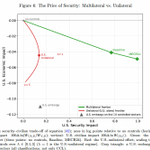
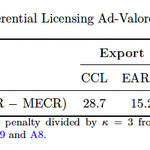
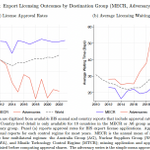
Export controls are broader than you think, but they buy more security with coordination
Jingting Fan (CKGSB), Kyle Handley @KyleLHandley @GPS_UCSD @UCSanDiego, Nuno Limão @Georgetown
ow.ly/BO8u5108PU9

Kyle Handley retweeted

The U.S. trade war strained businesses before Iran conflict. GPS Prof. @KyleLHandley urges Congress to restore predictable trade policy. Read this new commentary: cato.org/blog/trade-war-was-…
#UCSanDiego #GPSFaculty #TradePolicy #PublicPolicy

ALT Aerial view of colorful shipping containers at a busy port illustrating global trade issues discussed in economic commentary.


Kyle Handley retweeted

New Stata commands fereg and feppml fit regressions with many fixed effects. In simulations, they were 5–62 and 5–87 times faster than reghdfe and ppmlhdfe, from @JFSchmieder nber.org/papers/w36017

Kyle Handley retweeted

"The Trade War Was a Problem Before Iran—Congress Can End It" via @KyleLHandley cato.org/blog/trade-war-was-…

Kyle Handley retweeted
"Yet the finding that [the China Shock] caused one in four manufacturing jobs lost from 1990 to 2007 has not aged well. Neither has the populist turn against free trade that began around the time of the original research" 🔥 economist.com/finance-and-ec…

Kyle Handley retweeted
Multilateral controls on dual-use goods reduce leakage and adversaries’ real military spending. Acting alone, even with an embargo, cannot match the security impact, from Jingting Fan, @kylelhandley, and Nuno Limão nber.org/papers/w35898

Kyle Handley retweeted
New @nberpubs: "Export Controls and the Economics of National Security" nber.org/papers/w35898#fromr… viia @KyleLHandley

Kyle Handley retweeted
I think we academic economists failed, and I mean failed, to both push back and offer alternative narratives, mechanisms, and context for what the China Shock did. The publication herding on the China Shock as a credible identification strategy led to a series of papers giving the impression China Shock *caused* all of our problems. Super newsworthy and wrong. At best it caused some problems to get *relatively* worse in a very unequal way across regions. We needed a lot more Marshall McLuhan moments

Kyle Handley retweeted
"President Donald Trump’s tariffs are supposed to bring manufacturing back to America. But a bicycle factory in Virginia’s Blue Ridge Mountains shows how the levies themselves often sabotage that goal." 😯 bloomberg.com/graphics/2026-…


Kyle Handley retweeted
I organized an economist amicus brief in support of affirmance of the Court of International Trade's ruling in Oregon v. Trump and Burlap and Barrel v. Donald J. Trump that the administration exceeded its authority when it imposed 10 percent worldwide tariffs under Section 122 of the Trade Act of 1974.
In the brief, we argue that "large and serious United States balance-of-payments deficits," which the tariffs purportedly address, are impossible in today's system of floating exchange rates. We explain what such deficits looked like in the context of fixed exchange rates policymakers found themselves in until the 1970s, and that the government conflates balance-of-payments deficits with negative intermediate balances on the accounting statement known as the Balance of Payments. With floating exchange rates, no balance-of-payments imbalance can be “large and serious" in the sense of Section 122.
Separately, we argue the United States does not face the "fundamental international payments problems" the statute requires as a threshold condition for authorizing (or in fact, mandating) the tariffs.
The government's interpretation of the statutes and the economic concepts in it would grant it unconstrained authority to impose worldwide tariffs that, as we have seen, have vast economic and political significance.
You can read the full brief here: aei.org/wp-content/uploads/2….

Kyle Handley retweeted
When your biggest trading partner is also your biggest source of uncertainty, trade gets complicated.
GPS Prof. @KyleLHandley breaks down the U.S.-Canada trade war, where trust and future policy—not just tariffs—are at stake.
Listen: ow.ly/582p50ZHuek
#TradePolicy


Kyle Handley retweeted

Had a fantastic experience today being one of the guests on @KQEDForum alongside @KyleLHandley and @drdesrochers, hosted by Alexis Madrigal, talking US-Canada trade.
You can listen to the one-hour show here:
kqed.org/forum/2010101915050…
Kyle Handley retweeted

I typically keep opinions to myself, but when academic research strongly supports my prior on an issue that affects my daily life as a teacher, I can’t help but share. We need the SATs back badly. Thank you @dartmouth for this highly illuminating study. aeaweb.org/articles?id=10.12…

Kyle Handley retweeted

For those interested, because there is a lot of noise around the news, I offered an analysis of the claims demanded: monapaulsen.substack.com/p/c…


Kyle Handley retweeted

It seems a bit strange to call price controls a part of "Anti-fascist Economics" when price controls were one of the primary economic policies of Fascist Italy.
