

Hobby artist, sometimes cold-war/technical lore poster.
Joined March 2022
- Tweets400
- Following28
- Followers3.2K
- Likes95




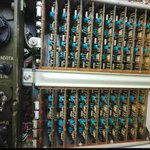




First glance at live PSNR-5 display after a nearly 2 month long restoration and repair, some practical demonstrations and more detail on operation to follow soon.
This is essentially an A-scope display, vertical axis is the range (set to 0-5km interval in this case), left trace follows the antenna azimuth, right trace deflects proportionally to signal strength (the noise visible at the bottom is the minimum resolvable distance clutter)

Another example of soviet military electronics assembly quality inside PSNR-5 (scope video output board).
Some things to note:
- virtually all components, even the ones labelled +-10% measure within +-1% of nominal value
- everything is covered with sprayed on solder mask, with exception of test points and parts of component leads
- no signs of any bad temperature control when soldering or improper solder joints overall
- all component leads are precisely bent and trimmed to specification
- backside of many boards is often additionally covered in about 2mm of epoxy-like resin
- all internal connectors have retaining springs, the connectors are not gold plated but each pin is a large blade with flat spring contacts on both sides (may be silver plated in this case)
- large components in round casings (electrolytic/foil capacitors too) always have their own retaining spring tabs soldered into the board
- component schematic markings the not printed on the boards, but all connectors, connector pin routings, power rails, and test points are
- all mounting screws seem tensioned to their intended torque
- every mounting screw uses 2 washers, flat one and internal tooth locking one
- every factory-adjustable component in properly sealed and proofed, often with additional mechanical fastening
- components (at least the ones I tested so far) only minimally drift with age, only notable failure found in the whole device so far was HV voltage multiplier capacitor falling to near zero capacitance (but still showing correct resistance and voltage tolerances)
- power supply generally relies on 4kHz impulse transformer system with ground/chassis reference being halfway through the used voltage range.

Very random subject once again, but this is what filming/developing Standard8mm film turns out like in 2026.


(1/16) In my stash of old technical documents I came across this 1925 catalog of aircraft engines offered by Salmson, a french aviation/automotive manufacturer.
It offers some interesting insight into the engine technology of the era.
Translation, specifications, performance curves, press reviews from the time and many photos of aircraft in which those engines were used are provided in this thread.

(15/16) A.B.9 Engine - 230 HP (cont.)
Press review
-------------------------------------------------------
1924 Transport Aircraft Grand Prix
20–24 August 1924
L’Écho des Sports, 23 August 1924
The Blériot flown by Bizot and Villechanoux took a brilliant second place. Its overall average reached 146.727 kilometres per hour, which must be recognized as an excellent performance. The three courses were completed with the same regularity as those of the Farman.A much closer contest between the Blériot and the Farman had generally been expected. This did not occur because the Blériot was fitted with 230 hp Salmson engines making their first public appearance. Salmson was introducing an air-cooled engine.Under these circumstances, it is understandable that Bizot and Villechanoux did not wish to press the engines too hard, since they did not yet know exactly what reserves of performance were available.They nevertheless tested them during the final part of the competition, and the aircraft then achieved a good 216 kilometres per hour, with a favourable wind, of course.This shows that the second-placed Blériot was in no way unworthy of its position in the Transport Aircraft Grand Prix, especially since the aircraft was ready to enter service on an airline immediately, if required.In conclusion, Blériot and Salmson had every reason to be satisfied with the results obtained. Their admirable performances were worthy of the reputation of French aviation.
-------------------------------------------------------
Official letter dated 23 August 1924
French Republic
Ministry of Public Works
Under-Secretariat of State for Aeronautics and Air Transport
Paris, 23 August 1924
Sir,
I am particularly pleased to send you my warmest congratulations on the brilliant success achieved during the events of the Transport Aircraft Grand Prix by your new engine, which, although only recently officially approved, demonstrated excellent qualities of endurance and regularity.
These excellent results bring great honour to your company and are due to the numerous improvements that you continually introduce into the construction of your engines.
Please accept, Sir, the assurance of my highest consideration.
The Under-Secretary of State for Aeronautics and Air Transport
Addressed to:
The Managing Director
Société des Moteurs Salmson
3 avenue des Moulineaux
Billancourt, Seine

