

Life is like a camera. Just focus on what's important & capture the good times, develop from the negatives and if things don't work out, just take another shot.
London, England
Joined December 2009
- Tweets24.5K
- Following371
- Followers35.8K
- Likes23.5K


Knowledge of London retweeted
Charlie Brown's Roundabout in South Woodford, East London, is a major road junction connecting the M11 motorway, the A406 North Circular, and the A1400.
The story actually begins a few miles south in the London Docklands. Charlie Brown Sr. (1859–1932) was a former boxer who took over the Railway Tavern in Limehouse in 1893. The pub became an internationally famous hotspot for sailors, who traded rare, global curiosities and treasures to Charlie Sr. in exchange for drinks. It became so iconic that sailors worldwide would simply say, "Meet you at Charlie Brown's."
When Charlie Sr. passed away in 1932, his funeral was one of the largest the East End had ever seen, drawing 16,000 people. Following his death, a family dispute arose over his massive collection of eccentric treasures. The curiosities were split between his daughter (who took over the Railway Tavern) and his son, Charlie Brown Jr., who ran the Blue Posts pub directly across the street. Both pubs aggressively put up signs reading "Charlie Brown's", causing mass confusion for locals and visiting sailors.
Moving to Woodford and 'The Roundabout' Pub
Tired of competing with his sister, Charlie Brown Jr. left Limehouse in 1938 and moved out to the Essex border to take over a newly built pub in Woodford called The Roundabout. He brought a portion of his father’s famous eccentric treasures with him.
The pub sat adjacent to a small, early version of the junction built in the 1920s. It quickly became a beloved community hub and landmark, with locals universally nicknaming the building (and the junction next to it) "Charlie Brown's". The pub was instantly recognizable by its unique pub sign: a tall pedestal topped with an ornate, moving fairground carousel complete with finely carved gilt horses. According to a local community group discussion on Facebook, this landmark pub, along with the adjacent Ted's Transport Cafe, served as the primary anchors for the area before major urban development changed the landscape.
Demolition and the Modern Junction
In 1972, major infrastructure plans completely altered the area. To accommodate the construction of the new M11 motorway terminus and expand the A406 North Circular, the original junction had to be drastically enlarged to build new slip roads and flyovers.
Tragically, The Roundabout pub stood directly in the way of the expansion and was demolished. The community was effectively split in two by the massive new concrete roads, cutting residents off from local shops and schools.
The remaining pub treasures were scattered or lost, and the iconic carousel pub sign reportedly disappeared "up north," despite later community efforts to track it down and reinstall it.
Though the pub has been gone for over half a century, the name stuck so firmly in the local lexicon that transport authorities officially designated the concrete interchange as Charlie Brown's Roundabout, keeping the memory of the East End's most famous publicans alive.

Knowledge of London retweeted
Red Post Hill, Junction with Denmark Hill.
The street's name is derived from an old landmark signpost that stood at the junction of the former Ashpole Road and Denmark Hill.
Documented as early as 1768, the signpost was inexplicably painted bright red and served as an early precursor to modern street signs, indicating local travel distances.
The original post vanished sometime before 1875, but the Dulwich Society stepped in to restore this quirky bit of history by erecting a modern replica red post in October 2010 to mark its historical site.

Knowledge of London retweeted
Located at the corner of Curzon Street and South Audley Street in Mayfair, Leconfield House served as the official operational headquarters for the UK’s Security Service (MI5) for over three decades, from 1945 to 1976.

Knowledge of London retweeted
Pulpit-Shaped Bridge Piers, Blackfriars.
Standing in the River Thames next to the modern train lines are the red, stubby columns of the original 1886 railway bridge. The tops are distinctly shaped like church pulpits to reflect the medieval dissolution of the monastery by Henry VIII.


Knowledge of London retweeted
In the late 1990s, archaeologists excavating near the foot of Vauxhall Bridge Road (where the subterranean River Effra flows into the Thames) discovered two lines of oak posts dating back to the Middle Bronze Age (between 1750 BC and 1285 BC). This represents the oldest known prehistoric bridge-like structure found anywhere in Britain.
Picture of how it would have looked by Time Team.

Knowledge of London retweeted
From the 1950s until its discovery in 1985, Soviet KGB agents used this specific Victorian lamppost in South Audley Street as a "dead letter box" to exchange secret documents and microfilms.
A spy would slip messages inside a small maintenance door at the rear base of the post and leave a white chalk mark on the side to signal to their handler that a pickup was ready.
In a bizarre twist of reality mirroring fiction, the building right next door at 3 Audley Square served as the production offices for EON Productions. In the early 1960s, legendary film producers Cubby Broccoli and Harry Saltzman were inside that building casting Sean Connery as James Bond for cinema's very first 007 movie, Dr. No.
While cinema's most glamorous fictional spy was being brought to life on paper and cast inside the building, real-life Soviet spies were quietly operating on the pavement just a few feet away outside their window. The lamppost still stands there today with its little metal trapdoor intact.


Knowledge of London retweeted
The churchyard of St Mary’s Church, Harrow on the Hill, with views of the countryside, is where young Byron would sit on this grave after school and compose poems. Visitors attracted to the tomb would chip away at it, therefore a cage was added.

Knowledge of London retweeted
London Character: Joe of Sidcup in 1953. Smokey Joe lived off Sidcup Hill. He could often be seen and heard rattling down the hill with no tyres on his bike, wearing a police helmet. It is said the police locked him up and gave a good wash in the winter.

Knowledge of London retweeted
Located inside the elegant Queen's House, Greenwich, is Britain’s first centrally unsupported geometric spiral staircase. Beyond its architectural brilliance, it is famous for a bizarre 1966 photograph taken by a retired Canadian reverend and his wife visiting the Queen’s House. The Reverend and Mrs R. W. Hardy had heard about the famous Tulip Stairs and took a photograph which after developing appears to show a shrouded, ghostly figure climbing the stairs.


Knowledge of London retweeted

Albion House on the corner of The Strand and James Street, Liverpool. You might also know it as the White Star Line building, White Star Line Hotel or the the streaky bacon building. The red and white brickwork shares an architect with the original New Scotland Yard in London. Which name do you usually call it?

Knowledge of London retweeted
Remember chewing your way through a Black Jack? They were part of the halfpenny chews, which had a kind of aniseed-flavour and would turn your tongue and teeth black, which would go down great for Halloween- although we never celebrated it back in the day.

Knowledge of London retweeted
The Hidden Roman Altar Stone, located right in the front garden of the Omnibus Theatre, 1 Clapham Common North Side, partially obscured by foliage, sits a mundane-looking stone block. This is actually a 1st-century AD Roman relic, likely an altar stone or milestone left behind from when the Romans built Stane Street right through Clapham.

Knowledge of London retweeted
Just in case there is any doubt that some of London's bollards are from recycled cannons, you can see how deep they go below the surface.

Knowledge of London retweeted
The Clifford's Inn Gatehouse is the last surviving structural remnant of Clifford's Inn, which was the first and longest-surviving Inn of Chancery in London. Located down Clifford's Inn Passage just off Fleet Street in the City of London, this Grade II listed building provides a stark, historical gateway into what was once a bustling medieval legal enclave.

Knowledge of London retweeted
The Rubble Mound of Arnold Circus
When the London County Council finally demolished what was the Old Nichol slum, they faced an immense logistical problem: how to clear millions of tons of toxic, rotting masonry.
Their solution created the most distinct geographic oddity in the area today. They kept the debris on-site, piling the entire crushed remains of the Old Nichol slum into a massive central mound.
This mound was transformed into Arnold Circus, a raised ornamental park featuring a grand bandstand at its peak. The wide, tree-lined streets of the Boundary Estate radiate out from this hill like the spokes of a bicycle wheel. When you stand in the peaceful gardens of Arnold Circus today, you are literally standing on top of the compressed ruins of London’s most notorious abyss.


Knowledge of London retweeted
In the 1960s, playground slides routinely towered between 10 and 20 feet high, dwarfing the standard 6-to-8-foot safety-regulated structures found in parks today.

Knowledge of London retweeted
The bronze pavement disc known as a Spitalfields Roundel is located right outside the historic Truman Brewery on Brick Lane, this specific piece features four tankards of ale alongside a Black Eagle motif, which pays direct homage to the brewery's heritage (originally founded as the Black Eagle Brewery in the 17th century).
It was created by local sculptor Keith Bowler in 1995, as part of a series of 25 distinct bronze discs embedded into the pavements of Spitalfields. They were designed to mimic traditional Victorian coal hole covers while visually telling the social, cultural, and industrial history of the local area.


Knowledge of London retweeted
The Great Wheel (also known as the Gigantic Wheel) was located within the Earls Court Exhibition grounds in West London.
Specifically, the giant Ferris wheel was situated on surplus railway lands just west of Warwick Road, sitting roughly where the later, now-demolished Earls Court Exhibition Centre stood. Historical records and maps pinpoint its exact placement:
The wheel stood looking east, directly in front of St Cuthbert's Church on Philbeach Gardens.
It was located near what became the Lily Bridge railway depot, just a short walk from the Earl's Court Tube Station.
Constructed by engineer Walter Basset, this 94-metre-tall behemoth dominated the West London skyline from 1895 until its demolition in 1907.

Knowledge of London retweeted
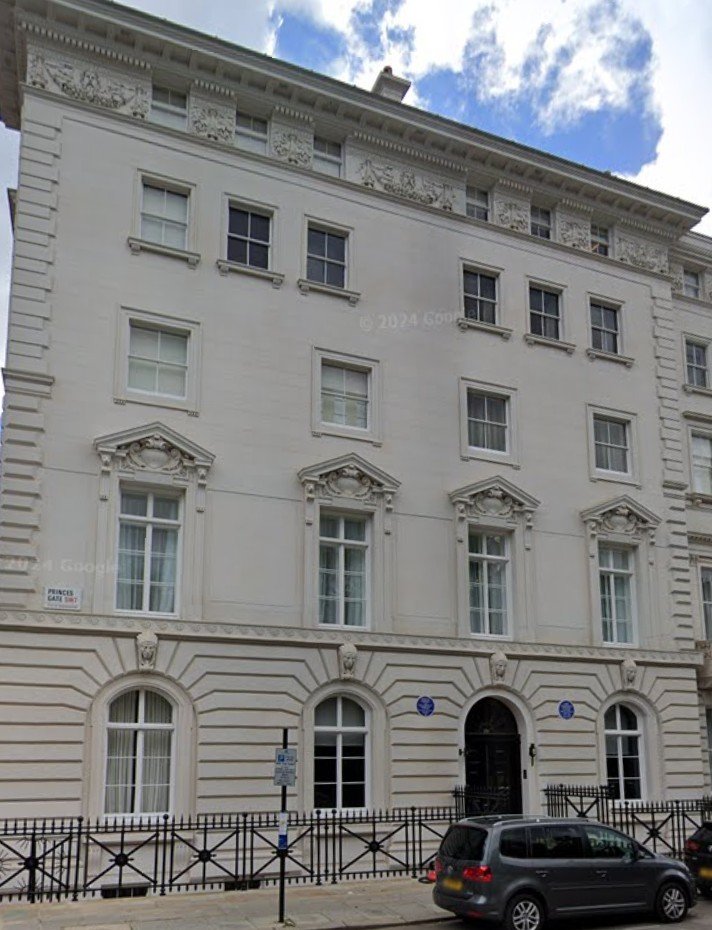
The grand mansion at 13-14 Princes Gate, Knightsbridge, served as the official residence for US Ambassadors from the 1920s to the 1950s. During a major remodel by American architect Thomas Hastings, a highly unusual architectural element was added to this classic London terrace, sculpted Native American heads were placed in the stone keystones right above the ground floor windows.
Before he was President, a young John F. Kennedy lived at 13-14 Princes Gate in the late 1930s. His father, Joseph P. Kennedy Sr., was the US Ambassador to the UK. JFK spent his early twenties living here, just a stone's throw from Hyde Park, until his father was recalled in 1940.
Before the American government took over Nos. 13-14, the estate belonged to the legendary American tycoon and banker J.P. Morgan. Morgan spent a few months every year in London and used Princes Gate to warehouse an incredibly massive, priceless private art collection, filling the rooms with rare books, Renaissance masterpieces, and historic curiosities.


Knowledge of London retweeted
The Nursemaids' Tunnel
Built in 1821, this structure is one of London's earliest surviving pedestrian subways. It was constructed after local residents petitioned for a safe passage underneath the busy New Road (now known as Marylebone Road).
The tunnel allowed Regency-era nannies and nursemaids to safely transport wealthy families' children from the residential terraced houses of Park Crescent over to the private gardens of Park Square on the north side without crossing the chaotic horse-and-carriage traffic above.
The Grade II listed tunnel has recently been beautifully restored by the Crown Estate Paving Commission. Unfortunately the tunnel is only open to residents. However, by visiting the gardens on the annual Open Garden Squares Weekend which is usually held around mid-June.


