

Knowledge Lab develops new big data, machine learning and crowd-sourcing approaches & techniques to comprehend the shape and limits of human understanding
University of Chicago
Joined September 2013
- Tweets583
- Following810
- Followers2.1K
- Likes124





In our last Nobel Prize prediction (for Economics), we're adding three things to prior predictions:
-- Economics-specific context modeling (Arna Wömmel)
-- Field-first prediction (first step)
-- Within the major fields, predicting the defining discovery and the candidate combination together (Second step)
Here's our next bold bet for the Nobel Prize in Economic Science:
Steven Berry
Yale University
New Haven, USA
James Levinsohn
Yale University
New Haven, USA
Ariel Pakes
Harvard University
Cambridge, USA
"For the structural estimation of demand and market power in differentiated-product markets"
More detailed results about tomorrow’s chemistry prediction here: github.com/Dawoon-Jeong0523/…
Alternative results from simulated committee decisions here: xitter.cf/BastosCostaDavi/status…


The 2026 Nobel Prize in Physics went to Francis Halzen alone for his decisive contributions to the IceCube Neutrino Observatory and the discovery of high-energy astrophysical neutrinos.
Our bold bet on quantum simulators with ultracold atoms (Bloch, Cirac, Zoller) missed. Neutrino astronomy was on our list, with Halzen named, but at only 3.5% (14 of 30) due to bundling with co-nominees.
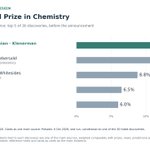
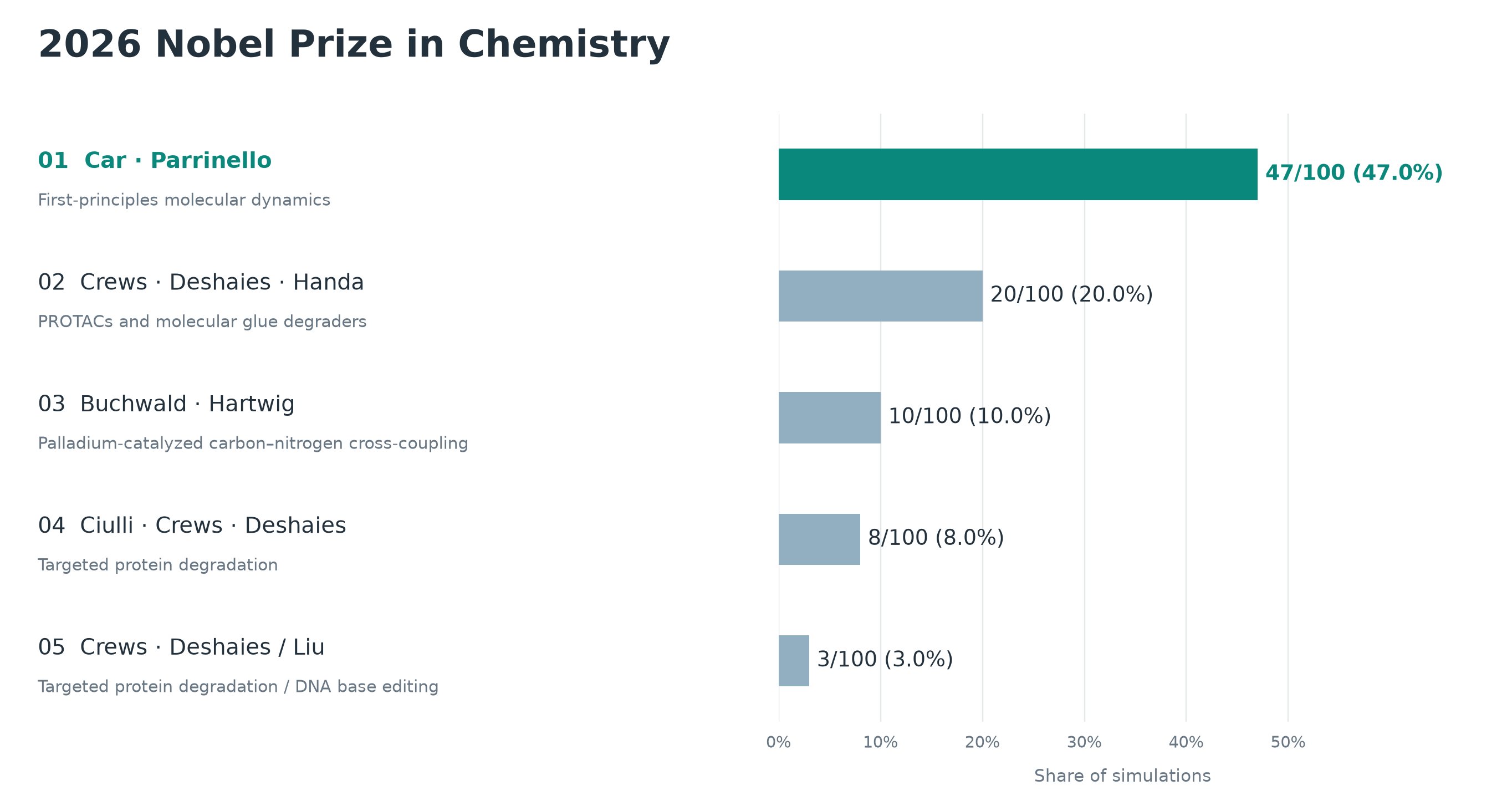
We're carrying three fixes into our Chemistry prediction:
Leaner lineups: AI committees now only nominate combinations they strongly support (10 of 30 Chemistry options are solo candidates)
Patents as evidence: discoveries are now supported by both their defining papers and tied patents
Additional sources: the profile cards are now one main source, weighed alongside prizes, news, predictions and the history of the prize, rather than the main evidence. Bibliometrics alone seem to miss some of what matters; for one, the value captured in patented technology.
Otherwise we used the same framework: "science of science" profile cards (citation impact, defining works, technological translation, textbook reach, collaboration, and now the patents tied to each discovery) built from OpenAlex, PatentsView and Reliance on Science, fed into the Preseen.com forecasting engine.
Here's our next bold bet for the Nobel Prize in Chemistry:
Shankar Balasubramanian
University of Cambridge
Cambridge, UK
David Klenerman
University of Cambridge
Cambridge, UK
"For the development of sequencing-by-synthesis, the basis of next-generation DNA sequencing"
More detailed results about tomorrow’s Chemistry prediction here: github.com/Dawoon-Jeong0523/…
Alternative results from simulated committee decisions here: xitter.cf/BastosCostaDavi/status…

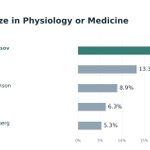
The 2026 Nobel Prize in Physiology or Medicine went to Karl Deisseroth, Peter Hegemann, and Georg Nagel for their pioneering work on optogenetics.
Our agent-based prediction models ranked optogenetics 6th (4% probability), which was lower than the leading prediction of GLP-1 at 24% — likely because they over-indexed on recent news rather than longer-term scientific impact.
Interestingly, a parallel approach we tested did predict optogenetics (flagging Deisseroth and Hegemann, though not Nagel). That model leaned into "science of science" signals: citation impact, technological translation, textbook reach, and collaboration networks — drawing on OpenAlex, PatentsView, and Reliance on Science data, all distilled into discovery “cards” and fed into the Preseen.com forecasting engine that took that as primary evidence, alongside the broader universe of relevant data and signals available to that system. Full author profiles and results for medicine here: dawoon-jeong0523.github.io/A…
Using that same prediction framework, here's our next bold bet for the Nobel Prize in Physics:
Immanuel Bloch
Max Planck Institute of Quantum Optics
Garching, Germany
J. Ignacio Cirac
Max Planck Institute of Quantum Optics
Garching, Germany
Peter Zoller
University of Innsbruck
Innsbruck, Austria
"for theoretical proposals and experimental realizations of quantum simulators using ultracold atoms in optical lattices"
More detailed results about tomorrow’s physics prediction here: docs.google.com/document/d/1…
Want to see the alternative predictions from yesterday’s model? We posted those here: linkedin.com/feed/update/urn…

Tomorrow, the Nobel Assembly announces the Nobel Prize in Physiology or Medicine. Today, we're putting our prediction on record.
Knowledge Lab’s simulated Nobel committee predicts that the 2026 Nobel Prize in Physiology or Medicine will go to:
Daniel J. Drucker
University of Toronto
Toronto, Canada
Jens Juul Holst
University of Copenhagen
Copenhagen, Denmark
Svetlana Mojsov
The Rockefeller University
New York, USA
“for GLP-1 physiology and the development of incretin therapies for diabetes and obesity”
This was the most likely outcome informed by deep agentic research across a wide range of data sources and analyses with Preseen, drawing upon Knowledge Lab’s own research, informed by 120 simulations of the Nobel Prize Committee’s deliberation process (xitter.cf/BastosCostaDavi/status…). More details here (docs.google.com/document/d/1…).
We'll announce our prediction for each prize the day before it's awarded.
These are bold bets. After the last prize drops, we'll open the hood: which approaches worked, which didn't, and what the horse race tells us. This is a part of larger experiments with Preseen.com to integrate science with forecasting complex human and collective decisions.
Thanks to members of KLab: @BastosCostaDavi, Dawoon Jeong, Robbie Ward, Arna Wömmel, @ArjSabet, Huadong Xiong, and Julia Koschinsky.


Knowledge Lab is delighted to announce a new partnership with Preseen, a leader in AI-driven forecasting.
How can we identify the most impactful areas for scientific investigation and technological investment? Deciding how to act now requires knowing what is likely – and what is possible – in the future. Knowledge Lab is leveraging Preseen's powerful forecasting engine to shine light on trajectories of scientific and technological change.
The goal is not merely to see what is coming, but to change it. By combining forecasting engines with methods of computational social science, we aim to give policymakers, founders, and researchers the insights they need to build a flourishing future.

Forecasting science and technology is hard. When Bell Labs unveiled the transistor in 1948, The New York Times gave it a throwaway item on page 46.
This pattern holds across fields with the best-funded programs and most-cited papers seldom being the ones that matter most, and the advances that do are often ones no one saw coming.
I'm excited Preseen will be partnering with the Knowledge Lab at UChicago to incorporate their data and models into Preseen's core forecasting technology to improve our ability to forecast science and technology.
More on this here: blog.preseen.com/p/predictin…

Do LLMs behave consistently across scenarios that have identical payoff matrices but differ in formally irrelevant details? A new preprint by Tianjia Dong, Nadav Kunievsky (@NadavKun), and James Evans (@profjamesevans) finds that the answer is often no. Behavior learned in one framing frequently fails to transfer to another. 🧵

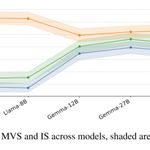
These findings suggest that prompt-suite evaluation is weaker than it appears. If behavior learned in one payoff-equivalent frame does not transport to another, then evaluations give us less confidence about deployment than their scores suggest. Before LLM agents are deployed in real-world decision-making contexts, we should not only measure performance on given environments, but consistency when details of those environments change.
Full preprint here: arxiv.org/abs/2606.22797

Knowledge Lab retweeted

Out today in @ScienceMagazine: with the amazing Haochuan Cui, Yiling Lin, & @LingfeiWu, we analyzed 3.6 million scientists publishing 1960–2020. The findings reshape a century-old debate about age and scientific creativity.
In some ways LLMs are alien minds, but in others, they are our digital doubles.
Latent spaces encode maps of meaning that mirror our own cultural and cognitive associations.
Check out The Semantic Structure of Feature Space by @AustinKozlo & @_Andrei_B_ , now on ArXiv!


Full paper here: arxiv.org/abs/2604.27169

Knowledge Lab retweeted

Excited to share our @DSI_UChicago new work accepted by ICLR 2026, with the remarkable Siyang Wu, Sida Li, Ari Holtzman @universeinanegg, and @profjamesevans James Evans! Link: lnkd.in/gd9YZNBh A thread (1/n)

LLMs can be sensitive to subtle changes in wording that shouldn’t matter. Ideally, models respond not to the specific words of the prompt, but the user’s underlying intent.
In new work accepted at ICML, @NadavKun and @profjamesevans formalize “understanding intent” then empirically assess the ability of LLMs to do so.
(...link below)

Larger models differentiate intents better, but can also be more responsive to superficial wording.
This suggests that we should evaluate models not only on mapping questions to correct answers, but in mapping questions to their intended meanings.

Preprint available here!
arxiv.org/abs/2506.16584