

Assistant Professor @USC | Making AI-enabled wearables, implantables, and ingestibles 🩹⚕️💊
Los Angeles, CA
Joined August 2009
- Tweets524
- Following1.8K
- Followers1K
- Likes1.6K





Yasser Khan retweeted

A sensor that reads your sweat and adjusts your meds? It’s real. @USCViterbi engineers built a wearable that detects lithium in sweat, a breakthrough for needle-free treatment in bipolar disorder.
viterbischool.usc.edu/news/2…

Yasser Khan retweeted

A breakthrough in wearable tech from @USC could transform treatment for millions with bipolar disorder.
Researchers at the USC Viterbi School of Engineering and the @KECKSchool_USC have developed the first fully printed wearable lithium sensor, allowing patients to monitor medication levels through sweat — no more painful blood draws.
Led by Professor Yasser Khan and in collaboration with psychiatrist Adam Frank, the device offers real-time tracking via smartphone and has already shown promise in patient trials.
PhD student Mohammad Shafiqul Islam who works in the @KhanLabUSC Khlan Lab described their goal to make it “as easy and comfortable for patients as checking a daily fitness tracker.” @USCMingHsiehEE @USCAdvComputing
Read more here: viterbischool.usc.edu/news/2…
Yasser Khan retweeted

"Wearable organic-electrochemical-transistor-based lithium sensor for precision mental health" cell.com/device/fulltext/S26…
@ucla Yasser Khan
@Device_CP

This article beautifully captures most of our recent efforts to create accessible medical technology. 💊🩹🩺✨ It also feels special to be covered by a Bangladeshi Newspaper.
Thanks to Shams Rashid Tonmoy and Amy Blumenthal for coordinating the article.
thedailystar.net/tech-startu…
@USCMingHsiehEE @USCViterbi @USC @dailystarnews
Our paper on the printed capacitive sweat rate sensor has been chosen as a cover for the journal, Advanced Intelligent Systems. 💦🩹✨
Cover: advanced.onlinelibrary.wiley…
Paper link: doi.org/10.1002/aisy.2024009…
PDF: khan.usc.edu/assets/files/is…
@Advintellsyst

Good news on a Wednesday: our paper on ingestibles made it to the "Best of 2024" list of Cell Reports Physical Science. ✨🎉@CellRepPhysSci

Yasser Khan retweeted
You are what you eat? Or what you eat will tell your health status? @KhanLabUSC’s ingestible sensors might be able to tell us about gut health and spot disease earlier. His work along with other innovations are featured in TFM. today.usc.edu/first-aid/

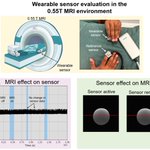
#wearables inside #MRI ? 🤔We demonstrated a custom wearable sensor operating in a low-field (0.55T) MRI scanner. We evaluated noise in a wearable device caused by eddy currents from the rapidly switching MRI gradients, as well as the MRI noise and artifacts introduced by the BLE wearable into the MR receiver. The sensor showed no impact on signal quality or MRI images. These findings highlight the potential for wearable sensing in MRI environments. 🧲📸🫀⌚
Paper link: dx.doi.org/10.1109/LSENS.202…
Paper PDF: khan.usc.edu/assets/files/mu…
@sensorsletters
ieeexplore.ieee.org/document…

New in the journal Advanced Intelligent Systems, we show a simple yet elegant printed capacitive sweat rate sensor, which is very practical and validated with analytical modeling and on-body testing.

Printed Wearable Sweat Rate Sensor for Continuous InSitu Perspiration Measurement (Yasser Khan and co-workers) 🔓 onlinelibrary.wiley.com/doi/…

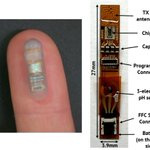
Another cool paper at the end of the year. We have developed a single-chip chemical sensing #ingestible that can self-orient. With this ingestible platform, the possibilities are limitless. Congratulations to all the authors: Angsagan Abdigazy, Shafiq Islam, Mohammed Arfan, Md Farhad Hassan, and Prof. Hossein Hashemi. 💊✨
Paper link: ieeexplore.ieee.org/abstract…
@IEEEorg @USCViterbi @USCMingHsiehEE

Ending the year on a high note. New in the journal Advanced Intelligent Systems, we show a simple yet elegant printed capacitive sweat rate sensor, which is very practical and validated with analytical modeling and on-body testing—A huge shout out to Shafiq Islam, Sangwon Cha, Md Farhad Hassan, Wenxin Cai,
Tahsin Sejat Saniat, Cedar Rose Leach, for leading this amazing research. Looking forward to many new exciting wearables next year!🎉
Open source paper link: doi.org/10.1002/aisy.2024009…
@Advintellsyst @USCViterbi @USCMingHsiehEE

End-of-Semester Reflections: This semester, Rehan Kapadia and I revamped @USCMingHsiehEE's Introduction to Electrical Engineering course. The course is designed to provide students with a high-level understanding of electronic systems, integrating both hardware and software perspectives and AI/ML tools.
We adopted a hands-on learning approach, combining lecture and lab sessions in every class. Students used a custom demonstration board featuring hardware and software modules focused on circuits, devices, sensor systems, optical communications, linear algebra, and neural networks for image and digit classification. We used @arduino Nano 33 BLE Sense and Jupyter Notebook for all the demos. There also was a module introducing quantum mechanics with a demo of the Hong-Ou-Mandel dip courtesy of A.F.J. Levi and Walter Unglaub. Also, thanks to Dolendra Vikas Addepalli and Atiyeh Abbasi for all the dev work.
In the final challenge project, student pairs used their demonstration boards to implement free-space optical communication, transmitting data optically from one board to another, targeting the highest possible data rate and accuracy. It was a fun semester, and hopefully, we'll be able to go open-source in the next offering of the course. ✨✌️🔴🟡
@USCViterbi


USC Viterbi School of Engineering undergraduate success story: Sangwon has been working with us for the last couple of years. He has led/co-led/published multiple wearable sensing works. And, yes, he is still an undergraduate student at the USC Ming Hsieh Department of Electrical Engineering. We, all in the group, are super proud of our super undergrads. Congrats Sangwon. 🌟🎉

From sleep patterns to stress levels and now...sweat rates? @USCMingHsiehEE student Sangwon Cha recently presented his sweat-rate sensor at the IEEE-EMBS International Conference on body sensor networks. According to Cha, sweat can be a key indicator on health in humans. @KhanLabUSC
Read more about this at the link: viterbischool.usc.edu/news/2…

We have multiple PhD student positions at Khan Lab @ USC. Students with a strong background in Electrical Engineering and interests in bioelectronics, device fabrication, and integrated circuits are invited to apply to our pre-application portal at ece.usc.edu. Please note that we are a hardware group -- looking for students passionate about physical electronics and hardware systems.
URL: khan.usc.edu
Pre-application: ece.usc.edu (please email me to evaluate your chances at [email protected] -- if your profile is competitive, I will let you know to apply to the pre-application portal)

Thanks for the highlight, @Berkeley_EECS. Proud Cal 🐻+ USC ✌️USC @USCViterbi School of Engineering!
eecs.berkeley.edu/news/alum-…
@Cal_Engineer

It feels surreal to write this – I’m honored and humbled to announce that I’m in the 2024 class of #PackardFellows! I’m part of a class of 20 visionary scientists and engineers whose work will push the boundaries of science and innovation. With the help of the Packard Foundation’s support, we will create exciting new technologies for health and neuroscience. packard.org/2024fellows 🌟🎉🧠💊
@PackardFdn @USC @USCViterbi @USCMingHsiehEE @KeckMedicineUSC

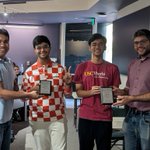
It's quite gratifying to see how amazing the students in our lab are doing. MHI PhD Scholars are the most promising PhD students in our @USCMingHsiehEE . The MHI undergraduate scholars distinguished themselves in research, academics, and contribution to the @USCViterbi community. Congratulations to Angsagan Abdigazy, Sangwon Cha, and June Shao. 👏🎊🤩

Thanks @agabramson for visiting USC. Looking forward to extending our bioelectronics collaboration.

It was wonderful to visit Saudi Arabia 12 years after graduating from KAUST. The economic transformation the kingdom is going through is remarkable. Took part in an amazing panel discussion on "AI in Health" at the Global AI (GAIN) Summit. Shout out to @SDAIA_SA for organizing a successful summit #GAINSummit


Welcoming @USC Class of 2028 with the third edition of our "Wearables for health and mind" microseminar. We also had a fun and busy summer with the @USCViterbi Summer Undergraduate Research Experience (SURE) and Viterbi Scholars Institute (VSI) programs. Thanks to our PhD student mentors and newly-admitted trojans. ✌️❤️💛


