


Kenneth Ssali retweeted

We 💛 V-G-R
On the evening before Voyager 1 reached its one light-day distance from Earth, people all over the globe came together to celebrate humanity’s farthest reach into the universe. Learn more about this historic milestone: go.nasa.gov/3VxPANX
Kenneth Ssali retweeted

Just 34 minutes before its cameras were turned off in 1990, Voyager 1 captured this iconic view of Earth – a pale blue dot in the vastness of space.
Today, Voyager 1 is one light-day away from Earth. A little piece of our planet journeying through interstellar space. 🌎💙

ALT Earth is seen in the vastness of space as a single, bright blue dot in the middle of a fuzzy, white sun ray. Other rays of light are scattered across the image. Credit: NASA
Kenneth Ssali retweeted

Shining bright across the solar system!
On Nov. 18, the Voyager 1 spacecraft will pass an extraordinary milestone, a distance reached by no other human-made object: one light-day away from Earth. And we're celebrating with a special message for the spacecraft!

ALT An artist’s concept depicting a Voyager spacecraft with a long instrument protruding from the rear of the spacecraft. The front is circular and golden with light shining into its right side. A long antenna stretches out straight to the left and two smaller antennae form a Y from the left side of the circle.
Kenneth Ssali retweeted

In 1959 a capsule with a 16mm camera was launched aboard a Thor missile. Designed to record footage of the missile, the engineers realized the device could record images of the Earth too. So this the first video footage of Earth from space on a 16mm film
Kenneth Ssali retweeted

Roscosmos finally uploaded full album of photos of the recent Soyuz-2.1b launch from Vostochny
All photos are taken by Ivan Timoshenko / Roscosmos Media
roscosmos.ru/45452/
1/4 Before rollout (7 photos)


Kenneth Ssali retweeted
Oh hell yeah!!!!
Congratulations to everyone involved in this audacious plan.




Kenneth Ssali retweeted
The Valentine nebula Sh2-174 is an unusual ancient planetary nebula where a low-mass star lost its outer layers at the end of its life. The core of the star is the blue star near the center of the blue gas.
Image: @jaume_zapata & Xavier Bros, Anysllum Observatory @AstroSabadell.

Kenneth Ssali retweeted

Proxima Centauri is the nearest star to the Sun, ~ 4.24 ly away. That places it ~ 40 trillion km from Earth. Even light takes more than 4 years to cross that distance, which helps explain why reaching another star presents such a different engineering problem from travelling between planets. Proxima Centauri also hosts Proxima b, a planet discovered in 2016 through the small changes its gravitational pull produces in the star’s motion. Its measured minimum mass is close to Earth’s & it completes an orbit every 11.2 days. These properties make it an especially interesting target for studying terrestrial planets outside our Solar System.
Proxima b orbits much closer to its star than Mercury does to the Sun. However, Proxima Centauri is a small, cool red dwarf that emits far less energy than our star, placing the planet within its habitable zone. This means that liquid water could exist on its surface under suitable atmospheric conditions. Whether those conditions actually exist remains uncertain. We haven’t established that Proxima b has an atmosphere, oceans or life & its star produces frequent flares & intense ultraviolet radiation. Models suggest that this radiation could drive substantial atmospheric loss, although the outcome depends on properties of the planet & its atmosphere that remain poorly constrained.
At a constant speed of ~ 75 km/s, covering Proxima Centauri’s present distance would take ~ 17,000 years. For comparison, Voyager 1 travels at roughly 17 km/s relative to the Sun. Dividing the same distance by that speed gives ~ 75,000 years, although Voyager 1 is heading elsewhere. These calculations hold the distance fixed & leave out acceleration, braking and the relative motion of the stars. They illustrate the scale of the journey; an actual mission would require a calculated interception trajectory.
Other spacecraft have achieved much higher speeds. During its close approaches to the Sun, Parker Solar Probe has reached ~ 692,000 km/h. Using that speed & Proxima Centauri’s present distance gives a crossing time of ~ 6,600 y. However, Parker achieves its record speed briefly while moving through the deepest part of its highly elliptical solar orbit. Turning that performance into an interstellar departure speed would require a different mission design. Its speed record provides another useful comparison, while leaving the practical problem of sending a spacecraft to Proxima unresolved.
Transporting ppl would add challenges that a robotic probe doesn’t face. A journey lasting 1000s of years would require many generations to live aboard the spacecraft, with reliable food production, water recycling, medical care, radiation protection & the ability to repair essential equipment. The population would also need to remain healthy & the community would have to function for far longer than any human institution has maintained a technological habitat. Researchers have explored aspects of these generation ships through demographic simulations & engineering studies. Such work examines the conditions a mission might require, but demonstrating a complete, durable system remains an enormous unresolved task.
Much shorter journeys have been proposed for extremely small robotic spacecraft. Breakthrough Starshot’s concept would use a powerful laser array to accelerate lightweight sails carrying instruments towards ~ 20 % of the SoL. At that speed, crossing the present distance to Proxima Centauri would take ~ 21 years, followed by another 4 years for the observations to reach Earth. Achieving this would require solutions to difficult problems involving sail materials, laser control, collisions with interstellar particles, onboard power & communication across interstellar distances. The basic concept involves a fast flyby, with braking at the destination presenting an additional challenge. It remains a research proposal & adapting such an approach to a spacecraft carrying ppl would introduce vastly greater demands.


Kenneth Ssali retweeted

A very HAPPY BIRTHDAY to Apollo 9's Rusty Schweickart!
Born October 25, 1935.
Here he is during his EVA on March 6, 1969, beautifully lit by the pale blue reflected light from Earth.
Rusty was also responsible for another very important photograph...1/2


Kenneth Ssali retweeted
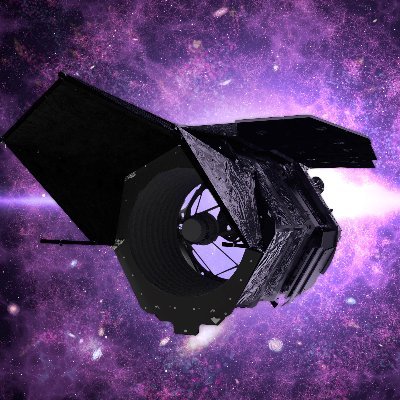
It's the final countdown 🎶
We're one step closer to Roman's first images! The observatory is now fully functional and the team is performing their final checks and calibrations before starting science observations.
go.nasa.gov/4A9menV
Kenneth Ssali retweeted
Voyager is slowly going dark.
NASA has been forced to shut down one of Voyager 1’s science instruments to keep the legendary spacecraft alive.
After 49 years of continuous operation, engineers have officially powered down the Low-Energy Charged Particle (LECP) sensor on Voyager 1, now located more than 15 billion miles from Earth.
The move was not due to instrument failure, but rather a deliberate survival strategy. The spacecraft’s plutonium-powered generators lose about four watts of electricity every year. By deactivating this instrument, mission controllers hope to prevent a critical power shortage that could cause the entire spacecraft to shut down permanently.
At this immense distance, communication is extremely challenging — it takes roughly 23 hours for a signal to travel one way between Earth and Voyager 1. Although the loss of the particle sensor ends that particular data stream, two other key science instruments remain active, continuing to send back valuable information from interstellar space.
NASA is now exploring even stricter power-saving measures to extend the mission as long as possible. This latest shutdown is expected to buy Voyager 1 at least one more year of operation, allowing humanity’s farthest-reaching explorer to keep sending data from the edge of the solar system and beyond.
The spacecraft may be fading, but its journey is far from over.

Kenneth Ssali retweeted

HALFWAY THROUGH THE CONGO BASIN! 🌍🚣♂️
400KM DOWN. 400KM TO GO.
We’ve officially reached the halfway point of Project 6!
400km paddling down the Sangha River, through some of the most remote rainforest on Earth. From incredible wildlife encounters to unforgettable moments with local communities, this journey has already been something special.
But we’re far from finished. Another 400km of the unknown lies ahead.
Halfway there. The adventure continues. 💪🌍
