

Historian of Medicine & Disability, Jewish Studies | Associate Prof. @uofcincy | Plant Lover
Cincinnati, OH
Joined December 2014
- Tweets55
- Following202
- Followers116
- Likes139




Kate Sorrels retweeted

In “The Origins of Camphill & the Legacy of the Asylum in Disability History,” Katherine Sorrels argues that Camphill’s lifesharing model may have been innovative, just perhaps not in the ways one might expect: muse.jhu.edu/pub/1/article/8…
#histmed
Kate Sorrels retweeted

and Disability and Belonging, an ArcGIS StoryMap exploring the Camphill movement, directed by @KateSorrels and reviewed by @jenguiliano #ReviewsInDH reviewsindh.pubpub.org/pub/d…
Thanks, Dan and Kathryn, for your terrific chapter!

Very excited that Ohio Under COVID, in which @Poements and I write (Ch. 1) about the gender politics of #COVID19 in Ohio, is now freely available from @UofMPress as an e-book. Or use code UMS23 for 30% off. It's a great collection--please check it out!
press.umich.edu//12396322

ALT Cover of: Ohio under COVID: Lessons from America's Heartland in Crisis
The degree to which paternalism is still baked into national legislation is shocking. Still, there’s some good news here. nytimes.com/2022/08/25/style…

2
Kate Sorrels retweeted

Ableist language, writes @DrMLGodin, is one of the more persistent and ingrained versions of ableism: “And it’s not just nondisabled people who use it; disabled people, evidently including me, can be ableist in their speech, too.” nyti.ms/3ASqMUb

Kate Sorrels retweeted

When @alexdstuckey told me months ago there were people needing publicly funded intellectual and disability services in Texas who were on waitlists for 10-20 years I couldn't believe it. It's true. And you can read it for free because our paywall is down. houstonchronicle.com/news/in…

To be totally honest, as someone who studies the past, I had no idea of the extent to which the institutionalization of disabled people was still an issue.
But once you're playing closer attention...
2
1
It's part of the catastrophe in Ukraine:
devex.com/news/people-with-d…

It's on our doorstep: disabilityscoop.com/2022/06/…

Kate Sorrels retweeted

[#Ukraine] "The most vulnerable populations, including older persons and people with #disabilities, face more difficulties evacuating and accessing #humanitarian aid" says Fanny Mraz, HI emergency director
Read more in @devex article: devex.com/news/people-with-d…
Kate Sorrels retweeted

Excited to be part of this volume on disability in German-speaking Europe with a piece on “Deafness and ‚Disfigurement’ as Relational Disorders: Aron Ronald Bodenheimer's Psychotherapy at the Zurich School for the Deaf during the 1960s.”
tinyurl.com/mpcmtaen
#DeafHistory

Kate Sorrels retweeted

Surprise parcel in the post: Thank you @CamdenHseBooks for this twin pack. 😍 A book I helped come to fruition (peer-reviewed it last year) & a copy of my own monograph which was released in paperback this month. I love June! (And I love my anonymous self being thanked in bk 1!)


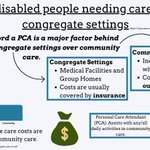
The average Personal Care Attendant makes just $13,300 a year. Yet the amount charged to disabled people for PCA services can be so high they cannot remain in their homes.
A complex issue that my amazing research assistant Meredith Chin sums up nicely in this infographic.

Ever wonder about your school's priorities? (Hint: sportsball and ill-defined "innovation".) We need more faculty to join the AAUP.
Watch “AAUP Investigation of UC Budget” by @LaureQuinlivan on #Vimeo vimeo.com/713757398
1
My new co-edited volume is available now! Unfortunately, it is quite expensive- I would be grateful to anyone who could recommend it to their library to buy! I also have a 35% discount code to offer 🙂
boydellandbrewer.com/recomme…

“Ableism remains the most socially acceptable form of intolerance.”
This article is yet another reason I stand behind the opening line in our introduction to Disability in German-Speaking Europe.

Disabled people ‘systematically ignored’ on climate crisis, says study theguardian.com/environment/…

Kate Sorrels retweeted

NEW! Linda Leskau, Tanja Nusser, and @KateSorrels's new volume explores the development of disability studies in German-speaking Europe and brings together interdisciplinary perspectives on disability in German, Austrian, and Swiss history and culture. boybrew.co/3n35gDP
