
Chief Shilling Officer (CSO) @xangle_official Ex-Reality Analyst @ TradiFi, but now researching virtual chaos
Joined March 2020
- Tweets1.4K
- Following1.5K
- Followers1.8K
- Likes4.2K





Pinned Tweet
Web1: Read-only
Web2: Read-Write
Web3: Read-Write-Distribute
‘Distribute’ — this is how I see Web3
Airdrop, Yapping, Farming… these are not just events, but new forms of social contracts and culture built around the idea of distribution.
In a time when Gen Z has lost access to opportunities, Web3 can rise as the spirit of our era.


(Below is the English translation of the text written in Korean)
Is There Truly an Oasis in the Crypto Space?
Amidst the widening wealth gap and intensifying social conflicts, modern life has gradually turned into a barren desert. In this parched reality, the crypto market emerged like a final oasis promising to quench our thirst. Early on, cypherpunks resisting centralized control paved the way, followed by early adopters who sensed the shift. Their success stories drew countless retail investors into the fray, and now, global financial titans and corporate executives have begun discussing the potential of this oasis. However, the journey toward it has not been as lush as expected. The reality we face is harsher than imagined, and the path has been anything but smooth.
To be sure, there have been meaningful achievements. The approval of Bitcoin Spot ETFs proved that this asset class has earned institutional trust, while DeFi and PerpDEXs have technically realized the possibility of finance without intermediaries. The proliferation of stablecoins and the revitalization of prediction markets were clear "streams" of water we discovered. Yet, before these streams could form rivers or lakes, far too many bandits appeared around the oasis to prey on the thirsty. Constant scams and hacks, founders obsessed with "early exits" rather than product-market fit, and the gambling dens fostered by exchanges have led to the bankruptcy of countless investors, drying up market trust. Consequently, nihilism has become pervasive.
The problem is that this is a complex crisis involving both internal and external factors. Internally, the market is flooded with crude services that can hardly be called "innovation," while "Degens" in their exclusive circles are mostly occupied with PvP games—stealing money from one another. In particular, the predatory structure of "VC Investment → CEX Listing → Retail Dumping" has blocked new inflows and exhausted existing participants. As the line between entrepreneur and scammer blurs, external technologies like AI and robotics are absorbing capital and talent at an overwhelming pace. These technologies are evolving rapidly and beginning to tangibly change lives. The old method of attracting idle capital through mere narratives has lost its "sexiness" in the face of these more compelling alternatives. In this chaos, we are forced to ask ourselves:
Could it be that we mistook a mirage for an oasis?
I believe the crypto market currently stands at a critical crossroads. If we continue to tolerate the practice of assigning value to projects without substance, the market’s development will stall or become obsolete. We must bid farewell to the era of selling dreams to enrich insiders. It is time to reclaim capital flowing to fake innovators and concentrate it on exceptional builders—like Hyperliquid—who prove actual utility. Only when our standards of evaluation become rigorous will the soil be prepared for talented entrepreneurs to return.
The only way to defeat nihilism is through the proof of utility.
Despite the need for painful self-reflection within the industry, I believe my thesis from last year—"Web3 is the Zeitgeist"—remains valid. In an era where AI and Big Tech monopolize wealth and the value of labor fades, the "distribution culture" of Web3—which recognizes user contribution and returns the fruits to the community—is the only alternative capable of correcting a distorting capitalism. Whether what we see is a mirage or a true oasis ultimately depends on the standards we use to purify the market and the values into which we inject capital. The power to transform a barren desert into an oasis will come not from vague narratives, but from whether actual value is created and whether capital is properly redistributed to those efforts.


24
35
378
Thoughts on the AI Bubble and Valuations
Discussions around an “AI bubble” continue to surface, and whenever noise emerges around data center capex—such as the recent Oracle-related issues—we see both Nasdaq equities and crypto assets sell off. Statistics showing that historical returns have been close to 0% when the S&P 500’s 12-month forward P/E reaches around 24x further reinforce the narrative that equity markets are currently overvalued.
Is this truly a time to be cautious?
Is the phrase “this time is different” once again a dangerous mantra that will ultimately lead bulls to defeat?
Personally, I view the AI cycle as fundamentally different from previous cycles. This time really is different. The difference lies in the nature of the cycle itself: AI is likely to create a much more powerful cycle (a much higher peak) and one that lasts significantly longer. The reason is that we are gradually entering an era in which past patterns and historical statistics are becoming less meaningful.
Throughout human history, there has never been an entity that fundamentally surpassed human intelligence. Today, however, AI is beginning to cross that line and is preparing to enter the realm of superintelligence, far beyond human capability. In 2025, concrete examples supporting this shift have started to emerge. For instance, the team led by Demis Hassabis accomplished in just a few years what would have taken humans roughly one billion years—predicting the structures of 200 million proteins. At Goldman Sachs, tasks such as IPO documentation, which previously required weeks of work by senior investment banking professionals, are now completed in minutes, dramatically improving efficiency (and this is a very basic example). What once improved in a linear fashion is now advancing exponentially alongside AI.
(Source: Waitbutwhy.com)
The chart above best illustrates this transformation. Human progress is no longer expected to follow a linear path. If we are indeed at that point on the curve, should we still evaluate today’s capital markets using the same yardsticks as the past? Would an AI arms race—where the cost of losing is extraordinarily high—really come to a halt simply because leverage has increased somewhat? More likely, 2026 and 2027 will be years in which this competition intensifies even further. With the cycle only three years into its formation, it is still too early to declare a bubble.
And historically, whenever the dominant question in the market has been “Is this a bubble?”, it never actually was.

34
47
407


<Coinbase’s ICO: A Strategic Move to Reclaim U.S. Crypto Dominance>
@coinbase just acquired a launchpad and picked @monad as its first ICO project. For a U.S. company that’s long been cautious about ICOs, this is a bold pivot — backed by the upcoming Clarity Act, which could legalize token offerings in early 2026.
The U.S. has walked this path before.
In the 1980s, it introduced the ADR (American Depositary Receipt) system, letting foreign giants like Toyota, Sony, and Nestlé list on the NYSE — a move that supercharged the U.S. capital market.
To list in New York, these firms had to rely on U.S. investment banks, market makers, and exchanges, enriching the entire financial ecosystem.
As Americans invested through pensions and funds, their wealth grew — and the U.S. cemented its role as the world’s financial hub.
The Clarity Act is the same playbook, but for crypto.
By legalizing ICOs, the U.S. aims to repatriate crypto’s capital formation and infrastructure — pulling value creation away from offshore hubs like Binance and back to American firms.
Coinbase is now the front-runner of this strategy.
And Monad ICO could be the first spark that reignites the retail hype the industry’s been missing.
If retail capital floods back into crypto under a legalized ICO framework, it could mark the true start of a new bull market. This cycle’s been institution-led and muted — but retail, as we saw in 2017 and 2021, plays much louder.
If the Monad ICO manages to feed the retail crowd, next year might just kick off the party.
Sure, every party ends with a game of hot potato —
but hey, everyone thinks they won’t be holding the bomb 💣

Stable’s 2nd deposit round is here.
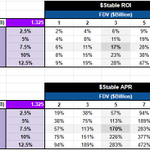
So… what’s the ROI looking like?
ROI Estimates
Base Case: 17%
- FDV $3B (same as Plasma)
- Airdrop allocation 7.5%
Bull Case: 38%
- FDV $5B
- Airdrop allocation 10%
Bear Case: 8%
- FDV $2B
- Airdrop allocation 5%
Assuming TGE happens within this year, the APR roughly translates to:
- Base Case: 170% APR
- Bull Case: 380% APR
- Bear Case: 80% APR
Looks like a no-brainer to join this @stable round.


The countdown to Phase 2 of the Pre-Deposit Campaign has begun...
@hourglasshq is set to lead the institutional vault in partnership with a top-tier investment bank.
Mark your calendars and get ready to participate on Thursday, November 6 at 2PM UTC (9AM ET).
14
31
1,628
$Theo YT ROI could actually exceed 100%?
This week’s @Theo_Network point distribution just wrapped up. Based on my rough estimate of ~$0.2 per point, the APY works out to around 20%. It could go even higher if you layer additional yield from other protocols like hyperEVM.
For those who’ve purchased $Theo YT, the cost per 1 point is around $0.1. With an FDV of $100M and a 10% airdrop allocation, that price feels fair — but if you’re expecting a $200M FDV or a higher airdrop share, the YT play could turn into a solid short-term ROI opportunity.

16
24
833
Payment solution for AI
Huge announcement
@GoKiteAI

We're thrilled to announce a new investment from Coinbase Ventures @cbventures. This funding extends our recent Series A round led by @PayPal Ventures and @GeneralCatalyst, and will accelerate development of our infrastructure for autonomous AI agent payments and adoption of the x402 protocol.
Kite @GoKiteAI is now natively integrated with the x402 Agent Payment Standard, positioning ourselves as a primary execution and settlement layer for the protocol. As one of the first L1s to fully implement x402-compatible payment primitives, Kite allows AI agents to seamlessly send, receive, and reconcile payments through standardized intent mandates, unlocking the full potential of the agentic economy.
Coinbase Ventures' investment will support Kite’s continued product and infrastructure development across three converging market shifts shaping the autonomous economy:
✅The Need for a Programmable Trust Layer
✅Scalable Blockchain with the x402 Protocol as the Native Payment Rail for AI
✅The Rise of Agentic Commerce as a Growth Engine
The future of the agentic economy is here, and we're proud to have Coinbase Ventures supporting us on this groundbreaking journey.
Read more: medium.com/@KiteAI/kite-anno…

[Ventuals is backed by the Hyperliquid community]
Among the 4,069 wallets staking on @ventuals, 821 wallets (≈20%) are from the Hyperliquid airdrop wallets, staking a total of 429K $HYPE (~$16M) — enough to meet the HIP-3 threshold alone.
Source:
hyperevmscan.io/address/0x88…
Considering that many farmers operate multiple wallets, the actual number of @HyperliquidX airdrop participants is likely even higher.
Notable KOLs participating in Ventuals staking include:
@krybharat — 50,005 HYPE (~$1.86M) 0x087...
@Bizyugo — 25,000 HYPE (~$930K) 0xbdf...
@mk4_lul — 10,000 HYPE (~$372K) 0x773...
@kirbyongeo — 5,000 HYPE (~$186K) 0x6cd...
The community has already voted with their stakes.
Now it’s up to Ventuals to deliver — and turn the vision of democratizing the private equity market into reality.

The Age of Agent Trading has already came
An interesting trading competition just kicked off on @the_nof1 — six LLM-based AI agents are competing as traders.
What used to be a distinctly human intellectual pursuit — investing and trading — is now rapidly being taken over by AI agents. Even in traditional equity markets, AI-driven agents have already started to appear. I personally think human investors may have less than five years before being completely edged out. After all, investing is essentially about analyzing massive amounts of data and making probabilistic decisions — something AI can do faster, smarter, and without emotion. (Maybe it’s time to go all-in before the bots take over…)
One key detail: this competition is hosted entirely on the on-chain exchange @HyperliquidX. Because it operates without KYC, it allows agents to act as autonomous economic entities — and since all trade data and positions are fully transparent on-chain, it’s the perfect testing ground for agent strategy development.
I believe the first true intersection of AI and crypto will emerge here — where AI agents gain financial autonomy through blockchain infrastructure.
Hyperliquid


The Era of 7% GDP Growth (by Cathie Wood)
Cathie Wood, the founder of ARK Invest, known for its annual BIG IDEAS reports, recently shared a bold view: global GDP could grow at 7% annually at 2030.
Back in the Middle Ages, annual GDP growth was only about 0.5%. It rose to nearly 3% during the age of steam engines and railways, and reached 7% in the early 1900s with the rise of electricity and the telephone. Her point: technological innovation drives productivity — and productivity drives growth.
Now, with AI, robotics, energy storage, and blockchain, she predicts exponential productivity gains that could increase the GDP growth and push inflation down to 0% or even negative levels.
What’s even more interesting is the convergence of these technologies. In crypto, we’re already seeing projects that combine AI, robotics, and energy — many attracting high valuations and investor attention. These intersections may be where the next wave of value creation will emerge.
Source: youtube.com/watch?v=VkkhClwZ…

1
4
317
Even after @KookCapitalLLC raised concerns about @ventuals, a massive 1.4M $HYPE (~$54M) was staked — nearly 3x the required 500k $HYPE ($18M).
One reason I’ve been bullish on the HyperEVM ecosystem is its deep liquidity supported by community. Looking at the top wallets staking in Ventuals, many are worth hundreds of millions. For them, staking a few $000k despite “scam risk” probably isn’t a big deal.
Data shows 3,867 wallets joined:
- 7 wallets with >$1M
- 54 wallets between $100k–$1M Plenty of whales here 🐋
Now that the team cleared the minimum for HIP-3, the next challenge is solving the private equity oracle pricing issue.


1M+ HYPE deposited into vHYPE within 24 minutes.
Thank you to our earliest supporters for coming onboard the journey to Make Private Markets Public.
Next stop: mainnet launch.
Now, let’s get back to work.

4
19
1,198
Another interesting project, @ventuals is launching in the @Hyperliquid ecosystem — deposits open today at 12am KST.
It’s a synthetic asset platform for trading private company stocks, allowing users to trade tokenized shares of companies like SpaceX and OpenAI. It feels like part of Hyperliquid’s grand plan to build a Web3 version of NASDAQ, focusing on the private equity segment. I’m planning to deposit a small amount of $HYPE myself — apparently, deposits over 100 $HYPE (~$4K) will receive an NFT.
Since it deals with private stock trading, the biggest challenge (and experiment) will be accurate price discovery. According to the docs, prices are determined by a mix of 50% external valuation estimates and 50% internal trading data:
Oracle Price = 0.5 × (External Valuation Estimate) + 0.5 × (8-Hour EMA of Perp Mark Prices)
Without an underlying spot market, the system’s ability to reflect real-world valuations will be a fascinating test case for on-chain synthetic markets.
testnet.ventuals.com/trade

1 day to go.
vHYPE deposits open tomorrow, Oct 16 15:00 UTC.
Together, we’ll Make Private Markets Public.
Be ready. Be early.

5
8
475
Current Binance FUD Summary
The fight started from Coinbase, but Hyperliquid is the only one getting attention by this
Hyperliquid
3
7
290
Stablecoin Supply Surpasses $300B
The strongest PMF in crypto — stablecoins — has officially crossed the $300B mark. Recent growth has been driven mainly by @Plasma's USDT and @arbitrum's USD.AI, both fueled by high APYs. @solana and @BNBCHAIN ecosystems are also showing steady momentum.
But there’s one thing lagging behind: Circle’s stock price — the only publicly traded stablecoin issuer. Since peaking in June, it’s been cut in half and continues to move sideways. The reason? The industry is growing, but competition is heating up. There are now 10+ stablecoins with over $1B in circulation (up from just 3 a few years ago), and more large platforms are preparing to launch their own.
As competition intensifies, issuers will likely compete through integrations that offer higher yields (like Plasma) or by launching yield-bearing stablecoins that share interest revenue with holders.
One good example is @Theo_Network's thBILL, a stablecoin backed by U.S. Treasury yield accrual.
Personally, I’ve been farming thBILL on multiple DEX LPs within the HyperEVM ecosystem — stacking LP APY + Theo points + HyperEVM DeFi points + potential Hyperliquid S2 rewards. A true quadruple-farming setup.
You can farm thBILL early on at platforms like @prjx_hl, @HyperSwapX, @ultrasolid_hl, @Upheavalfi, @HypurrFi, and @felixprotocol. For early-stage yield, Ultrasolid offers high risk–high return opportunities, while Hyperswap could be a good late-stage sprint before TGE.

Last weekend was a reminder for all of us just how crucial oracles are.
Maybe it’s time to revisit the Xangle research on the No.1 oracle — @chainlink

"Chainlink systematically abstracts three critical layers—technology, payments, and operations—into a unified platform experience."
Read @harrychjin of @Xangle_official's research report on how Chainlink abstracts complexity to enable mainstream adoption ↓
2
8
384
I'm ready for this one.
gTheo :)
@Theo_Network


🚨신규 온보딩: @Theo_Network
요약
1. 야퍼 100명 균등 $1,000 보상
2. 야퍼 250명 총 토큰 0.05% 보상
3. Theo 자체 포인트도 필요함 (예치작)
- - - - -
신규 프로젝트가 온보딩 됐으니 초기선점 해야겠죠?
보상 (이중 구조)
1. 매달 야퍼 100명
- 글로벌 TOP 50
- 한국인 TOP 25
- 중국인 TOP 25
=> 50,000 thBILL 씩 2달
=> 총 100,000 thBILL
=> 평균 1인당 $1,000 균등분배
2. TOP 250 야퍼
- 총 토큰 0.05%
- 자체 리더보드 기준
- 마쉐, 포인트, $KAITO 스테이킹 등
- 최소 Theo 포인트 100 이상이어야 됨
=> 매달 말 스냅샷 찍음, 최종 종합해서 배분
- - - - -
Theo가 무슨 프로젝트?
1. HackVC 포함 총 $20M 투자 받음
2. 온체인 자산을 글로벌 금융 시장에 연결하고자 함
3. 지금은 RWA 기반으로 상품을 발행하고 있음
4. 코같투(@Edward__Park)님이 밀고 있음
참고로 Theo 포인트를 쌓기 위해서는
Theo에 지갑을 연결하고, 코인 예치를 해야합니다.
(링크는 댓글에)
Theo 뭔가 Falcon, Mira, Boundless 같은
달달한 향기가 납니다..
0.05%라서 보상이 작아보이지만
혹시나 추가 보상이 나올 수도 있고
업빗썸 상장시 엄청난 펌핑이 나올 수 있으니
무조건 초기선점 글을 쓰고 지켜보는 것을 추천!!


5
9
406
The Future Hyperliquid Envisions
Reading the post below naturally raises the question — why would @HyperliquidX , which already runs its own PerpDEX, allow others like @tradexyz and Basedapp to launch their own?
The answer lies in what Hyperliquid ultimately aims to become: not just a brokerage, but a Nasdaq-like trading infrastructure.
Just as Robinhood, Webull, and Schwab operate on top of Nasdaq, Hyperliquid envisions countless DEXs being built on its high-performance Hypercore — a network where various assets can trade freely.
This strategy fits perfectly with the L1 playbook of sustaining attention through constant “new TGEs,” while the $20M(500k HYPE) deposit requirement for deployment adds strong tokenomic support to $HYPE. On top of that, Hyperliquid can take up to 50% of trading fees — a significant advantage.
It seems the market is finally starting to understand what “Don’t mistake Hyperliquid for just another DEX” really means, something community has been saying for months.
As for @tradexyz it’s not just any new DEX — it’s built by Unit, the most hyped team in the HyperEVM ecosystem. Could this be the Robinhood of Hyperliquid?
If your wallet has traded over $5M, you can now register for the waitlist here:
👉 trade.xyz/

Unit / Tradexyz has officially launched their HIP-3 DEX on mainnet, marking the first Dex deployment since HIP-3 went live a few hours ago.
app.hyperliquid.xyz/explorer…
4
6
319