

The Media Program South East Europe of Konrad-Adenauer-Stiftung was founded in 2005 and actively supports free and independent media in the region.
Sofia, Bulgaria
Joined October 2014
- Tweets1.8K
- Following228
- Followers1K
- Likes1.1K




Strategic Communication Study Visit in Berlin and Brussels together with experts from Albania, Bulgaria, Germany, Kosovo, Moldova, Romania and Serbia. Our group met with experts of the KAS, BND, the German Bundestag, NATO, EEAS, Martens Centre.


At the International Conference for Political Communication (IKPK 2026) in Berlin, the KAS MPSEE hosted its annual panel discussion. The focus was on the topic "When the periphery is as important as the centre – Political Communication in the regions of South East Europe".


This weekend, the Tag des Auslandsjournalismus (Foreign Correspondence Day) took place in Munich, with the support of the Konrad-Adenauer-Stiftung’s Media Programme South East Europe.


The annual True Story Award has announced its official call for entries for its 2027 edition!
Based in Berne, Switzerland, the annual True Story Award is one of the world’s most prestigious awards.
Read more about it or apply here:
truestoryfestival.org/en/awa…
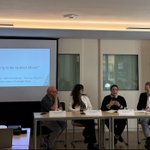
We successfully concluded our inspiring conference “Journalism and Media - Anything to Be Upbeat About?” on Lake Como.
And to answer the question we posed at the beginning- yes, there is still a lot to be upbeat about, but there is still a lot of work to be done.


“The risks facing journalism have not driven young people away from the profession - they have driven them towards it.”
Robert Bierman, member of the Assembly of BIRN, opened our conference “Journalism and Media – Anything to Be Upbeat About?”, at Villa La Collina.


Day two of the First Balkan Media Conference in Tirana! 🇦🇱
Participants had the opportunity to hear from experts on topics such as the growing influence of Big Tech and the challenges of curtailing them. One point that stood out: algorithms tend to favour attractive speech over critical speech but journalists must not make compromises with their work.
Furthermore, although influencers and journalists may sometimes appear similar because they shape public opinion, a key difference lies in how they gather and verify information and how they present it to the public.
Today’s discussions highlighted the rapidly changing environment journalists are working in. Thus, we look forward to continuing the dialogue also after the conference draws a conclusion!
#BalkanMediaConference #Journalism #Media #Balkans #Tirana #MediaAccountability #MediaFreedom


First Balkan Media Conference - “Journalism needs to reclaim Journalism” in Tirana, Albania! 🇦🇱
Today, we opened the first Balkan Media Conference, organised by the KAS Media Programme SEE, bringing together media professionals and experts from the whole region as well as from Germany to exchange perspectives on the challenges and opportunities that journalism is facing in the region.
The conference began with opening remarks by Christoph Plate, Director of the KAS Media Programme SEE, followed by Marja Freudeberg, Deputy Head of Mission at the Embassy of the Federal Republic of Germany in Tirana, who welcomed all participants to the conference.
“Journalism is worth reclaiming, and that is the responsibility of journalists.”
With these powerful words, Fatjona Mejdini, Director of the Observatory of Illicit Economies in South Eastern Europe, delivered a keynote that immediately sparked discussion among participants.
Her message set the tone for the conference: to exchange ideas, challenge perspectives, and strengthen the knowledge and expertise needed for the future of journalism in the Balkans!
#BalkanMediaConference #Journalism #Media #Balkans #Tirana #MediaFreedom


Russia's malign influence in the Western Balkans depends whether they are given opportunities. The newest report by the European Centre of Excellence for Countering Hybrid Threats (Hybrid CoE) explains what can be done to prevent this.
And how? Hybrid COE suggests European Union enlargement, stronger democratic resilience to reduce the space for hybrid interference across the region.
Read the full report here: hybridcoe.fi/wp-content/uplo…
KAS Media Programme SEE attended to the #BIRNSummerSchool2026! Some of the key topics: OSINT, data journalism, public interest reporting and media safety.


🗞️Freedom of Information requests, that allow journalists and citizens to compel public institutions to release documents and data, are an essential tool of investigative journalism.
Balkan Insight addresses a BIRN report analysing 1,740 such requests submitted by journalists across Albania, Bosnia and Herzegovina, Montenegro, North Macedonia, Kosovo and Serbia in 2025. While approval rates have risen from 38% in 2022 to 58% in 2025, the report finds that institutions have developed new ways to obstruct access in practice: More than a quarter of all requests receive no response at all, legal exemptions are interpreted broadly and selectively and legally binding decisions by oversight bodies are routinely ignored without consequence.
‼️In Kosovo, institutions justified refusals by citing ongoing prosecutorial proceedings; in Montenegro, journalists were repeatedly denied access to information even in cases where the responsible oversight body had already ruled in their favour. The report also warns that legislative attempts to expand exemptions risk eroding transparency safeguards further. When institutions can disregard binding decisions with no consequences, independent reporting and democratic oversight are weakened.
📷Read the full article and report here: balkaninsight.com/2026/06/30…
#independentjournalism #media #FreedomOfInformation

🌍 The European Media Freedom Act (EMFA) is the EU's landmark regulation to protect media independence, pluralism and journalists.
‼️One year after it became fully applicable in August 2025, the situation is concerning: the European Federation of Journalists (EFJ) warns that the EU has a two-speed implementation problem. According to the annual Media Pluralism Monitor by the Centre for Media Pluralism and Media Freedom, the lagging countries - among which Bulgaria and Romania, are held back by regulatory ineffectiveness and political influence, thus making the adaptation of national systems to EMFA slower and more difficult.
The EFJ warns that without active enforcement and the political will, the risks of EMFA remaining only on paper are rising.
🔗 Read the full article here: europeanjournalists.org/.../…
#emfa #mediafreedom #journalism

🗞️ "The future of media freedom in Europe is determined in Central and Eastern Europe." 📣
Pavol Szalai, Director of the Prague Bureau of Reporters without Borders, makes a compelling case in an interview with Columbia Global Freedom of Expression, an Initiative of Columbia University bringing together international experts and activists regarding the protection of free expression.
From RSF's satellite project exporting information and news into Russia to the EU's stalled Anti-SLAPP Directive and mass protests in Czechia defending media independence, Szalai maps the full spectrum of threats and resistance across the region. A success story comes from Lithuania, where journalists and civil society effectively pushed back against attempts to defund public media.
Particularly relevant for Southeast Europe is Szalai's warning that surveillance and smear campaigns against journalists in Serbia have intensified to the point where the country now sits at its lowest position in RSF's Press Freedom Index in the organization's 25-year history.
Read the full interview at Columbia Global Freedom of Expression:
🔗globalfreedomofexpression.co…
#media #ReportersWithoutBorders #journalism #mediafreedom

🎙️"Our journalism should be licensed, not taken."
Alessandra Galloni, Editor-in-Chief of Reuters delivered the 2026 Andrew Olle Media Lecture in Sydney last week. Her central message:
As AI companies train their models on journalistic content without consent or compensation, the revenue and infrastructure that sustain original reporting are under threat. Galloni called on the industry to license verified journalism to AI companies on clear terms, with proper attribution and fair payment, rather than allow it to be taken for free.
At the same time, she argued that AI, used responsibly and with strong editorial oversight, can be a powerful tool for journalists: helping identify patterns, build databases, and speed up reporting without replacing human news judgement.
Both the threat and the opportunity are acutely relevant for Media in Southeast-Europe, where independent newsrooms already operate under financial pressure, political interference and shrinking advertising markets.
🔗Full lecture: reuters.com/media-center/ale…

Annual KAS Academy for political communication – When the periphery is as important as the centre
From July 12 to 15, the KAS Media Programme South East Europe brought together political communicators, journalists, public officials, and media experts from eight European countries in Timisoara, Romania.
Throughout the Academy, participants discussed political communication beyond capital cities, the role of local media, the relationship between spokespersons and journalists, communication challenges in smaller communities, public trust, speechwriting, and lobbying.
The main conclusion was that understanding local communities, strengthening dialogue, and recognizing the value of diverse regional perspectives are essential for building trust, fostering democratic participation, and building resilient societies.
#KASMedia #academy #politicalcommunication #timisoara


A new UNESCO-supported study shows how social media algorithms are reshaping journalism across South-East Europe and Türkiye.
Whether a story reaches its audience increasingly depends not on editorial decisions, but on platform feeds and recommendation systems. Small and local newsrooms are hit the hardest, and during elections, independent content can simply disappear from feeds as political advertising takes over.
The study calls for greater platform transparency and stronger recognition of verified journalistic content in the region. 🗞️
🔗 Full study via UNESCO: unesco.org/en/articles/how-d…
South East Europe is also represented in the 1/16 finals by Croatia and Bosnia and Herzegovina. We wish both teams – and all the journalists and reporters covering the games – the best of luck! ⚽️🏆📰
#KASMedia #SportsJournalism #WorldCup #Croatia #BosniaAndHerzegovina

“Military and journalism are like a married couple.” These were the words of Paul Hurmuz, Senior Associate Expert at the New Strategy Center in Romania, during the Global Media Forum hosted by Deutsche Welle in Bonn on 23–24 June 2026. This years edition of the forum is titled: Journalism out loud.
The Konrad Adenauer Stiftung Media Programme South East Europe participated in the conference and had the opportunity to host a panel discussion titled “Talking to Each Other: Black Sea Security Experts and Journalists.” The panel brought together experts and journalist from Bulgaria, Romania and Germany.
The Director of KAS SEE had the pleasure of moderating this important panel, which highlighted a key takeaway: While the relationship between the military and the media is complex, it remains essential. Open dialogue, mutual understanding, and cooperation are crucial for informing the public and strengthening security communication in times of growing global challenges.
#GMF26 #JournalismOutLoud #Media #journalism #Conference #Security #Military #Communication


