

Ham radio, technology, and geekie bits.
Gold Beach, OR
Joined May 2008
- Tweets13.8K
- Following3.6K
- Followers8.1K
- Likes3K






You Can Receive SSTV Images From Space This October! youtu.be/zpWlBve95WU?is=uOwg… via @YouTube


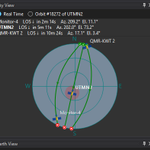
Well, it was easy to have #SkyRoof control my @CsnTechnologies controller to automatically track satellites. @amsat #haamradio


Randy retweeted

Ham Nation #633 A look at Pacificon, The Scratching Post K5K, AR Newsline, Ham it or Can it, ISS SSTV pics and the hosts get JTTY with it. Hosts: @Hoshnasi @K7AGE WB6NOA @K1DDN @1donwilbanks Sponsored by @IcomAmericaInc youtube.com/live/MkbOS4_EpOg…

This is amazing. Generate animated maps of your travels . Great for you SOTA and POTA trips. mapanimator.baldinger.se/ ##hamradio youtu.be/7CGv25f8JsA?is=42Hm…

10 meters up. Cool.

Felix Paez, EA4GQS reports that AMSAT-EA is launching UNNE-1B and HADES-L on SpaceX’s Transporter 18 mission.
#hamradio #Amsat
UNNE-1B (HADES-E2) is an improved version of UNNE-1, which is still awaiting launch from the UK with RFA. It implements our usual VHF-to-UHF FSK/FM repeater. The repeater will be active 24/7 once the satellite has been checked and commissioned.
The name UNNE-1 comes from Universidad Nebrija, a private university that has developed a small Arduino-based computer with a guessing game. More details about the game will be published by the university, and we will also add a link to it on our website.
The UNNE-1 frequencies are:
Uplink: 145.925 MHz FM (no subtone), FSK up to 2400 bps
Downlink: 436.888 MHz FM voice, FSK 200 bps
HADES-L has a different approach. As has happened to us several times, this has been a very quickly developed satellite, taking advantage of an available launch opportunity. HADES-L implements a 29 MHz USB to 436 MHz FM repeater. The main challenge with this satellite is that, due to the space occupied by the experiment it carries, it only has three solar panels, so power availability is a concern.
Because of this, the repeater is only active for 4 minutes every 12 minutes, and if the energy level is very low, it may remain switched off during some passes. Nevertheless, we think having an uplink in the 29 MHz band is very interesting.
The best way to know whether the repeater is active is to listen to the downlink for the typical FM noise. It is currently configured to activate automatically even without an uplink signal, to make operation easier. This configuration may be changed if circumstances require it.
The HADES-L frequencies are:
Uplink: 29.472 MHz USB (not 28.472 MHz; there was a typo in the first version of the document sent to IARU)
Downlink: 436.665 MHz FM voice, FSK telemetry at 800 bps
The HADES-L coordination request was sent to IARU rather late, but we expect to receive the coordination document in the coming days.
Software for both satellites is available here, thanks to Andy UZ7HO:
amsat-ea.org/proyectos/
Me too. Great @ARISS_Intl SSTV event. Lots of daytime passes. I got All 12 images. Thanks. @AMSAT #hamradio

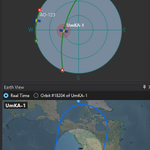
Sputnik’s 69th Anniversary UMKA RS-40s Broadcast
youtu.be/CJw6d6Z6MIE


I figured out how to save the images from the VGC app. These images are from yesterday, taken using the VGC VR-N76 and my arrow beam. I am getting more comfortable with the app. @Hoshnasi @AMSAT @ARISS_Intl #hamradio


I learned the if the squelch is open, the radio does not change frequency to track Doppler from the APP. One more pass outside today using the VGC N76 with their app. @Hoshnasi @AMSAT @AmsatUK #hamradio
I’m getting the VGC N76 Android app figured out. Does anyone know how this updates the satellite elements? #hamradio

