

I break down how one person + AI agents replace whole teams. Real setups. Real revenue. New breakdown every week
Earth
Joined May 2026
- Tweets1K
- Following137
- Followers511
- Likes1.4K







@Coldly retweeted
A man who spent twenty years pricing risk stood on a stage and told a room full of finance people that their edge was already gone. Not shrinking. Gone. Most of them had built a whole career on it.
His point was simple and it ruins your afternoon if you sit with it.
An edge in finance is just information other people do not have yet. The analyst who could build the model, read the filing, run the numbers faster than the desk next door — that speed was the edge. It was worth a salary because it was scarce.
Then he put six versions of the same thing on the screen. Midjourney V1 through V5.1. The first one can barely draw a face. The last one you cannot tell from a photograph. Three years between them.
That curve is not about pictures. That is the speed at which "hard to do" becomes "type a sentence."
The model that took an analyst a week now takes a prompt. DeepSeek did it for a fraction of the cost everyone assumed was required. Cursor writes the code the quant used to guard like a trade secret. The scarce skill went to zero, in public, for everyone at once.
Here is the part that should stop you.
An edge that everybody gets is not a smaller edge. It is not an edge at all. The moment the whole room can build the model, the model is worth what the electricity cost to run it.
This is the trap nobody on that stage wanted to say out loud. For thirty years the finance career was: learn the hard thing, get paid for the gap between you and the person who could not do it. AI did not shrink that gap. It deleted the far side of it.
So what is left, if the skill is free?
The same thing that was always underneath the skill and never got the credit. Knowing which question is worth asking. Knowing what the number means once the machine hands it to you. Judgement does not come out of a prompt, because a prompt cannot tell you what you should have wanted.
The analysts who survive this are not the ones who type fastest. Everyone types fast now.
They are the ones who already knew the model was never the job. The model was the ticket in. The job was deciding what to do with the answer, and that part never automated, because it was never a skill. It was taste.
The edge you trained for is public now. The edge you cannot download is the only one left.
Thirty minutes of a free conference talk. It has been sitting online the whole time, and the people who most needed to watch it were too busy defending the skill it just made worthless.


@Coldly retweeted
Jim Simons had never taken a finance class in his life walked into markets at forty and beat every professional on Wall Street for thirty years straight.
He could not have told you why a single one of his trades worked. That was the point. He built it that way on purpose.
He was not a trader. He was a geometer. In the 1960s he proved a theorem so deep that ten years later physicists picked it up and built part of modern physics on top of it. It still carries his name: the Chern–Simons theory.
Before Wall Street he broke enemy codes for the US government in a secret building in Princeton during Vietnam. Between assignments they let him spend half his time on his own math. He spent it on the shape of curved space.
Then he walked into finance knowing nothing about it, and did the one thing the textbooks swear is impossible.
The textbook is called the efficient market. It says the price already contains everything knowable, so nothing in the past can tell you the future. The price is always right.
He sat with decades of price data and said, plainly, that is just not true.
Not dramatically wrong. Subtly wrong. Commodities drift. Trends bend a little more one way than the other. No single crack big enough to matter, because if it were, someone would have already taken it.
So he did not look for one big edge. He collected hundreds of tiny ones. Anomalies too small to see alone, stacked until together they predicted, just barely, better than chance.
He hired no one from finance. He hired mathematicians, code-breakers, a physicist who had won the Nobel. People who had never bought a stock and did not care to.
The fund they built compounded 66% a year, before fees, from 1988 to 2018. Over $100 billion in trading profits, from around 300 people, none of them hired off Wall Street. No other fund in history has come close, and it closed itself to outside money because it did not need any.
Here is the part that should sit with you.
He had one rule, and it was not a formula. It was that no human is ever allowed to override the machine. Nobody walks in and says the computer wants to do something crazy, so we won't.
Most people hear that as discipline. It is not. It is logic.
The moment you let yourself override the system on a bad day, you no longer know what your system actually does. You only know what it did on the days you happened to leave it alone. The backtest that justified everything becomes meaningless, because it never accounted for the boss changing his mind.
So he removed the boss. Himself included.
The other rule was older and simpler. Do not run with the pack. If a thousand people are working on the same problem, a topologist who was never the fastest runner has almost no chance. Find a problem almost no one is working on, and the odds invert.
He never took a finance class. He walked into the most crowded game on earth and refused to play it where everyone else was standing.
Three hundred people. None from finance. More trading profit than most of the industry combined, from a man who refused to let any of them, or himself, touch the wheel.
Asked near the end of his life for his favorite number, he did not hesitate.
Seven. Next question.
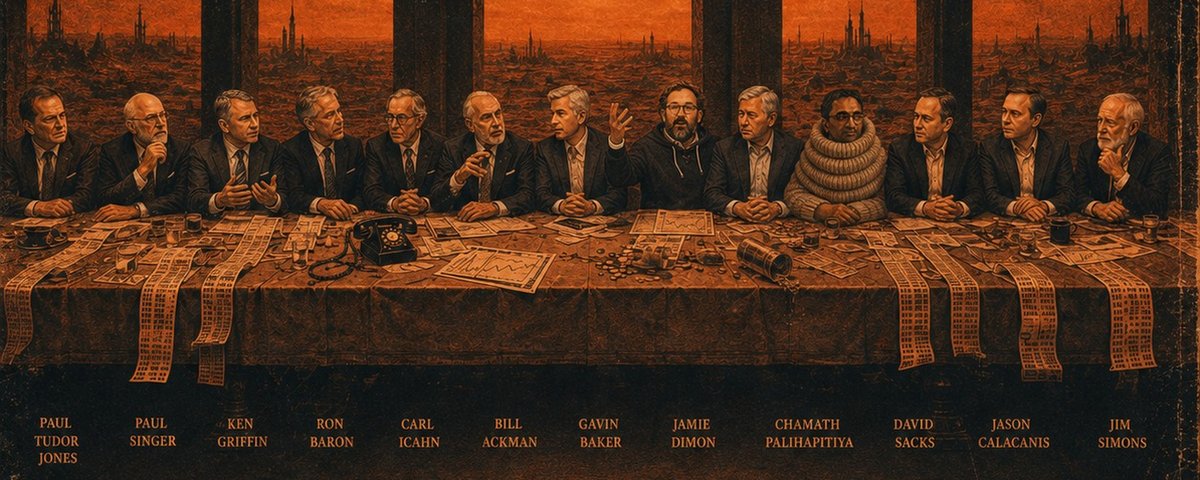
He died in 2024. Last week a breakdown of the twelve greatest investors alive and dead crossed 2.7 million views, and he was on it, number twelve, the only one who won by removing the human instead of trusting him.
But the whole method is not in some paid course. It is an hour of him at a desk, calm, explaining exactly how it worked. It has sat on YouTube the entire time, free, and almost no one who trades for a living has ever watched it to the end.

@Coldly retweeted
Anthropic will pay you $85,000 to learn AI with no degree and no experience.
Applications for the first group close July 17.
You don't apply with a résumé full of machine learning. You apply with nothing.
They teach you to build with Claude and Claude Code from zero.
Then they point you at the part nobody else is doing: helping nonprofits actually use AI - groups working on education, youth development, workforce access, community support.
Not another chatbot. Not a certificate. A year of getting paid to do work that reaches real people.
For two years the story was the same. AI money is for engineers. For founders. For people who already speak the language.
A 19-year-old without a CS degree read that and assumed the door was closed.
This is the company that makes the model saying the opposite. Come in with nothing. Leave with a year of building real things for real organizations.
The people who'll get these spots won't be the ones with the best GitHub.
They'll be the ones who applied before they felt ready.
The last gold rush paid the people who already owned the tools.
This one is paying people to learn how to hold them.


@Coldly retweeted
He bought a Mac Mini to run AI at home.
Two weeks later he had the Apple return page open and his cursor on the button.
Not because it broke.
Because it worked, and that somehow felt worse.
He'd just run the same prompt through two machines. ChatGPT in the cloud. Qwen3 on his desk.
"Give me 100 viral hooks. Human sounding. Create curiosity. Don't explain the whole thing."
The cloud version was sharper. He admits it.
But the local one - free, offline, no account - came back with lines like "I almost deleted this clip…
then it made me $14k"
"My ad budget last month: $0. My reach: 1.3M."
Not as good. Closer than it had any right to be.
That's the trap.
You buy the machine expecting magic. You get a slightly slower version of something you were already renting.
So you sit there with the return page open, doing the math on a box that cost more than the subscriptions it replaced.
That's where most people click "return."
That's where the story usually ends.
His didn't.
He kept it. And the thing that changed his mind had nothing to do with which model wrote better hooks.
It had to do with a question one of his clients asked three weeks later.
The machine was never the product.
The product was a question he hadn't been asked yet.

@Coldly retweeted
We gave the agents a million tokens of context.
They still drift.
I know because I can watch them do it.
My screen is a tiny office. Isometric, clean, the kind of room you'd see in The Sims. Six little figures on the floor. Each one an agent.
For the first fifteen steps the orange one moves with intent. Straight to the desk. Straight to the Kanban wall. Picks up SAMS-201 and gets to 72%.
Then green-agent stalls. 55%.
It doesn't crash. It just starts wandering. Back to a decision it made ten steps ago and undoes it. Wanders to a corner nobody pointed it to.
On the floor, drift has a body. You can see exactly where it lost the thread.
Here is the part nobody prices in.
A model doesn't read its context evenly. It reads the start. It reads the end. The middle it skims — even when it's built for long inputs.
So the room the agent can actually think in is far smaller than the floor I gave it.
And watch what the agent does all day. It accumulates. Every tool result, every note to self, every step gets appended.
In the office, you see it as clutter. The floor fills. More sticky notes on the wall, more tickets, more figures crossing paths.
The tokens climb in the corner. 12,840. Then more.
Every one of those is something the agent now has to step around to get to the thing that matters.
The window isn't holding the work.
The window is manufacturing the errors.
So I built the room to watch them work.
What I actually built was a map of what each agent is holding in its head right now. Who's standing where. What's on the wall behind them. What they walked past to get there.
Because that turned out to be the only question worth asking.
Not how big the floor is.
Of everything this agent knows — what should it be looking at on this exact step.
A bigger window doesn't answer that. It just hands the agent a bigger room to get lost in.
green-agent isn't stuck at 55% because it ran out of context.
It's stuck because it can't tell which corner of a full room to stand in.
The whole industry is still buying floor space.
It was never a space problem. It was always a standing-in-the-right-place problem.
The teams that see that will ship agents that finish the ticket.
Everyone else will ship agents that get to 55%.


@Coldly retweeted
The top AI skill of the last three years just became useless.
Not slowly. In one sentence.
Boris Cherny helped build Claude Code at Anthropic. He doesn't really prompt the model anymore.
His job is writing loops.
For three years everyone raced to get good at one thing. Writing the perfect prompt. The exact wording. The right examples. The phrasing that made the model behave.
You got good at it. You saved your best prompts in a notes file.
That file is now a typewriter manual.
Because prompting has one flaw nobody wanted to say out loud.
You are holding the agent's hand the entire time.
Type. Wait. Read. Correct. Type again. The whole thing runs through you.
You are the slow part.
So the skill changed shape.
The new one is loop engineering. A loop is a system that prompts the agent for you.
You give it one goal. It runs on its own. Finds the work, does it, checks it, repeats until done.
You stop typing into a chat box.
You start building the box that types.
But here is the part the hype videos skip.
A loop without a real check is not a loop. It is the agent agreeing with itself on repeat.
The model that did the work is a terrible judge of its own work. It is too generous.
Skip the check and you get what an engineer named the "Ralph Wiggum loop." The agent decides it's done too early, exits on a half-finished job, and the loop keeps running and spending while producing nothing.
It doesn't crash. It bills you in silence.
So there's one number that matters more than tokens spent or loops run.
Cost per accepted change.
If the loop hands you ten results and you throw away six, you're doing the review it was supposed to save. Below a 50% accept rate, it costs more than it gives back.
Strip it all down and it comes to one move.
- One agent writes.
- A second agent, stricter, checks.
- Neither of them is you.
The prompt was the skill when the human was still in the loop.
Loop engineering is the skill for when you're not.


@Coldly retweeted

🚨 Anthropic just showed a 24-minute workshop on how to actually do prompts for Claude.
Taught by the people who built it.
Free. No registration. No paywall.
I've seen $300 courses that don't cover what they teach in the first 8 minutes.
Watch it and bookmark it now.

