




Jovanny retweeted

I can go two hours building something before I start building the thing that builds the thing
All the AI game dev stuff on here got me wondering.
Do I want to try and make a game inspired by one of my favorite animes, Hajime No Ippo?
Nah. Wouldn't do it justice.
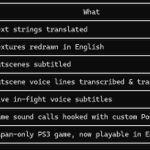
What if I can do a better translation of the Japanese only Hajime No Ippo: The Fighting! game?
While there's an English patch out there, it doesn't convert graphics or add English subs to the cutscenes.
Was able to convert a lot of the tutorial graphics and working on opening cutscene to the Best Match Mode.
This is going to be a very fun weekend.


Jovanny retweeted
I've been thinking about what a true, closed-loop software factory will look like.
One where agents know what to fix, what costs to optimize, and the big one: what features to actually build.
We're not there yet. But maybe we're getting close...

Jovanny retweeted

codebases have always contained slop. we have always been okay with this because code rarely needs to be perfect, outside of mission critical "hard" (eg embedded) software.
swe is a unique form of engineering because you're often building something that constantly evolves and is almost organic - user tastes change, your mental models evolve, and features come and go.
admittedly, i and many others who've been coding for a long time were initially (like back in 2024) skeptical that agents would write production code. "but what about all the slop that would enter our beautiful codebase?".
well, even before, we had human slop, and there was a lot of it! if we're being truthful, most people call "code i didn't write" slop. the reality is that 99% of people (i include myself in that number) don't even know what Good Code looks like, let alone be capable of writing it. i would propose that Good Code is:
• correct
• bug free
• fast and cost efficient to run
it has always been exceedingly difficult and expensive to write truly Good Code, because for the longest time (maybe @bendlang will change that), code was not something you could cheaply and formally guarantee to have all 3 of these properties. this is why writing hard software is much more difficult and expensive, because depending on the use case, you may only get one chance and so you have to be right from the start.
but the vast majority of software we use does not need to be Good Code to provide value to users. in fact, it is very likely that most software we use is not formally verifiable! we accepted some bugs in exchange for velocity and progress, so we rely on tests and o11y instead and have adopted a more incremental approach. this is a good thing!
agents help us move faster, and if you're open to the idea, are capable of helping us write better code. it won't be Good Code (that is still expensive), but it is likely to be much better on average at scale.
the new craft of swe is to figure out how to do this. it's your job now! if your productivity with and without agents is not significantly different, you're doing something wrong. but it's not too late to embrace it and use it as an opportunity to learn a whole new skill tree
Jovanny retweeted
i feel like swe interviews could probably collapse into just 2 technical rounds:
• system design (how well can you articulate your ideas, do you actually know how to engineer something)
• onsite project to build a real thing with agents (can you translate your intent into high quality outcomes)
everything else we used to ask is no longer necessary

🗞️ if your team is too busy doing their 'normal job' to experiment with AI, you're preparing them to be replaced
ghuntley.com/replaced/
In this post, I guess this's the last time I'll say it. AI use is no longer optional if you wish to be employed. What follows is advice for current employees and hiring managers on how to hire in 2026 to source AI-first candidates.


Jovanny retweeted

Introducing Guided Reviews: the better way to review a PR
A big diff is shown in file order, so you spend the first half hour jumping between files, working out what the PR does
Guided Reviews does that for you
- Overview shows the before vs after like a show-me. This way you understand what's changed on a high level
- Files are grouped into chapters, each explained in plain words so you review one idea at a time
- Only pay attention to what matters! The core change comes first. Database, tests and generated files come last

Plugins and guided reviews are here!
Capy 0.4.4
• Plugins from the Capy marketplace
• A guide on every reviewed PR
• Custom models on your own key
• Desktop threads without a project
• Fixes and improvements
capy.ai/changelog/0.4.4

Jovanny retweeted

Here's a deal with software factories. If what you're doing is just firing up a harness and chatting with it about changes to the code base and nothing else, with frontier models, you can get very far. Where things start to break now is the rest of the SDLC, and adding more structure into things like architecture, test coverage, adversarial review/testing (for things like accessibility,) and the rest of the pipeline to production.
All those things are inside the circle of the "software factory", and the reason to have one is so that you (and your team) can iterate together on making the process by which the agents create outcomes better.
Without it you're just sharing skills and hoping.
Notice I'm not telling you to use a particular shape, or a particular implementation - because, by definition, what works to create your software won't be what works to create mine (because they are different things).
If I was a magician, I probably would have just called it my "coding agent" or "software engineering agent" and moved on with our lives. But here we are, and I'm an old veteran scarred by the configuration management, cloud, and DevOps vocabulary wars. So I'll call it whatever y'all want. :)
Jovanny retweeted

We've always called it software engineering, but we've actually been builder...gineers.
In civil engineering, aerospace, or architecture, the people who do the engineering and the people who do the building are obviously different.
But in software, we collapsed them into the same role. With agents, we're finally separating the jobs.
We're going to specify and encode more upfront, add more guardrails, and design architectures that bias agents toward success.
In many ways, we're finally starting to look like actual engineers.

Jovanny retweeted
Here’s the truth about where the industry is at with AI adoption: most of it is awful, and most of us are suffering under the weight of it.
Early on, the bet was that the models are really smart and we will just chuck everything at them and let it sort it all out. This has largely led to incredibly wasteful, in-reproducible solutions - like huge skills and MCP, where the agent re-solves your problem a million times, getting it right some percentage often. Turns out it’s hard to get that to produce real value beyond individual experiences.
As engineers, we have struggled to get our heads around how to use these capabilities effectively. Is it the harness? An agent? A factory? A tool call? Maybe a skill? How about a dark factory! We need RAG! No, RAG sucks, we need… you get my point. Everyone needs to take a breath, and start thinking about this new capability as a component of your systems, rather than the substrate upon which your systems get rebuilt.
Meanwhile, coding agents got fucking fantastic. But for most of us, we changed nothing about our SDLC except that now we should be doing it all faster, because agents. That leads us to be stuck like a surfer in the chop - being responsible for everything but in control of nothing, with an avalanche of code nobody looked at when they wrote it, but that you’re responsible for ensuring doesn’t break the world.
Luckily, we can stop the madness spiral. Breathe. We can engineer our way out of this problem.
Are you working on how to use AI to improve your SDLC? If so, start by looking at how it works now, and using AI to automate it. Where in the process do you need intelligence? Is it there. How much do you need? Use that to decide your model. Encode the standards.
Swamp, and primitives like it, are a part of how you do that. They solve problems like how to break the problem down into reusable components, how to store data, how to build the contract between components, how to string them into workflows, and how to expose that to agents, ui, or whatever you want. The way out of the suffering is to turn our engineering brains back on, and start building in ways that enable and support the future.
Jovanny retweeted

My keynote at LDX3 New York, "The state of the tech industry in 2026". is out now. Timestamps:
00:00 Introduction
00:53 What changed
12:29 What's not changed
16:14 What broke
22:53 What’s next
And for notes + slides, see: newsletter.pragmaticengineer…
Hope it's useful!