

The National Tax Journal (NTJ) is the journal of the NTA and features high quality original research on govt governmental tax and expenditure policies.
Washington, DC
Joined March 2019
- Tweets463
- Following44
- Followers1K
- Likes11



New work in National Tax Journal:
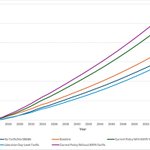
“Debts, Deficits, and Tariffs”
By @kpomerleau and @therealalimelad
@kpomerleau and @therealalimelad explore the long-term budgetary effects of the Trump Administration's tariffs.

They find that under plausible tariff and fiscal policy scenarios, federal debt as a share of GDP could range from 161 to 212 percent by 2056.
Read more here:doi.org/10.1086/742149

New work in the National Tax Journal:
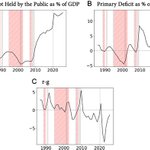
“The evolution of deficits in the United States and implications for debt sustainability”
By Jesse Bricker, William Peterman, and Rebecca Wasyk

Moreover, assuming current law holds, this debt ratio is projected to further increase to more than 150 percent over the next 30 years (CBO, 2025b).
Although there is not one definition of debt “sustainability,” many consider the current trajectory “unsustainable” (see, e.g., Dynan and Elmendorf, 2025; Edelberg, Harris, and Sheiner, 2025). Read more here: doi.org/10.1086/742262
New work in National Tax Journal:
“Grading Government: A Deficit Management Scorecard”
By Alan Auerbach and Danny Yagan

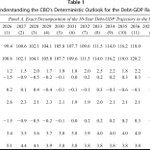
This paper proposes a deficit management “scorecard” that grades Congress’s recent behavior against the benchmark of past fiscally responsible Congresses and estimates the incremental year-by-year congressional action needed going forward to achieve fiscal sustainability.
Read more here: doi.org/10.1086/742158

Moreover, assuming current law holds, this debt ratio is projected to further increase to more than 150 percent over the next 30 years (CBO, 2025b).
Although there is not one definition of debt “sustainability,” many consider the current trajectory “unsustainable” (see, e.g., Dynan and Elmendorf, 2025; Edelberg, Harris, and Sheiner, 2025). Read more here: doi.org/10.1086/742262
New work in the National Tax Journal:
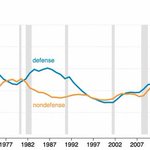
“The Federal Government’s Discretionary Spending”
By Karen Dynan, Doug Elmendorf, and Teri Gullo

In the US, both defense and nondefense discretionary spending as shares of GDP have remained roughly stable for several decades. If these patterns persist, they will produce federal deficits larger than official CBO projections by 2036 of roughly 1.5 percent of GDP.
Read more here: doi.org/10.1086/742302
New Work in the National Tax Journal:
"Assessment Regressivity and the Homestead Exemption"
By Daniel McMillen and Ruchi Singh

ALT Figure 3. Homestead exemption and effective tax rate with Suits index = 0.
However, a long-standing tendency toward higher assessment rates for low-priced homes commonly leads to a regressive tax structure.
Read more here: doi.org/10.1086/740783
