

From the mysteries of Ancient civilizations to the frontiers of space. Analyzing global affairs through a historical lens. Community liaison, Kaishan.
The African Savannahs.
Joined April 2021
- Tweets14.5K
- Following3.5K
- Followers726
- Likes15.9K





Joe Tubula retweeted

This week, a supermoon will bring a little extra magic to the night sky.
A supermoon occurs when a full Moon coincides with the Moon's closest approach to Earth in its elliptical orbit. The result? A full Moon that appears slightly larger and brighter than usual. Enjoy the view!

ALT A large, full Moon glows against the black night sky behind NASA’s Artemis II Space Launch System (SLS) rocket and Orion spacecraft. The rocket stands vertically in the foreground, partially obscuring the Moon, with the launch tower and Artemis logo visible to the right. Photographed Feb. 1, 2026, at Launch Complex 39B at NASA’s Kennedy Space Center in Florida. Credit: NASA/John Kraus.
Joe Tubula retweeted

We're on our way to explore the mysteries of Europa, an ocean world that could support life.
Take a behind-the-scenes look at the mission that's making it possible. Our new documentary, The Europa Concept, is now on NASA+: plus.nasa.gov/video/the-euro…
As a community liaison, I meet people almost daily crying for jobs—some even desperate enough to offer bribes. I feel their pain every time, though positions are limited. To everyone going through this rough patch of life, may God see you through!
2
Joe Tubula retweeted

63 years ago today, John Fitzgerald Kennedy, the 35th President of the United States, was assassinated. We remember JFK, a pioneer of justice, and supporter of Israel.

One special thing about Leona Lewis music: they never age.
youtu.be/sxbX-z5-QHs?si=CYXl…
20
Just to let you know: The kaishan project is now on construction phase, with administration block set to be completed in coming months. The next stage will involve the construction of green amonia fertilizer plant & the 165 MW of geothermal project.

Kenya has launched a KSh103B green ammonia fertilizer project in Naivasha, led by Kaishan Group and KenGen.
The plant will produce 480,000 tonnes a year using 165MW of geothermal power, reducing reliance on imported fertilizer and stabilizing prices.
It is set to create 2,000 jobs during construction and generate KSh1.7B in annual profit for KenGen while cutting emissions.

4
Joe Tubula retweeted

After an eight-year journey through the inner Solar System, a spacecraft called BepiColombo is approaching Mercury. It will investigate the secrets of other planets - like how some so close to the Sun can have ice on them. 🚀🌑
🎧The science of water around our planetary system bbc.in/4AF0fFt
Joe Tubula retweeted

Einstein published the paper behind E = mc² when he was 26 years old on this day in 1905.


If it's not an emergency call, I think it's should be made illegal to call someone past midnight hour.
9
I normally find myself in being odd in many ways. I sit or walk along with friends whose main agenda is discussing gossip, politics, celebrity trends, but all I want is switch topic and start discussing buffaloes, hyenas and space.
8


Joe Tubula retweeted

Just 34 minutes before its cameras were turned off in 1990, Voyager 1 captured this iconic view of Earth – a pale blue dot in the vastness of space.
Today, Voyager 1 is one light-day away from Earth. A little piece of our planet journeying through interstellar space. 🌎💙

ALT Earth is seen in the vastness of space as a single, bright blue dot in the middle of a fuzzy, white sun ray. Other rays of light are scattered across the image. Credit: NASA
People's management is one of the most difficult jobs in the world. Besides draining one mentally, it's one of the most time consuming thing. I spend half a day nowadays just resolving people's conflicts, listening to griviances, before you going on with my personal business.
9
Joe Tubula retweeted

After traveling for 50 years at ~38,000mph, Voyager 1 is now officially one light-day away from Earth.
That’s .064% of the distance to the nearest star. After 50 years at 50x the speed of sound.
Space is big.
Jupiter, Saturn and Io: the first celestial bodies ever visited by Voyager 1. Ever cruising at 60000 km/hr since she entered interstellar space in 2012.

1
13
Joe Tubula retweeted
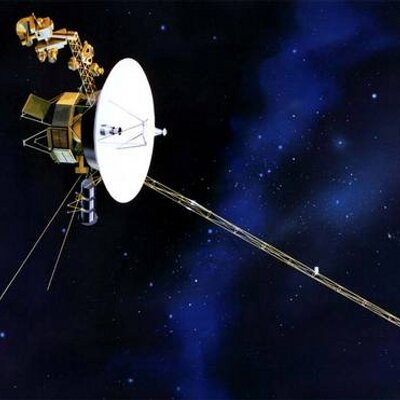
Sister ship Voyager 1 is currently ~24h 00m 00s of light travel time from Earth, or 25,902,000,000 km / 16,095,000,000 mi / 173.145 AU (2026:322:120000:1L) ONE LIGHT-DAY from Earth! …
Joe Tubula retweeted

Voyager 1 is the first human-made object to reach one light-day from Earth.
A light day is the distance light covers in 24 hours (25.9 billion km).
It has travelled for 49 years at ~61,000 km/h relative to the Sun. A car at 80 km/h would take 37,000 years to reach that point!

