

A Hyper-Boutique Law Firm. Sports, Tech, & Entertainment Law. Consigliere to Athletes, Founders, & Creators. // Email: hello@jocurlegal.com
Miami, FL
Joined February 2022
- Tweets271
- Following106
- Followers131
- Likes506




Pinned Tweet
Posts on this account are commentary and analysis — not legal advice. No attorney-client relationship is formed by reading, replying to, or DMing about them.
If you’re dealing with an NCAA eligibility or other issue and want actual counsel, reach out: hello@jocurlegal.com
JOCUR LEGAL retweeted

ESPN is committing nearly $1.7 billion to college football, and we’re still supposed to believe the players are the ones ruining the sport because they want to get paid?
The networks negotiate billion-dollar deals. The conferences chase revenue. The universities maximize their financial interests.
But when a 20-year-old exercises that same economic freedom, suddenly we’re concerned about the integrity of college athletics.

Breaking: The College Football Playoff and ESPN have signed a five-year, nearly $1.7 billion deal that will expand the field to 24 teams in 2027 with ESPN as its continued broadcast partner, sources told @CFBHeather.

JOCUR LEGAL retweeted
A 24-team College Football Playoff means more games, more revenue, and more injury exposure for players.
Yet somehow we’re still debating whether these same players should have the freedom to transfer or maximize their earnings.
The conferences, networks, and institutions are free to make decisions that generate billions of dollars, but when players exercise that same freedom, suddenly it’s ruining college football.
You cannot continue to commercialize the sport while expecting the people responsible for the product to operate under some romanticized notion of amateurism.
There is no college football without the players.


JOCUR LEGAL retweeted

One potential change being discussed by SEC officials this week at meetings is a template for a league-wide player contracts, per ESPN sources, in which parts are standardized and parts are custom for the school.


Proud to announce that our client Ben Osueke has been granted a temporary injunction against the NCAA.
JOCUR LEGAL retweeted

The Protect College Sports Act would have major implications for college athletes.
Athletes.org published seven reasons to oppose the PCSA, including concerns over athlete compensation and institutional control.
Full story: athletes.org/news/pcsa-seven…

JOCUR LEGAL retweeted
A lot of the current debate around college football starts with the same question: have players been given too much power? NIL. The transfer portal. Eligibility litigation. Revenue sharing. More mobility. More money. More control. But that framing ignores the history.
For decades, the power imbalance ran overwhelmingly in the other direction. A new coaching staff could arrive and change a player's career overnight — new system, new recruiting relationships, new personnel preferences. Players the staff didn't recruit could quickly find themselves buried on the depth chart or pushed toward the door. That was accepted as "part of the business." The coach had leverage. The institution had leverage. The athlete often had very little.
Now that players have clawed some of that leverage back, everyone seems uncomfortable with player power. That doesn't mean every transfer is wise, every demand is reasonable, or every eligibility lawsuit has merit. It does mean we should be honest about the shift — and we should be asking harder questions about coaches.
If college athletics is still about education and development, then coaches can't be judged only by recruiting, scheme, and wins. Can they lead young people? How do they treat players they didn't recruit? How do they handle injured players, or players who no longer help them win? Do they develop people, or only talent?
Nick Saban is often held up as the standard because his impact extended beyond football. We should study those stories. We should also study the opposite ones. Because if coaches are entrusted with young athletes during some of the most formative years of their lives, leadership isn't a bonus — it's part of the job.
College sports spends a lot of time debating what athletes owe the system. We should spend more time asking what the adults running that system owe them.
JOCUR LEGAL retweeted

“Justice was served like a cold cup of gumbo, and the judge forced them to eat it.” - only in Louisiana
JOCUR LEGAL retweeted

"It is a truly surreal scene."
@PeteThamel details the latest on the SEC suing LSU and Lane Kiffin in federal court ✍️
JOCUR LEGAL retweeted
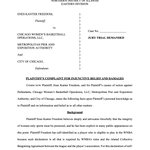
Enes Kanter Freedom has filed a federal complaint against the City of Chicago, the Metropolitan Pier and Exposition Authority, and the Chicago Sky's ownership entity, alleging that his ejection from an August 23 game and subsequent indefinite ban from Wintrust Arena constitute First Amendment retaliation and viewpoint discrimination under 42 U.S.C. § 1983.
Plaintiff's own complaint sets the governing standard: restrictions on speech in a nonpublic forum are permissible where "reasonable and not an effort to suppress expression merely because public officials disagree with the speaker's viewpoint." Perry Educ. Ass'n v. Perry Local Educators' Ass'n, 460 U.S. 37 (1983).
Applying that standard to the pleaded facts: the conduct at issue is Plaintiff leaving his seat and approaching the court to confront a player during live play, not the content of his shirt or his public statements. The response — removal by three independent security entities acting on the same real-time assessment — was directed at that conduct and applied without reference to viewpoint. A content-neutral security response to a spectator approaching the playing surface during a game is the type of reasonable, viewpoint-neutral restriction the very case law cited in Plaintiff's own complaint contemplates.
Plaintiff frames this as punishment for a T-shirt. The complaint conveniently omits that Plaintiff left his seat, approached the court, and verbally confronted a player mid-game. A shirt is speech. Charging the floor during play is a security matter. We expect Defendants’ motion to dismiss to make that distinction for them.

🚨SEE YOU IN COURT!!!
Just filed a federal complaint.
I’m taking legal action over my ejection from the @chicagosky game while peacefully exercising my First Amendment rights.
My T-shirt did what the whole @WNBA apparently couldn’t: define a woman.
No threats. No violence. Just biology.
And somehow, that required a security escort.
You don’t have to agree with my speech but you don’t get to silence me for it.
I will not be intimidated.
I will not be silenced.
I will continue to stand for women and defend free speech.


State courts continue to reach divergent conclusions concerning the NCAA’s Class-of-2022 transition rule. On September 2, 2026, a Missouri court declined to dismiss Sterling Webb’s action or dissolve the TRO permitting him to play a fifth season for Missouri.
The ruling preserves Webb’s interim eligibility without resolving the merits or protecting other athletes. Notably, the TRO also shields institutions from NCAA penalties—confirming that relief must protect both the athlete and the school to have practical roster value.
The NCAA’s shift to a five-season eligibility model continues to produce conflicting state-court results. On September 2, 2026, a Kentucky court extended its existing TRO to 25 additional athletes, including Louisville’s Seth Trimble and Kentucky’s Alex Afari Jr.
The relief is temporary, plaintiff-specific and does not establish class-wide eligibility or bind the SEC. Afari’s NFL activity was limited to a Packers tryout, underscoring why counsel must distinguish draft entry, tryouts, roster status and signed contracts.
JOCUR LEGAL retweeted
The NCAA spent a decade fighting NIL in court and losing every time before “student-athlete voices” became the talking point. Convenient timing for an antitrust exemption.
O’Bannon, Alston, the House settlement — same outcome every time: NCAA loses, gets forced to give athletes more. Now it wants Congress to hand over the antitrust shield it couldn’t win in front of a judge, dressed up as gratitude to the athletes it spent that whole decade fighting.
NCAA Eligibility Litigation Update — Missouri
A St. Louis County court granted a temporary restraining order permitting a former Missouri defensive lineman to compete in 2026, crediting his argument that the NCAA’s age-based eligibility model excludes his cohort without a principled basis. The Court declined to stay the order pending the NCAA’s appeal.
The ruling adds to a growing body of state-court authority reaching individualized results under the same core theory — reinforcing that even a favorable ruling for one athlete turns on that athlete’s specific enrollment timeline and competition history.
NCAA Eligibility Litigation Update — South Carolina
A South Carolina court has denied temporary relief to eighteen Class-of-2022 athletes, finding the plaintiffs failed to establish irreparable harm. The Court also questioned its jurisdiction over out-of-state plaintiffs lacking any South Carolina residency, enrollment, or competitive nexus — a narrower holding than a wholesale jurisdictional bar.
The case proceeds for plaintiffs with a cognizable South Carolina connection, and the ruling is a useful data point for defense counsel on the limits of forum shopping in multi-plaintiff eligibility suits.