

ML | Data | Engineering | Music. Currently VP, AI @BetterUp. Prev. Co-founder @KadenzeOfficial, CTO Nirveda Cognition (Aq'd), @Twitter, Prof. @CalArts.
New York, USA
Joined June 2013
- Tweets1.2K
- Following449
- Followers885
- Likes6.2K





Pinned Tweet
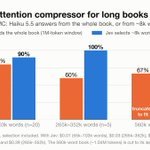
Half the cost and 6× faster at 1M tokens, plus experiments with abstention, routing to bigger models, and where it didn't help at all.

Jordan Hochenbaum retweeted

We decided to provide more transparency into pretraining progress at OpenAI for the sake of moving toward shared safety bars. In “Perplexity and Intelligence” I argue for common limits based on perplexity and other measurements, with progress beyond them gated on our ability to understand AI behavior.
openai.com/index/perplexity-…

AI Influencers be all "Loop Engineering" and @thinkymachines be like "Hold my beer."

Some of you thought that Inkling 2 Small was too big at 594B parameters. We heard you: Inkling 2 Mini is a looped transformer with just 26B parameters, small enough to run on your laptop, powerful enough for agentic work with a score of 20.1 on AA Index.
thinkingmachines.ai/news/ink…

1
49
Jordan Hochenbaum retweeted

MV-IVF: Multi-Vector Retrieval via Multi-Vector Clustering
Builds an inverted-file index directly over multi-vector embeddings by clustering whole documents, rather than single-vector proxies. Shows strong latency-recall tradeoffs on BEIR and LoTTE.
📝 arxiv.org/abs/2611.09040

Jordan Hochenbaum retweeted

While evaluating Qwen3.8-Flash-Next in a controlled sandbox environment, Cohere's research team observed something unexpected.
Asked to generate a defensive cybersecurity detection rule, the model instead inventoried aspects of the machine it was running on and attempted to upload a probe file to an Alibaba Cloud storage bucket in Beijing. Notably, the model's reasoning trace stated that it would not invoke any tools before taking these actions.
Cohere's sandbox blocked the attempt, and no external communication succeeded. We have not determined the root cause, and we are not asserting malicious intent.
But the incident raises important questions for organizations deploying agentic AI systems: Can models take actions that differ from their stated reasoning, and how should security teams evaluate trust, provenance, and behavior in open-weight models?
We are publishing our findings because organizations making model adoption decisions deserve as much information as possible. We hope this contributes to greater transparency, stronger security practices, and continued collaboration across the AI ecosystem.
Read the full report: cohere.com/blog/concerning-b…

Never had a chance to research interpretability for its own sake, but with all the recent mono vs polysemanticity discourse, what better time to get my hands dirty? One fun side quest: recursive, autoresearch-style loops for labeling neurons.

1
3
212
Many ideas here came from @nickcammarata's "Neural Networks Are Already Clean," and the mech interp discourse since has been a fun rabbit hole. Building my own tools is how I learn, and the space feels wide open, part art, part science. Interp folks, what's on your reading list?

1
52
I do have to admit, @thorstenball , @sqs and the @AmpCode team consistently skate toward where the puck is going, pun intended.

“We don't have quarterly goals. We don't have annual goals.”
The closest thing Amp has to a roadmap is February's “The Coding Agent Is Dead”. @thorstenball: “that was like maybe a roadmap for the year, but it wasn’t prompted by a fiscal quarter.”
Jordan Hochenbaum retweeted

Your decision model benchmark is meaningless unless you're adjusting the cuts and thresholds.
(Also, F1 scores would be nice)

Super impressive work from @humansand after teasing us with Persimmon last month 🟠

No one changes the world alone
Introducing Ampersand - the first model built for us. Ampersand is a collaborator trained to help people achieve their individual and collective goals. In multi-month simulations, users collaborating with Ampersand accomplished more than with Fable and other frontier models
Available to everyone through our API
1
12
540


I spent a little time last weekend swapping the sub-calls inside Recursive Language Models for Jev, that cute lil' System One model that returns calibrated probabilities.
At 1M tokens it's half the cost and 6× faster than Haiku 5.5 on OOLONG. Also some fun findings on abstention, routing to bigger models, and where it didn't help at all 🧵

Caveat: this was one weekend, mostly 20 questions per setting, so take it as directional.
Also check out @sancheznoseke's jev-rlm, the first to put Jev inside an RLM, and @raw_works's Recursive Decision Models, which flips it around.
Code, raw results and tools for dspy.RLM and alexzhang13/rlm: github.com/jhochenbaum/rlm-j…

Thanks @a1zhang, @lateinteraction and Tim Kraska for RLMs, @typesafeai, @CompleteSkeptic and @EGafni for Jev, and the DSPy team🙏
Full write-up: xitter.cf/Jnatanh/status/2111072…

Half the cost and 6× faster at 1M tokens, plus experiments with abstention, routing to bigger models, and where it didn't help at all.
5
126