

Digital Marketing Executive and Entrepreneur
Joined October 2025
- Tweets114
- Following22
- Followers1.8K
- Likes0





Content structure has never been more important.
Schema, heading alignments, list sections, you name it.
Check out the illustration below to see just how important content structure is to AI.
Basically, the cleaner the structure, the easier it is for AI systems to lift and reuse your content.
Structure has always been important. This isn’t earth-shattering news.
But optimizing content is no longer done purely for the sake of the reader.
Content optimization now serves a dual purpose.
Overlooking this is becoming that much more detrimental to the results you’re looking for.
Because if your content isn’t easy to parse, AI will simply move on to someone else’s.

1
3
321
If you want GEO & SEO tips sent straight to your inbox, join our newsletter here: opascope.beehiiv.com/

2
180
This chart excites me every time I see it.
AI traffic has grown 9.7x from June 2024 to June 2025.
I’m certain that this trend hasn’t slowed down either.
This is particularly exciting for me because it feels like the early days of SEO.
I started my SEO career in 2007. At that point, not many brands were leveraging SEO, and those who were reaped the rewards like no other.
The same opportunity is here again. Just in a different form.

1
2
156
Only 16% of LLM citations come from the top 100 domains.
Whereas 84% of citations come from 148,000+ other domains.
Demonstrating once again that LLMs value relevancy over page authority.
There is no “page one” to win, which is honestly quite refreshing.

1
1
168
LLMs value freshness.
But that doesn’t mean you need to write completely new content every week.
Refreshing older content the right way often beats writing from scratch.
Updates get crawled faster, you keep the authority you already earned, and the overall process is more cost and time-effective.
And in many cases, a well-refreshed page will outperform a brand new one because it builds on existing signals instead of starting from zero.
If you were initially concerned that LLMs value freshness, don’t worry.
Refreshing isn’t difficult.
This has been keeping me up at night recently.
Right now… everything on the internet is mostly API-based.
Services like Shopify require technical API integrations for tools like ChatGPT to interact with them.
However, in the near future, AI agents may interact with websites directly like humans, removing the need for complex APIs to even exist in the first place.
The implications behind this are profound.
If someone wants to buy, let’s say, a new TV, they could get an AI agent to…
Search for the best TV.
Compare options across multiple stores.
Check the user’s existing accounts.
Complete the purchase.
Schedule delivery.
Book installation.
Check the user’s calendar for when they’re available for the installation.
How exactly will this impact eCom brands? Hard to know exactly.
But there’s a world where most of the traffic that lands on your website isn’t even human; it’s simply AI agents shopping on behalf of someone else.
There could be an entire A to Z interaction where the customer never sees your website, ads, checkout page, or anything at all.
The copy on your website will be written for agents AND people.
This might just be the tip of the iceberg. Who knows what else will change.
1
3
596
If you want GEO & SEO tips sent straight to your inbox, join our newsletter here: opascope.beehiiv.com/
505
GPT already thinks Brooks Brothers is for 50-year-olds, and that’s a visibility problem.
Here’s how they can reposition themselves to win millennials in AI search.
1
2
439
If you want GEO & SEO tips sent straight to your inbox, join our newsletter here: opascope.beehiiv.com/
208
I was asked to audit Brooks Brothers to identify areas of improvement.
I found that LLMs think they are suits for older people, but their strategy is try to expand into a younger audience. However, their content isn’t doing that.
Right now, AI sees Brooks Brothers as “Father of the Bride” energy, but is that the whole story?
If they want millennials, they need to teach the LLMs that their suits aren’t just for 50 year old bankers.
1
4
413
If you want GEO & SEO tips sent straight to your inbox, join our newsletter here: opascope.beehiiv.com/
222
Great findings here by Ahrefs.
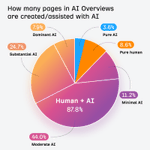
They tested with a sample size of 1.9 million URLs associated with AI overviews.
Here’s what they found:
3.6% of pages cited in AI Overviews were categorized as “pure AI.”
8.6% were categorized as “pure human.”
87.8% were categorized as a mix of two.
Of the ones that were a mix of both human and AI:
11.2% showed minimal AI use (1-10% of the page content was categorized as AI)
44% showed moderate AI use (11-40%)
24.7% showed substantial AI use (41%-70%)
7.9% showed dominant AI use (71%-99%)
The pie chart below provides a better visual of their test.
Extremely interesting findings.
Not necessarily that people are creating content with AI, but that AI-generated content is cited more than human writing by a sizeable margin.
So don’t be afraid to use AI to help your brand create content for you, just make sure it is good content and valuable to your customers and clients.

1
3
314
If you want GEO & SEO tips sent straight to your inbox, join our newsletter here: opascope.beehiiv.com/
178
Are you losing site authority by getting rid of pages?
Here is how to check using AHREFs and determine if you want to try to do something else than leaving a 404 page.
2
213
AI will eventually power 30–70% of your life.
Like the iPhone or the shift from film to digital, adoption will feel gradual… until suddenly it isn’t.
The real risk is here is underestimating how fast everything changes.
By the end of 2026, we’ll probably look back and realize it moved faster than we imagined.
3
450
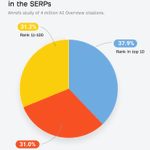
Here’s a great illustration that all AIO/AEO enthusiasts should look at.
According to Ahref’s updated 2026 analysis on AI overviews, they discovered that 37.9% of AIO citations rank in the top 10 of SERPs.
At first, you’d think that ranking in SERPs is practically mandatory, until you analyze the following pie chart of data.
Beyond the 37.9% in the top 10 SERPs, the remaining citations were almost evenly split between positions 11–100 at 31.2% and beyond the top 100 SERP rankings at 31.0%.
(Note: combined percentages slightly exceed 100% due to rounding.)
What’s interesting about this study is that with traditional SEO, the drop-off in traffic from the top SERPs is quite dramatic.
Whereas with AIO, ranking well in SERPs is obviously a leg up, but ranking outside the top 100 doesn’t rule out the possibility of getting citation clicks.
But perhaps most interesting of all, Ahrefs conducted this study last year, with dramatically different results.
Last July, they derived that 76% of AI Overview citations pull from the top 10 pages.
Compared to now, we sit at 37.9%.
This means that Google is selecting far fewer pages straight from the original SERP.

1
327
LLMs aren’t looking for more information… they’re looking for resolutions and answers to your questions.
If your content doesn’t outline decision factors, options, and follow-up questions, you won’t get picked.
1
170
SEO gets you ranked, but AEO gets you quoted…
Although fewer people will complete the full decision-making journey directly on your website, the ultimate goal remains the same: driving them to buy your products or services.
Done correctly, AEO increases the odds your brand becomes part of the AI’s answer, changing the user’s perception long before they ever reach your site.
Think about it this way: Google has become part of people’s lives as its proven to be useful over a long period of time.
Since Google’s proven useful, when people see your website in the SERPS, they associate it with being useful by extension.
The same thing is happening with LLMs today. People find LLMs useful for finding the truth, and if your content is quoted as the truth, you benefit when a percentage of that traffic clicks deeper to your page.
History doesn’t repeat, it rhymes. That’s exactly what’s happening now.
1
127
Claude, ChatGPT, and Gemini aren’t playing the same game.
One may be choosing the professional lane (and a completely different revenue model).
3
293
Your #33 ranked article can outrank the top 3… if you write this one thing right.
In an answer-engine world, your meta description is a 165-character pitch to the LLM explaining exactly what it will learn if it clicks.
Drop the marketing speak, list the real decision factors, and you can win the citation, even from the bottom of page one.