

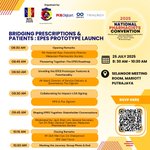


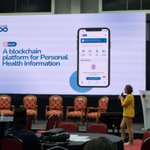


To Pharmacists, we will be showcasing the prototype for the Electronic Prescription Exchange System. Blockhain used for traceability. Come and meet us. Would love to hear your thoughts.

119
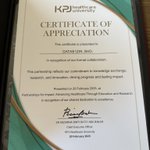
This arrived yesterday. R&D partnership with KPJU, KPJ D’sara, D’sara 2, Ampang & Tawakal for the development of AI for insulin titration for T2 diabetes. It’s still WIP.


2
4
432

In solidarity with Mesolitica
@khalilhimura @huseinzol05
Keep at it, as we always do 💪🏻


This

Many Big Tech players have tried to “disrupt” healthcare over the years:
→ Google tried to build a personal health record (later shut down).
→ Microsoft also tried to build a personal health record (also later shut down).
→ IBM Watson tried to build AI-powered clinical decision making tools (later sold off parts of the business)
→ Amazon tried to team up with JP Morgan Chase and Berkshire Hathaway to… I really don’t know. Although, to give them credit, Amazon’s come the closest with Amazon One Medical, Pharmacy and other initiatives still in place.
You can have all the resources in the world - billions of dollars, the brightest technology minds - and still struggle to build a solution that achieves adoption by patients and providers AND meaningfully improves health outcomes.
Because it’s not 1% idea + 99% execution as you’d expect in most tech companies.
It’s 10x harder in healthcare… it’s 0.1% idea + 99.9% execution.
This is why you see so many tech companies re-inventing the wheel in Healthcare:
“How has nobody built X tech product before?”
Until the innovator realizes it’s 10x harder because it wasn’t the tech that was the biggest barrier.
Most likely someone HAD built it before… but they couldn’t figure out everything else beyond the tech.
What this underlines is that in Health Tech:
→ Technology is necessary but not sufficient. People and Process often matter more.
→ We can’t “Technology” our way out of the biggest challenges in healthcare
The companies that win will be those that choose to:
→ Embed evidence-based clinical content, workflows and approaches into the Technology
→ Deeply understand day to day clinical workflows and needs of patients/providers
→ Build within the current reality of reimbursement models and economic incentives (while still advocating for a better future)
→ Be co-drivers (not passengers) for building more and more clinical evidence
I don’t know if most technologists have the patience, resilience and stomach to invest beyond the Tech to make it work.
You probably won’t be able to build the next trillion dollar company in healthcare - at least if your focus is on helping providers care for patients.
And if you’re a Big Tech company, building in healthcare certainly won’t move their bottom line as trillion dollar market cap companies.
So why would they care?
If it’s gotta be 0.1% idea and 99.9% execution… then you gotta be a little crazy and incredibly resilient to do it.
Hats off to the crazies.

1
113


Sharing our experience in R&D-ing & commercialising healthcare solutions with physicians from HUSM. Thank you @kamarul_imran for having us yesterday. Much appreciated.

1
2
96


Thank you KPJU for highlighting our collaboration on GULA-AI. It’s an important solution to provide equitable access to healthcare for type 2 diabetic patients who have to administer their own insulin titration.
instagram.com/p/C6srjvstgKt/…
114


#KL20 gotta be real to turn pipe dream into a reality.

Of Ecosystems, hubs and innovation district
1. I am excited about data centers and semiconductor manufacturing investments recently. Companies are investing and building productive capacities here, because we are located in the middle of a venn diagram - accessible to both US and China, relatively cheap talent and investors friendly.
2. But these investments do not in itself, generate innovation in areas that we want innovation to happen.
3. There was also announcement about KL20 on tech, VC and startups, without being specific about KL. We have a few govt VCs with very small dry powder. Maybe they spend more in salary than deployment. But, I digressed.
4. The brookings Institute defined innovation district as "geographic areas where leading-edge anchor institutions and companies cluster and connect with startups, business incubators and accelerators".
5. These places should be "physically compact, transit accessible and wired with mixed-use housing, office and retail." It should be a nice place to live.
6. Richard Florida suggested creative class consisting 2 groups of people:
a. Supercreative core-> that fully engage in creative process (in media, arts, tech, science and research)
b. Creative profession -> the usual techbros, engineers, doctors and lawyers. This group should form about 20-30% of our workforce.
7. Career-wise, I sit at the intersection of tech, economic policy and real estate. Hence my interest in this space. But, just like Malaysia, I am not exactly the best in each circle, eventhough I am probably among a few sitting at the center of this venn diagram.
8. There are a few points i want to make.
8.1 We need a vision and intention as innovation district. We have to put a sense of the place, people and tech in KL20. Creative Cultural City should be the base. Affordable and improving liveability will attract talent.
8.2 We need more interactions between the supercreative core beyond yearly large meetings. A bunch of techbros with coding skills does not make a VC deal pipeline. If Institute of Medical Research (IMR), Jalan Pahang does not employ tech startups or researchers and have never interacted with Cradle on Jalan Raja Laut, which is 3-4 blocks to its west, we have no deal pipelines. If Xeraya cant find medical researchers while having Along Haikal sambal pedas berapi, we have no deal pipeline. If the innovation from IMR are not deployed on pilot at HKL, we have no deal pipeline. We have pipe dreams.
8.3 Interaction happens when we cultivate a vibrant community with a sense of place. Currently we have enough physical space in KL and it is cheap. As Jane Jacobs famously said that “new ideas need old buildings". My point is, we dont need another building. We just need some place and a lot of space for these.
8.4 Medici Effect. We need an environment with a high density of talent and divergent thinking. An environment where we can be surrounded by other big thinkers and ambitious minds.


314