





The equity positioning gap between discretionary money managers and computer-driven funds using systematic strategies is now the second-widest since 2020, Deutsche Bank AG data show bloomberg.com/news/articles/…

The S&P 500 Index hasn’t posted a 1% decline in 53 trading sessions through Tuesday, marking the longest such stretch since January 2020, data compiled by Bloomberg show. $SPX has also now gone 89 sessions without a drop of at least 2% — its second-longest stretch in a year.

The S&P 500 hasn’t suffered a 1% decline in 52 sessions through Monday — tied for its longest stretch since July 2024, according to data compiled by Bloomberg. If the equities benchmark goes 53 sessions without a 1% drop, it would mark the longest such stretch since January 2020.

On Wednesday, the S&P 500 Index’s $SPX streak without a 1% decline reached 49 sessions, its longest stretch since July 2024, according to data compiled by Bloomberg.

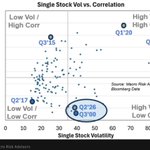
The gap between index-wide calm and single-stock volatility is nothing new for traders, but lately it’s grown extreme, reaching the widest level since 2000, data compiled by Macro Risk Advisors show bloomberg.com/news/articles/…


Jessica Menton retweeted

Investors have "added $22 billion into technology-focused US exchange-traded funds this quarter, compared with $4.6 billion into the rest of the market"
@JessicaMenton

$SPX dropped 0.4% on Wednesday, its sixth straight decline following a Federal Reserve interest-rate decision. That’s the longest stretch of losses since 2018, when the equities benchmark posted declines for seven consecutive policy decision days, data compiled by Bloomberg show.


$SPX earnings in the first half of 2026 are expected to reach 28%, the highest rate for a January-June period since 2004, excluding the rebounds after the pandemic and the GFC, according to data compiled by Wendy Soong, a BI equity strategy analyst bloomberg.com/news/articles/…


Options traders appeared to be getting ready for volatility even before Tuesday’s drop. Take open interest in VIX call options relative to puts, a ratio that climbed to its highest level of the year in a sign of increased demand for downside SPX protection
bloomberg.com/news/articles/…

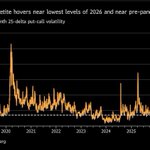
The cost of insurance against a 10% drop in the S&P 500 Index in the next month touched the lowest level in more than a year relative to contracts that profit from a similarly sized rally, options-market data compiled by Bloomberg show. bloomberg.com/news/articles/…


One-month skew, a measure of demand for options to protect against a drop in the S&P 500, has climbed from the lowest in a year to a 72nd percentile of observations, according to data compiled by Mandy Xu, head of derivatives market intelligence at Cboe bloomberg.com/news/articles/…


Traders nervous about a further drop in US stocks in the coming weeks are loading up on downside protection bloomberg.com/news/articles/…

After rising 1.1% early in the day, $SPX reversed gains to trade down as much as 2.3% — the gauge’s second-biggest swing since the Trump administration paused implementing sweeping additional tariffs on dozens of countries in April 2025, according to data compiled by Bloomberg.

