









Cuteness has privileged access to the human psyche and can therefore be employed as a bootloader for extractive technology. In agentic designs, cute aesthetics should be viewed with a heavy dose of skepticism.


Some people worry that AI will control them, but what they overlook is the fact that they’re already controlled by probabilized extinction scenarios, an unrelenting fondness for shawl-collar knitwear, a habit of anthropomorphizing tools, and a willingness to claim credit for unmaterialized wins, all while ignoring the fact that my iphone contacts still aren’t syncing.


Jeremy retweeted

One way to think about Palantir AIP: how do you treat the enterprise the way that developers treat code?
This requires a maximalist vision, where both humans and agents get more capable over time.

Jeremy retweeted

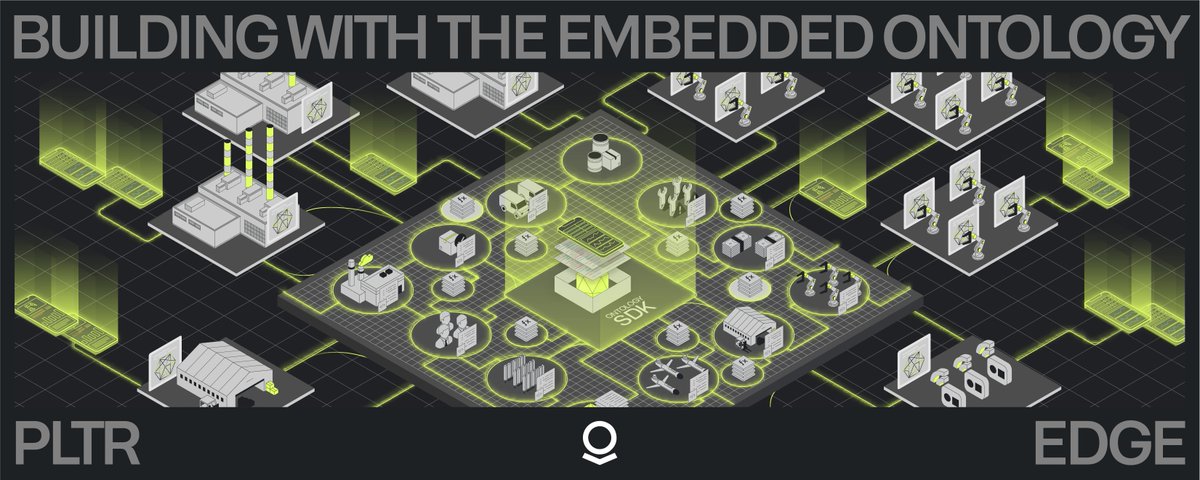
The Palantir Ontology bridges AI-enabled cloud workloads with operations on any device.
See how, step-by-step, in the latest blog post:
Jeremy retweeted
I think @geoffreylitt is exactly right; AI can help finally deliver on the promise of malleable software.
...but you need a tool factory, not simply an ad-hoc collection of tools and skills; and you need a foundation that can compound human+agent serendipity.

Jeremy retweeted
In the most critical manufacturing environments, operating with AI requires connecting the cloud with the shop floor.
Learn how Palantir’s Embedded Ontology enables the connected edge.


Jeremy retweeted
Palantir's Ontology is not a thin "semantic layer."
It's a system that consists of a language, engine, and toolchain ; which integrates data, logic, action, and security
{L,E,T} x {D,L,A,S}


Jeremy retweeted
Most companies are stuck 'vibe coding' point solutions and dashboards that solve nothing long-term.
@hyperindexed: go maximalist.
Build agents and automations that compound value daily, amplify human expertise, encode tribal knowledge, and create true operational advantage.
How much of design is a dimensional logic puzzle?
Arguably a lot. At least in media, the history of design seems to be about how to relax linearity and accommodate more and more interplay across dimensions.
The design of books and scrolls oriented readers around a single reading path, from left to right and top to bottom. Newspapers, magazines, and journals introduced a more spatial layout, with things like jumplines and footnotes offering many more possible paths of navigation.
And when it arrived, hypertext made dimensionality the default. Algorithmic content feeds and adaptive UX emerged as new solutions that helped manage a more volumetric information space. Each innovation added dimension while preserving coherence.
This progression probably unfolded in our physical spaces too. We first built enclosures organized around a single central space. Over time, more relational spaces emerged, with distinct rooms serving distinct social functions.
Architectural innovations like vaults and flying buttresses dramatized the vertical dimension, while Baroque emphasized perceptual depth with interlocking sightlines. Modern architecture added a temporal dimension to physical space: open and configurable spaces that change function throughout the day.
In each case the logic puzzle presents more dimensions, more interplay, and the ongoing design challenge of keeping it coherent. If and when AR takes off, that would seem to accelerate us along the dimensional path.


