

Assistant Professor @MRC_BSU @Cambridge_Uni
Cambridge, England
Joined May 2018
- Tweets203
- Following410
- Followers280
- Likes311




Pinned Tweet
Excited to share our latent factor approach for high-dimensional trait #GWAS + #finemapping out in @CellGenomics
doi.org/10.1016/j.xgen.2025.…
Uses summary-level data.
Software: github.com/jennasimit/flashf…
@FZ_Cambridge @WilliamAstle @aidanbutty
@MRC_BSU @CAMBRIDGE_CEU

Improved genetic discovery and fine-mapping resolution through multivariate latent factor analysis of high-dimensional traits dlvr.it/TK6f0Z
Jennifer Asimit retweeted

This went live today, on Thanksgiving, which feels quietly special.
This article is about one of my favorite topics: how human genetics is being used to shape drug development. It’s a synthesis of ideas and lessons that have emerged over many years, brought together into a single narrative.
I’m grateful for the opportunity to give structure to these thoughts — and excited about where human genetics–driven drug development is headed next. The future here feels genuinely promising.
Many thanks to the editors at @WorksInProgMag — @bswud and @salonium — for the opportunity and for helping edit this article into its best possible version.
Hope you enjoy this light read on Thanksgiving Day :)
🧬 Nature’s laboratory
worksinprogress.co/issue/nat…

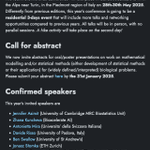
Looking forward to the BioInference conference in Bardonecchia, Italy on May 28-30, 2025.
It will be three exciting days of talks and networking!
Abstract submission deadline for oral/poster presentations is January 31, 2025.
See details here: bioinference.github.io/2025/

Jennifer Asimit retweeted

Adjusting for and quantifying environmental heterogeneity in the meta-analysis of genome-wide association studies of diverse populations identifies additional heterogeneity beyond ancestral effects. doi.org/10.1038/s42003-024-0…

New preprint - for #GWAS loci associated with >1 glycaemic traits, multi-trait #finemapping (flashfm) + functional annotations improved resolution
@JanaSoenksen, Ji Chen, Arushi Varshney, Susan Martin, MAGIC
@InesBarroso4, Andrew Morris, Stephen Parker
biorxiv.org/cgi/content/shor…

Delighted to share that our environment-adjusted meta-analysis of #GWAS from diverse populations (env-MR-MEGA), is now in @CommsBio
Amazing teamwork with @SiruRooney @SolaOjewunmi @ab_kamiza, Michele Ramsay, Andrew Morris, @tchikowore1 @SFatumo
@MRC_BSU
rdcu.be/d0hIh

Try our env.MRmega R package at SiruRooney.github.io/env.MRm….
For input, only need GWAS summary statistics and study-level covariates, e.g. mean BMI, urban proportion.
Jennifer Asimit retweeted

Nice paper from @GenesHealth, an increasingly valuable resource

Among British S Asians (individuals ancestrally from Bangladesh & Pakistan living in East London), a missense variant in PIEZO1 (MAF 3.9%, but very rare in non-SAS) leads to lower HgA1c & thus delayed T2D diagnosis nature.com/articles/s41467-0… @NatureComms


Jennifer Asimit retweeted

Close these dates off your schedule. 03-07th, Feb 2025. It's AfSHG in Uganda. See you there!

Submit your abstract to the 15th African Society of Human Genetics Conference and the 1st Ugandan Society of Human Genetics and Bioinformatics to take place on 3-7 February 2025 in Uganda 🇺🇬
Link: afshg2025.org
#Genetics #Bioinformatics #Africa
New preprint - genetic analyses of latent factors from high-dimensional traits give enhanced power for #GWAS discovery and #finemapping
Highest gains are through multi-trait fine-mapping of latent factors - we introduce flashfmZero
@FZ_Cambridge, @WilliamAstle, @aidanbutty

Improved genetic discovery and fine-mapping resolution through multivariate latent factor analysis of high-dimensional traits biorxiv.org/cgi/content/shor… #biorxiv_genetic
In SMIM1, flashfmZero produces single-variant 99% credible sets (CS99) - rs1175550 - for each of three latent factors related to red blood cell traits
CS99 for latent factors were 5-27 variants
CS99 for red blood cell traits were 30-58 variants

R package for flashfmZero, bundled with updated flashfm functions (correlated traits) available at:
jennasimit.github.io/flashfm…
Jennifer Asimit retweeted

"My time at the BSU was incredible. I learnt so much and have a newfound appreciation for the integral role of statistics in medical research."
Such a privilege to host work experience students this summer 🤩
Read more 👇
mrc-bsu.cam.ac.uk/news/inspi…
#GetIntoSTEM @Cambridge_Uni

ALT Photo of one of our placement students, Zayneb Kusar, sat at desk in front of computer, looking and smiling at the camera.
Jennifer Asimit retweeted

I'm often asked about the latest GWAS datasets for different cardiovascular traits🧬
🔗This is my list with links to the most recent and largest publicly available GWAS summary statistics for cardiometabolic traits❗️
docs.google.com/spreadsheets…

Happy to share env-MR-MEGA - first in our suite of environment-adjusted #GWAS methods
Use summary-level data to quantify environmental and ancestral heterogeneity
Amazing teamwork with @SiruRooney, @SolaOjewunmi, @ab_kamiza, Michele Ramsay, Andrew Morris, @tchikowore1, @SFatumo
Accounting for heterogeneity due to environmental sources in meta-analysis of genome-wide association studies biorxiv.org/cgi/content/shor… #biorxiv_genetic
In our analysis of LDL in 12 sex-stratified African GWAS of ~19k individuals, adjusting for sex, BMI, and urban status, we identified additional heterogeneity beyond ancestral effects for nine variants - examples for sex (b) and urban status (c) below

Try our env.MRmega R package at SiruRooney.github.io/env.MRm….
For input only need GWAS summary statistics and study-level covariates, e.g. mean BMI, urban proportion.
Looking forward to the INSERM workshop "Massive Genomic Data: Statistical and Bioinformatic advances" in Bordeaux, Sept 16-18
I’ll be speaking on multi-trait and multi-ancestry fine-mapping - part of a series of exciting talks and discussions.
Details: tinyurl.com/4yetstds
