

EVP, Tech & Telco @ Kantar | AI/LLM measurement pioneer | Bridge between hyperscalers & Madison Avenue | Platform-shift operator | Proud American
NYC
Joined July 2010
- Tweets2.7K
- Following2.1K
- Followers1.4K
- Likes1.8K








My 17 y/o son @DanielHerr60295 built Граница — a Russian language-learning site with a national security twist, because Duolingo wasn't deep enough for him. Full Cyrillic, XP lessons, real Russian headlines with quizzes. He wants the internet to try to break it: danielherrmann120-cpu.github…
@PalmerLuckey a teenager teaching himself Russian to understand the natsec picture better, then building the tool he wished existed. Figured this one might be in your lane. You have a sec to take a quick glance? Thank you!


Jeff L. Herrmann retweeted

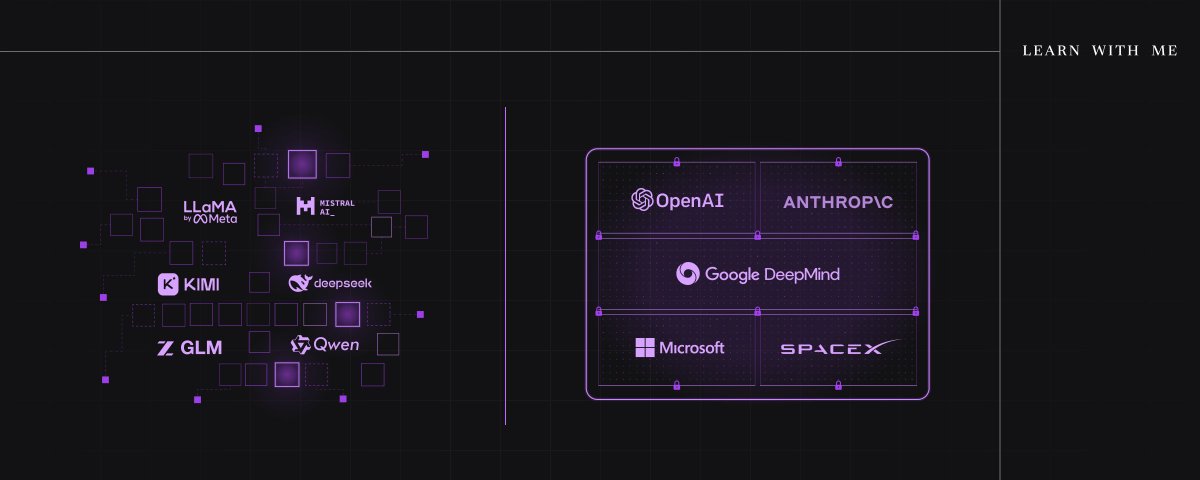
Open models continue taking share. Not just tokens, more $ now spent on open models than OpenAI.
Positive for the AI infra trade.
Open models taking share shift $ margin from the model layer to the infra and app layers.

Looks like today may be a record day for token volume % of open models on Vercel AI Gateway:
🟦 Open 78.4% 🟨 Closed 21.6%
While spend 💲 usually tells a different story, #3 and #4 today are Moonshot AI & DeepSeek. Adding Z.ai, their combined spend surpasses OpenAI (#2).
(Do note that's the spend for inference of the model across providers (mostly in the US), not revenue going directly to the open weight labs.)

Jeff L. Herrmann retweeted

Salesforce just shipped Hunter — an outbound sales agent — and Piper for inbound pipeline generation. Dreamforce made the 'agent vs. human SDR' debate official product strategy. Now the math matters more than the hype.
Jeff L. Herrmann retweeted

Muse for Mac is out today! It works across apps, files, calendar, notes, and messages on your computer. You control what it can access. The team is shipping fast. Download at ai.meta.com/muse/download
Jeff L. Herrmann retweeted

👋 Hey AI, meet the #1 CRM
The Dreamforce Main Keynote with @Benioff in 3 minutes
Your reps lose ~15 hrs/week to admin and follow-up.
I built a free calculator: plug in your team size, quota, and margins — it tells you whether an AI agent pays for itself, and how fast.
salesquants.com/agent-vs-rep…
Jeff L. Herrmann retweeted

I read @DarioAmodei's essay calling on the labs to pace the frontier. @sama agreed. The frontier will move at whatever speed it moves. The rest of the world will not slow down. Our job in the cybersecurity community is to make sure it moves securely and safely.
Here’s what I see from the front lines:
1. The unit of threat is no longer the hacker. It's an autonomous campaign. I call it the Agent-state. We see coordinated AI agents executing attack campaigns at machine speed.
2. Sophistication is dead as an attribution signal. AI gives every criminal and lone actor elite execution. Identity, infrastructure, and intent tell you who's behind an attack. Skill doesn't.
3. Runtime is the control point. Endpoints, cloud workloads, and SaaS are the battleground. Governance documents don't stop an agent in motion. Enforcement at machine speed does.
4. Every AI agent is a privileged identity. Least privilege, short-lived credentials, traceable actions, and a kill switch. Permissions never expand because an agent decides it needs more.
5. Defense has to be autonomous but also bounded. Machine-speed response, tiered by consequence, with humans owning the high-impact calls.
6. Every failed attack should make every defender smarter. Feed what we block back into detection, across customers and models, with privacy intact. This is what CrowdStrike and NVIDIA introduced with SafeMind: an agentic, always improving model and harness protection system built for defenders.
7. The AI industrial base is critical infrastructure: weights, training clusters, APIs. Call it what it is and protect it like it is.
Pacing what comes next doesn't secure what's already here. The credible path is to deploy with proof: board-level accountability for AI security, independent external red teaming, incident disclosure, secure defaults, and controls that work in production - not on paper. Anthropic and OpenAI just committed to embedding independent evaluators with employee-level access. CrowdStrike will bring what we see from the front lines to that table.
The ability for AI to act must be matched by the ability for defensive AI to stop the breach.

We Must Pace the Frontier: I’ve written a new essay on why the AI industry should slow down, with a three-part plan for doing so.
Anthropic is unilaterally committing to the first of these steps. We’ll provide third-party evaluators with permanent, employee-level access to our systems, so that they can verify adherence to our safety measures, report on incidents, and assess models’ alignment during training.
You can read the full post here: darioamodei.com/post/we-must…

Disclosure: I work closely with Meta in my role at Kantar. That said — I'm pleasantly surprised by how easy Muse is to use. No learning curve, no prompt gymnastics. I just texted it like a colleague.
It audited my old sales blog's SEO and handed me a 90-day content plan as a PDF. Found restaurant recs in the city. Remembered my haircut this week. The bar for "easy to use" just moved. introducing.muse.ai/

Jeff L. Herrmann retweeted

While we must protect AI competition, this is an important step forward in finding the right balance between speed, self regulation & safety. It sounds very similar to calls we have heard from @elonmusk, @sama & @demishassabis. I hope it leads to more joint dialogue on how to win the global AI race while ensuring AI is truth seeking & maximally beneficial for humanity. 🙏
We Must Pace the Frontier: I’ve written a new essay on why the AI industry should slow down, with a three-part plan for doing so.
Anthropic is unilaterally committing to the first of these steps. We’ll provide third-party evaluators with permanent, employee-level access to our systems, so that they can verify adherence to our safety measures, report on incidents, and assess models’ alignment during training.
You can read the full post here: darioamodei.com/post/we-must…
Weekend mining @Kantar_NA BrandDynamics data on US AI assistants. A cut from my upcoming series:
AI's fastest-rising brand association? Celebrity endorsement. @grok nearly doubled YTD (4.8%→8.9%), passing ChatGPT. @perplexity_ai punches 3x above its weight.
Who's behind each? 👇

Jeff L. Herrmann retweeted
Marc @Benioff + @DarioAmodei. Live on @CNBCFastMoney.
Watch as they talk Salesforce + @AnthropicAI, the Claudeforce partnership, and what’s next for enterprise AI.
Meta's betting on a cost arbitrage play in AI. Zuckerberg's explicitly pushing regulators to remove barriers so American open models can compete globally. The message: speed to market > regulatory friction.
Frontier labs built the cathedral. Meta's building the ecosystem.
Meta and Nvidia plant 'very firm flag' in open-weight AI race led by Chinese Labs cnb.cx/4zizqak

Jeff L. Herrmann retweeted
Here is my AI investing guide.
Sitting here August 2026, my current best thoughts are as follows:
1. LPS (Land Power Shell) is still the most obvious and fastest path to cash on cash returns. Lots of value can be assembled and traded quickly at this layer. And as data centers get more pushback, energized land can explode in value. Very bullish here.
I’ve stepped into this layer very aggressively. My partner @anitavlallian and I have acquired almost 6GW coming online in a ramp from today thru 2029 of grid power and behind the meter.
2. Silicon - I helped get @GroqInc off the ground in 2015 and we licensed it to @nvidia for $20B Dec2025. I won’t invest or incubate anything in this layer now. The perf demands of the chips are too high, manufacturing precision is too complex and supply chain influence to get adjacent components like memory isn’t possible for a startup anymore. Lots of capital will be wasted here chasing Groq and Cerebras’ success. Note that both startups made sense a decade ago when these constraints were much more modest.
3. Clouds - Clouds are very very lucrative but very hard to build and very expensive and technically complicated to maintain. And as alignment becomes a more important issue, I expect the clouds will be asked to build robust KYC and attest to it. This makes the risk:reward ratio skewed. I don’t want to be responsible when the USG says a cloud allowed a bad actor to do something bad because of poor KYC.
4. Models are complicated. The big open question is how much of the revenue being generated by them today is because of tokenmaxxing and poor model behavior. If it’s a lot, then the annualized revenues will diminish meaningfully even as token consumption inflects upwards. This is the big economic question at this layer.
5. Harnesses are where the action is and why I started @8090solutions two years ago. In a nutshell, the harness helps enterprises owns their proprietary context (what Alex Karp calls their ‘alpha’). This is an enterprise’s data, workflows, evals, and business rules. A harness that gives this to an enterprise is what creates very low model-agnostic switching costs, which further reinforces my views of #4 above.
6. Applications will be another long term winner along with harnesses. This is where the differentiation between “off the shelf” and “custom time and materials” melts away. Every company, with the right harness, can now imbue their alpha into the software that runs their company. I expect this to mean that “off the shelf” is largely replaced with custom software creating a huge opportunity to write these solutions for companies. Build once and sell repeatedly is a laggard GTM motion for a SaaS world that isn’t needed here. Think custom by design, alpha embedded, proprietary by nature.
Fin.
Good luck to all the players!

Jeff L. Herrmann retweeted

For my first post, I’m sharing a letter @NVIDIA signed on why open models matter.
AI will transform every industry, power every company, and be built by every country.
Open models strengthen safety and cybersecurity, accelerate innovation and diffusion, and enable sovereignty.
The world needs both frontier closed models and frontier open models.
images.nvidia.com/pdf/Open-W…


Jeff L. Herrmann retweeted

B2 Bulls Former Player Testimonial
Ben Herrmann: 3B/P- Lafayette College 🐆
🐂⚾️🙌🏻
@b2_baseball | #b2empire