

European Economist @Bloomberg 🇪🇺🇫🇷🇨🇭 Ex @aft_france @dgtresor @banquedefrance Views = own. Hic Sunt Leones.
Paris
Joined November 2015
- Tweets4.6K
- Following1.2K
- Followers2.2K
- Likes36.7K





Pinned Tweet
Publication ce jour d'un Trésor-éco sur la stratégie d'émission de la dette de l'Etat par @aft_france cc @DGTresor @agnesbq1 ⤵️

#TrésorEco | Face à la crise sanitaire, la #dette de l’État a fortement augmenté, passant à un niveau proche de 114% du PIB fin 2021. Vous vous demandez peut-être comment l’État procède pour emprunter tout cet argent ?
🎥 Explications de @Jeadal1 et @CopinPol - @aft_france ⤵
Jean Dalbard retweeted

What France can do to break its budget deadlock bloomberg.com/news/articles/… via @WHorobin @alicegledhill1

Jean Dalbard retweeted

While markets chase Anthropic’s IPO, a different opportunity is hiding in plain sight: long-duration bonds. A duration desert today, a scarcity premium tomorrow? Investors crossing it early could capture 50–100bps. #FixedIncome #BondMarkets
tinyurl.com/yakhjzeb
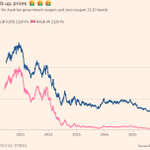
Geeky one for fans of debt sustainability analysis — and for those concerned about a 10-year French yield trading at 5%.
• France’s debt-servicing costs are set to rise sharply — from 2.8% of GDP in 2026 to around 4.3% by 2031 in our baseline, pushing headline deficits higher.
• The issue: those projections rely on market forwards, which currently embed a very large term premium and can distort future refinancing rates — especially at the short end. A 1-year French rate 10 years ahead is currently priced above 6%.
• Using Bloomberg Economics’ new Time-Varying Endpoint Term Structure Model, we replace long-run short-rate forwards with model-based estimates while retaining the maturity-specific term premium.
• Result: a much flatter refinancing path, with debt-servicing costs rising closer to 3.8% of GDP by 2031.
• Bottom line: these new estimates do not remove the need for major fiscal consolidation over the coming years, but provide a better benchmark for calibrating the adjustment.

Jean Dalbard retweeted

Switzerland’s economy unexpectedly grew in the third quarter, showing resilience as energy costs rose bloomberg.com/news/articles/…

Jean Dalbard retweeted
The social-media narrative that Europe is a dangerous mess isn't true, but that doesn't stop it from affecting real-life investment decisions, says @LionelRALaurent (via @opinion) bloomberg.com/opinion/articl…

Jean Dalbard retweeted
Denmark is showing the world how to deal with AI job disruption bloomberg.com/news/articles/… via @sanne_wass

Jean Dalbard retweeted

🇪🇺 Klaas Knot making the case for "principled pragmatism" if he becomes ECB president:
"If circumstances so dictate, we won’t hesitate [to intervene]. I wouldn’t even exclude the fact that we would design another more tailor-made tool."
ft.com/content/4dfbc7b0-1add…

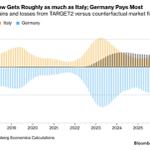
France has quietly become one of the euro area’s largest TARGET2 debtors — but the story is more nuanced than some capital-flight narratives suggest.
In our latest analysis with @RoyeBjorn - available @TheTerminal - we highlight three main takeaways, building on @HannoLustig et al. (2025):
• Higher French yields have made this funding channel increasingly valuable, with an estimated €5-11bn annual advantage — now slightly larger than Italy’s.
• France’s €181bn TARGET2 liability largely reflects Banque de France balance-sheet adjustments, including higher ANFA holdings, with little evidence of money leaving the country.
• A further rise in the balance could matter for ECB intervention choices and revive fragmentation concerns with creditor countries.

Jean Dalbard retweeted

I've mentioned several times that Le Pen might be barred from running- and i know some are surprised by this. So let me share our in house research on this - we're not lawyers so treat this accordingly. A thread.

Jean Dalbard retweeted

La moitié des foyers ne paient pas d'impôt sur le revenu.
10% des foyers paient 73% du total de l'impôt collecté
1% des foyers en paient 31%
0,1% des foyers en paient 12%

Jean Dalbard retweeted
With little gas in storage and prices surging, Europe is holding its breath for a mild winter bloomberg.com/graphics/2026-… via @johnainger @TomFevrier @WHorobin

Jean Dalbard retweeted

L’impôt le plus lourd ? Notre taux effectif moyen de TVA est inférieur à 10 %, soit plus de dix points de moins que le taux normal de 20 %, qui est l’un des plus bas de l’UE. La France est au 24e rang de l’UE pour le poids de la TVA dans les prélèvements obligatoires.
Alors qu’elle représentait plus du quart des recettes totales des prélèvements obligatoires en 1970, la TVA ne pèse plus que 16 % aujourd’hui. Sur la même période, notre pression fiscale a augmenté de 10 points. Or, ce qui n’a plus été prélevé par la TVA l’a été par des impôts beaucoup plus « coûteux » économiquement, en particulier sur le capital et le travail qualifié.
L’impôt le plus régressif ? Du fait des taux super réduit (2,1 %) et réduit (5,5 %), la TVA effectivement payée est légèrement progressive suivant le niveau de revenu. Il y aurait toutefois plus efficace que les taux réduits de TVA pour soutenir les ménages modestes : la TVA ne dépendant pas du niveau de revenu mais de la valeur consommée, les taux réduits profitent davantage aux… riches. Le taux intermédiaire (10 %) est quant à lui d’autant plus injustifié qu’il vise des biens et services surconsommés par les ménages aisés.
Si l’on rapporte la TVA payée non plus au revenu annuel mais à la consommation sur le cycle de vie, la TVA est encore moins « régressive » qu’on le dit. Plus fondamentalement, la TVA est « redistributive » dans la mesure même des services publics et des transferts sociaux qu’elle finance. On ne peut pas isoler l’impôt de la dépense publique qu’il finance. Nos débats sur l’injustice de la TVA n’existent pas dans un pays comme le Danemark 🇩🇰 qui applique un taux unique de 25 % (!!!) sans aucun taux réduit (!!!) afin de collecter un maximum de recettes, nécessaires pour financer un État-providence généreux. Inimaginable en France, alors que c’est à la fois plus efficace et… plus juste.

Jean Dalbard retweeted

Political earthquake tonight. We’ve been writing a lot about midterms lately. A few thoughts:
1. D margins are looking large enough to put to preclude any serious attempt to challenge results. That’s good. Also large enough that Jeffries can tell DSA faction to pound sand when necessary.
2. Trump will be lashing out. Expect some admin departures and foreign policy moves btw now and Jan.3.
3. Corporate-Admin honeymoon is likely over. Dems have already called out more than 200 private companies. Trump admin officials may stonewall oversight efforts but business leaders won’t have that luxury. This could have cascading impact on Trump’s priorities (eg, trade deals that rely on private investment commitments).
4. Despite D control of house and senate, Trump can still dictate US trade policy unilaterally. It’s possible that after these results Congress might attempt to claw back some of its article 1 trade authorities — and maybe even overcome a filibuster — but Trump has his veto.
5. The most impactful change might be at the state level. The U.S. economy is dangerously dependent on the AI buildout. Markets already showing some worry. There’s a non-zero chance the next Congress arrives and is immediately faced with major macro headwinds.
Jean Dalbard retweeted

An announcement that is as personal as professional:
18 months ago, we started collecting online prices in real time to track how Liberation Day tariffs were feeding into inflation.
A lot has happened since. The BLS commissioner was fired. The longest government shutdown in US history meant CPI wasn’t published for the first time. And the case for an independent measure of inflation became much stronger.
What started as a tariff inflation tracker has since grown into something much bigger:
The Bloomberg Price Project (BPP), our attempt to build the US CPI from the ground up using alternative data.
Today, BPP covers 87% of the CPI basket, across both goods and services (more new data will be added in coming weeks). Every month, we collect millions of prices from card transactions, e-commerce sites, grocery stores, pharmacies, rental listings, corporate data, Bloomberg Terminal market prices and government records. And more data are coming.
The payoff is detail. Official CPI data let you drill down to categories such as “uncooked beef steaks.” BPP goes much deeper — breaking the CPI basket into almost 700 line items, compared with roughly 200 in the official data.
Brought to you by: myself, Troy Durie, Daniel Ripperger-Suhler, Joshua Danial and Scott Johnson from across Bloomberg Economics.
Explore the Bloomberg Price Project at BECO MODELS BPP <GO>, or download the data at ECAN US BPI <GO>.
I believe the paywall on Bloomberg.com is coming down briefly so you can read this without a subscription (but you should subscribe!)
bloomberg.com/graphics/2026-…
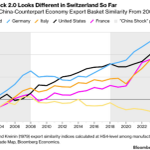
Interesting chart from our latest analysis — available on @TheTerminal — on the China Shock 2.0.
Our new export-similarity index shows how rapidly China is moving into European economies’ export strongholds.
Switzerland has been a notable exception so far — but that may be starting to change, including in pharma and specialized machinery. 🇨🇭🇨🇳


Jean Dalbard retweeted
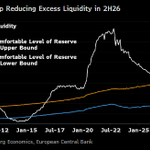
🇪🇺A credit tightening by design - but one that is now likely to produce unintended consequences.
Jean Dalbard retweeted

At these multiples, we need either record valuations to last another decade or earnings growth we have seen only twice since 1880 for US equities to beat TIPS over the next decade. Just to harvest a small equity premium. thetwocents.substack.com/p/t…

Jean Dalbard retweeted
How France got caught in a debt spiral bloomberg.com/news/videos/20… via @WHorobin
