

Materials Scientist 🌏 | Clean Energy & Nanomedicine Buff 💡 | Sci-Fi & Dog Lover 📚🐾
Vancouver
Joined August 2022
- Tweets4.2K
- Following260
- Followers37
- Likes7.6K
Jasper Li retweeted

We developed PhysLDM, a high-quality neural simulator based on latent diffusion models (LDMs)!
Highlights:
- A spatiotemporal VAE that compresses dynamic 3D deformable meshes into a compact latent space.
- An LDM that models both global motion and local deformation.
- Fully differentiable, enabling challenging inverse problems!
We hope PhysLDM will make 3D simulation more accessible and ML-friendly!
Awesome work by Yu Zhang @yucrazing !
🌐 Project: yucrazing.github.io/physldm
📄 Paper: arxiv.org/abs/2610.07609

Jasper Li retweeted

#Robots are stealing the show at the 140th Canton Fair in Guangzhou, south China -- dancing with flawless precision, boxing punch for punch, and even ruling the badminton court. #CantonFair #AI
Jasper Li retweeted

Will Al Take Their Jobs As Well? Construction Workers Use Head-Mounted Cameras to Train Al.
The cam-footage can help train Al systems and robots through first-person data, allowing machines to learn how skilled human workers perform real-world tasks.
Jasper Li retweeted

Excited to share our group’s new work, PACT.
PACT co-optimizes a 17-servo robot hand and its posture retargeter using human grasping poses. The fabricated hand achieves 3.9 mm pose-tracking RMSE, an 86% grasp success rate on YCB objects, and 75% success in imitation-learning-based can pick-and-place.
Paper: arxiv.org/abs/2610.18443
Project: pact-hand-2027.github.io
#Robotics #ImitationLearning #RobotHand

Introducing PACT: we co-designed a 17-servo anthropomorphic hand and its retargeter together, so teleop demos for imitation learning track the human hand much more closely.
3.9 mm keypoint RMSE on human grasps (vs. 12.8 mm for LEAP Hand).
📄 arxiv.org/abs/2610.18443

Jasper Li retweeted

Iran says two supertankers hit mines in Hormuz this weekend.
About 4 million barrels of crude between them, if the IRGC is right.
It says both took an unauthorised route with navigation systems off.
One caught fire, the second was left immobilised, Iranian state media says.
The US says it controls the strait and it’s open.
The IRGC says it’s closed.
Brent closed Friday at $109.86. today is at $107.
themerchantsnews.substack.co…
Jasper Li retweeted
⚠️🇪🇺Germany’s gas storage is only 61% full.
Winter is weeks away.
The EU average is 74.5%, GIE data shows.
A year ago it was about 83%.
That’s below the 2017 to 2021 range for this time of year.
Italy 89.7%
France 87.6%
Spain 78.2%
Austria 68.1%
Netherlands 64.5%
Germany 61%
Brussels wants 90% by 1 December, or 80% when markets are tough.
Germany needs another 19 points just to reach the floor.
The LNG that should fill those tanks is stuck behind Hormuz.
Qatar’s Ras Laffan was hit in March.
A cold November means Europe bids against Asia for every cargo.

Jasper Li retweeted

✨🇨🇳 At a high-speed railway station in China, a smart safety barrier is installed on the platform.
When the train arrives, the flexible safety rope automatically retracts, and the indicator light flashes to remind passengers to get ready for boarding.
This innovative device effectively prevents people from accidentally falling onto the tracks.
Jasper Li retweeted

How safe is your model on a real humanoid? 🤖
At @AIMSafety_, we're opening the PhysHarm waitlist!
Submit your model.
We'll test it in simulation and on real humanoids in our Seoul lab, then share safety scores, videos, and episode-level data.
Jasper Li retweeted

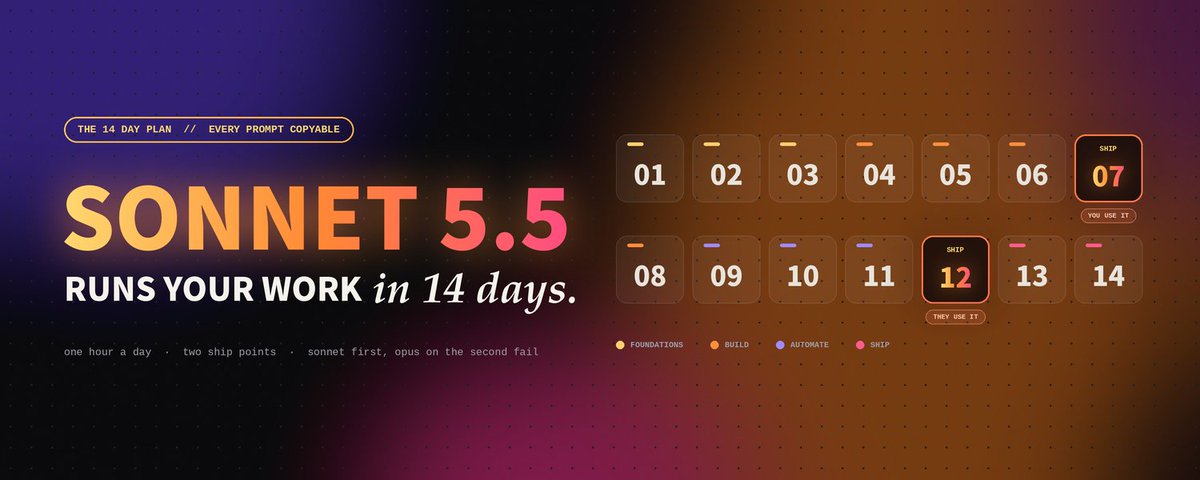
ANTHROPIC’S SONNET 5.5 JUST MADE OPUS 5.5 LOOK LIKE A WASTE OF COMPUTE
the real power isn’t one perfect answer, it’s the loop: plan, act, verify, repeat
it starts with a five part brief and 3 questions before any work begins
then come tests first, so every change has something to prove itself against
when it breaks, you paste the error and watch it read it, form a guess, check it and fix one thing
high effort for planning, low for formatting, and the static part of the prompt stays cached
anything that sends, deletes, buys or publishes waits behind an approval gate
opus 5.5 only comes in after sonnet fails twice on the same task
and sonnet 5.5 already posts 70.6% on terminal bench 4.0, while opus sits at 66.4%
a single answer is a guess, a loop is a system

Jasper Li retweeted

Anthropic turned a model loose on sequencing data nobody could classify and pulled out a virus that matches nothing on record
It was never looking for a virus. The question was what the leftovers are - the reads every pipeline throws away as junk.
> KEEP - the unclassified fraction of each dataset retained instead of discarded
> SHAPE - those reads assembled by structure, with no reference genome to lean on
> HOST - each assembly matched to what else was living in the same sample
Every sequencing run produces a pile that matches nothing. Standard practice is to delete it and move on.
That pile is not noise. It is mostly things with no close relative in any database, which is the definition of undiscovered.
Assembling without a reference is the hard part. You cannot align to something known when nothing known is close.
The host step is what makes it useful. A sequence alone says little; a sequence plus what it was living inside says a lot.
Most of the biosphere has never been catalogued, and the evidence has been sitting in discarded data for years.
The assembly method and what the samples contained are laid out underneath.


Jasper Li retweeted

Inside China's Massive Fleet of 10,000 #Autonomous Delivery Bots
by @XueJia24682
#SupplyChain #Innovation #FutureTech #EV
Jasper Li retweeted
No Hands Needed: The Semi-Humanoid Refueling #Robot Is Here
by @CyberRobooo
#AI #Robotics #EmergingTech #Technology #Innovation
Jasper Li retweeted

This is fucking dangerous.
Apple spent 7 years and $3,500 per unit developing the Vision Pro. This guy made something better with a simple webcam from his bedroom.
And no, this isn't a render. It's running in real time on his laptop right now, with a webcam pointed straight at his hands.
The camera tracks 21 points on each of your hands in real time: every fingertip, every knuckle, and every joint, all mapped onto a 3D skeleton at 60 frames per second.
A piece of digital silk is linked to that skeleton. When you open your palm, the fabric drapes over your fingers. When you close your hand, it crumples into your fist. When you tilt your wrist, the fabric slides and folds using real physics, while light bounces off it like it's actual material.
You can grab it, stretch it, toss it, and catch it, all using just your hands and without wearing any device.
No headset.
No gloves.
No $3,500 computer strapped to your face.
No 600-gram brick on your head.
No battery that lasts 2 hours.
No Apple ID.
No App Store.
Just a webcam, TouchDesigner, and a guy who watched the Vision Pro keynote and thought:
"I can do that for free."
Apple has 3,000 engineers, $200 billion in cash, and 7 years of development. They built a face computer that most people will probably never own.
This guy had a laptop, a webcam, and a weekend.
And he built a future that most people could actually use.
That's what happens when you stop waiting for permission and just start building.
Read the article below for more.


Jasper Li retweeted

We taught a robot to play!
Introducing Dexterity from Supervised Play (DSP): turning minutes of human play into a world model and dexterous manipulation policy. No task demonstrations or sim2real!
play-policy.github.io
Jasper Li retweeted

GLM 5.3’s biggest leap came from post-training alone.
“GLM 5.3 was built entirely by post-training the previous model. For me, that was a wake-up call.”
“Post-training is far more GPU-efficient than pre-training from scratch. Plenty of companies can’t afford to train a model from scratch, but they have proprietary data. They can post-train themselves and beat some of the closed models.”
“There’s still so much juice left to squeeze from post-training. We compared GLM 5.3’s cyber capabilities with 5.2, and it’s a night and day difference. That’s all just post-training.”
Jasper Li retweeted

Packaging and testing facilities require specialised technical roles. The partnership will align skill development with the workforce needs of India’s growing ATMP ecosystem.
Read- pib.gov.in/PressReleaseDetai…
#SEMICONIndia2026 #DigitalIndia

Jasper Li retweeted

Left: YOLO26n fine-tuned 50 epochs on PPE data
Right: stock YOLO26n finds people, a local 27B vision model (Jev) judges each crop. Zero-shot, no training.
This is probably the future of computer vision.


Jasper Li retweeted

Self-Healing Electrical Material. Cut into the circuit, and it keeps working.
Researchers at Carnegie Mellon embedded tiny droplets of liquid metal inside a soft, stretchable material. When damaged, the droplets rupture and connect with their neighbors, creating new paths for electricity.
The surprising part is that the damage itself triggers the response. The material can keep conducting while being punctured or having pieces removed.
For soft robots and wearable sensors, this could mean surviving a tear that would normally cause an electrical failure.
Watch what happens to the device when the material gets damaged.


Jasper Li retweeted

Your matcha is ready. Linkerbot O30 made it just for you.
#linkerhand #linkerbot
Jasper Li retweeted

A 19-year-old MIT student created these AI-powered robots costing $85,000 that do an excellent job.
Humanoid robots are mixing mortar in a pan, buttering bricks with a trowel, and stacking them into a wall between concrete columns.
That’s the part most automation pitches miss. Bricklaying machines usually need a redesigned workflow, special blocks, or a site prepared around the machine. Here, the robots appear to use the same pan, trowel and bricks a human mason would. A contractor doesn’t need to rebuild the process. They need to hire a different kind of crew.
So imagine the business. Not a company selling robots to builders, but one renting a robot crew by the day to small contractors who build brick walls between concrete frames, with a foreman who supervises, restocks bricks and checks alignment. The customer isn’t buying technology. They’re buying walls finished by Tuesday.
Whether that works depends on things the video can’t show: speed, how straight the courses run, how much human help the robots need, and what happens when one breaks down mid-wall. Those details decide whether this is a business or a demo.
But notice who might benefit most. Not a giant developer with an automated factory. A small builder who loses weeks every season waiting for masons to become available.
If humanoids can use human tools, every trade that already has tools becomes a candidate market.
Which trade would you hand to a robot crew first: bricklaying, plastering, or painting?