Jason Hillary (@JasonHillary) profile picture

Sports, startups, stats, code Every insight here is built with the Zerve AI agent Building AI‑native data tools · working on @Zerve_AI

Ireland
Joined May 2023
Photo by Jason Hillary (@JasonHillary)Photo by Jason Hillary (@JasonHillary)Photo by Jason Hillary (@JasonHillary)Photo by Jason Hillary (@JasonHillary)Photo by Jason Hillary (@JasonHillary)Photo by Jason Hillary (@JasonHillary)Photo by Jason Hillary (@JasonHillary)Photo by Jason Hillary (@JasonHillary)Photo by Jason Hillary (@JasonHillary)Photo by Jason Hillary (@JasonHillary)
Agentic coding tools like Cursor and Claude feel incredible in software engineering repos, but underpowered in data science notebooks. I analysed 300 notebooks & repos from GitHub to see how the work differs, and what that means now that agents are writing more code. 🧵👇 (1/10)
1
1
3
2,255
Most AI tools help you write. Ours helps you do research. Today we launched the AI Co-Researcher at Zerve. It's a multi-agent system that runs the research cycle end to end. Not a chat assistant sitting next to your notebook. A parent agent that plans the work and spins up sub-agents for systematic review, coding, analysis, replication, and drafting. #AI #MultiAgent
1
2
4
96
The sub-agents run in parallel across multiple lines of inquiry. Learnings are documented and organised continuously as they work, so context persists across projects instead of dying with the session.
1
25
Today we're launching the Agentic Report on @Zerve_AI Analysis got faster. Communicating it didn't. One prompt. The agent turns any analysis into a live report stakeholders can chat with. Same analysis. CIO version. PM version. Risk version. Three reports, three audiences, one source of truth.
2
1
5
36
We added a Deploy tab to notebooks. The agent reads your code, writes the app, gives you a URL. FastAPIs, Flask, Streamlit, Gradio, Dash — same project. Hot reloads. Live previews. Streaming logs. @Zerve_AI turns any analysis into a live app in seconds. Full demo below ↓
1
4
164
Notebooks feel brittle because meaning moves, but the name doesn’t. A small working set of variables evolves, gets reused ~3.4× more, lives ~10× longer, and is depended on far downstream. Local change. Global dependency.
1
2
114
Is AI and vibe coding changing what actually gets shipped? I looked at recent Product Hunt data to find out. AI Marketing, Dev Tools, and Productivity now make up ~55–60% of AI launches. High volume. Heavy competition. Some categories are accelerating fast. AI Analytics ~80% growth. AI Writing ~76%. AI Design ~60%. But activity isn’t outcome. AI products get ~60% more average votes, while the median stays the same. The standout is AI Voice & Speech. Lowest noise. Highest winner rate (~23%). If launches are an early signal, what does this say about 2026?
1
1
138
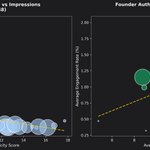
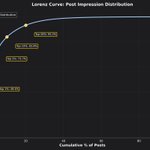
1/🧵 Founder-led marketing follows a power-law. Looking at founder posts across AI companies over the past 12 months: ~1% of posts account for ~49% of total impressions • ~5% account for ~74% • ~20% account for >90% Winner-takes-most dynamics, similar to venture returns.
1
1
190
2/🧵 This goes well beyond the usual 80:20 rule of thumb. Most posts contribute marginally. Outcomes are dominated by rare spike events, not steady posting. Founder-led marketing does not behave like a traditional content pipeline.
1
1
20
1/ 🧵 I’ve been looking at why some agents feel inutitive, while others feel more deliberate - even on the same underlying model. It turns out the difference isn’t the prompt. It’s how system prompts access latent information held in the models 👇
1
208
2/ 🧵 What I expected: Certain words would carry most of the information. “Build a Spotify clone” should embed very differently from a vague prompt. That wasn’t what happened.
1
35
I’ve been thinking lately: should we rethink what information we store when we write code? Most of our tooling is optimised for git workflows, not agent workflows. Files, diffs, commits, comments. They’re great for versioning execution, but not for preserving learning. That made sense when humans did most of the reasoning. With agents, it starts to break down. Agents don’t just need the latest code. They benefit from the context behind it. What was tried. What failed. What assumptions were tested. Why a particular path was chosen. Today, that information is implicit. Scattered across files, notebooks, charts, commit messages, and people’s heads. So every time an agent picks up a task, it has to reconstruct context from partial signals. Over and over again. That reconstruction cost compounds, and small gaps in context turn into repeated mistakes. There’s an opportunity here to persist what we already know, instead of letting it evaporate between artifacts. Right now, we already separate concerns in practice: - data as raw material - code as executable logic But learning and context are treated as byproducts, not first-class information worth storing. What if we made them explicit as well: - learning as what’s been discovered - context as why decisions were made If learning were first-class and persisted, agents wouldn’t need to recompute meaning from scratch each time. Indexed, searchable insights become shared state, allowing both humans and agents to reason from accumulated knowledge rather than reconstructing context each time. Charts could carry their key findings. Analyses could store conclusions, not just outputs. Code could have natural-language interpretations alongside it. Your project stops being organised around files alone. It becomes a searchable, shared basis for accumulated understanding. That doesn’t reduce rigor. It increases it. Execution remains precise. Learning becomes durable. And agent performance improves not because models are smarter, but because they’re reasoning from consistent knowledge instead of rebuilding context every time. That feels like an important shift as we keep building more with agents.
208
Roast my agent 🔥. Try it on a world data/ML/AI problem. I’ve refactoring tools & system prompts to strip noise. The result: better speed & reasoning, and higher signal-to-noise charts. 1 month of Zerve Pro free for all builders. Code: PRONEWYEAR26. Tell me what it gets wrong.
1
388
What I’ve been focusing on with data agents and agent behaviour: • KISS analysis selection (right tool, right depth) • Faster agent response loops • Clearer agent reasoning + progress signals • Charts optimised for signal-to-noise and time-to-comprehension
270
In practice, agent parallelism is bounded by a risk–validation tradeoff. The faster you can validate outputs to an acceptable confidence level, the more agents you can safely run in parallel. Improving that interface is one of the places I expect to see real progress this year.
250
I love vibe coding with Replit and Lovable. But I’m not sure I want a personalised app for everything. Often I just want the information. Most AI UI hype assumes the future is more interaction. But every high-leverage system humans use compresses information: short text, images, charts, short video. When I need to know something fast, I think compression trumps exploration.
1
357
How do you scale output without scaling your hours? By moving from coder to orchestrator. Atomic Throughput is about orchestrating agents simultaneously to saturate the pipeline. I now maintaining a baseline of concurrent PRs well above my old serial workflow. 🧵👇 (1/5)
1
499
My current pillars of Agentic Orchestration: Context Concurrency: Work across repos so if one branch is blocked, others keep move. Atomic Throughput: Optimize PR size for review time to minimize "idle gap." Sequence Planning: Prevent logic overlap for agents in one repo (2/5)
1
135
Most of us don’t struggle with a lack of data. We struggle with learning latency. The time between a question and understanding is still far too long. 👇🧵 (1/8)
1
249
Progress does not come from collecting more data. It comes from learning from the data you already have, faster. If insight arrives too late, or in a form that doesn’t fit how you think, it does not matter. (2/8)
1
30
In 2025, I traded Copilot for Agents (Cursor, Claude Code). The result? PR velocity doubled from jumping from 3.0 to 6.7 merged per week. In 2026, I’m treating coding like a performance sport: optimizing the system, not just the code. The data: 🧵👇 (1/5)
1
634
The biggest win wasn't "faster typing", it was killing the Post-Meeting Recovery Gap (~20hrs scheduled meetings/week). I measured the time it takes to get back into the zone after a meeting: Co-pilot era: 49.6% recovered in <2h Agent era: 65.3% recovered in <2h. (2/5)
1
137
Why is it that AI coding agents struggle more with data than software engineering? It’s not a model problem. It’s a topology problem. Data & SWE are different shapes of thought. I analyzed 100's of notebooks and repos to find why. Full details today at 2PM GMT / 9AM EST. 🧪🧵
517
Now Amorim is gone here is how his reign compared to the previous Man Utd managers. Compared with Mourinho, Solskjær, ten Hag and Rangnick, he ranked last on: • Points per game • Win rate • Clean sheets
541
Ruben Amorim’s time at Man United has come to an end today. The most common attacking output under his reign? 0 goals. A negative goal difference (-6) followed. #ManUtd
278
Using coding agents to generate charts has quietly changed how I work with data. High‑quality visuals make analysis faster and genuinely more enjoyable. When plotting is almost free, you explore more and end up asking much better questions. #DataScience
304
A tale of two step-ups. Potter to Chelsea. Frank to Spurs. In both cases, the early pattern looks similar: • Fewer goals scored • Fewer goals conceded • Lower points per game Despite moving to stronger squads. 🧵👇 #PL #CFC #THFC #BHAFC #BrentfordFC
3
520
What really jumps out: their points per game at the bigger club looks a lot like what they delivered the season before.​ Same coach, better squad on paper, almost identical trajectories. #PremierLeague #FootballData
123