

PhD Physiotherapy, Professional Slam Poet, Market Enthusiast and Free Thinker 🙏
Joined March 2021
- Tweets4.9K
- Following418
- Followers402
- Likes87.4K






This was excellently done 🙏.

I cross-examined @SECGov Chair Gary Gensler about the term 'investment contract', which is key to determining his authority over crypto.
Gensler struggled to answer basic questions like whether an investment contract requires a contract. His evasions are deafening and damning.
2
2
184


Consumer spending depleted.
Student Loan debt restarting.
High-risk period for recession just hit.
Recession hits by EOY.
Market lows to follow.

Americans outside the wealthiest 20% have run out of extra savings and now have less cash on hand than they did when the pandemic began. The figures point to dwindling firepower available for US consumers, whose resilience has kept the economy growing at a rapid clip this year and staved off the recession that many expected. Some analysts warn a downturn is still in the cards as households run low on spare cash. bloomberg.com/news/articles/…

1
77


Still too much grift in the industry.
I'm sorry, but this bear market doesn't end while $Doge is in the top 5 marketcap (excl stables).
Pain.

1/6
Oh btw Huobi is probably insolvent again.
Claims to have $200M in ETH, defillama shows less than $113M even if you add in weth and steth.
Claims users hold $624M in USDT. But there is only $119M USDT in the exchange.


1
60
The amount of Bitcoiners preaching this kind of stupid shit is insane.
Fed selling.
Fastest interest-rate hikes in history.
Yield Curve inverted.
And when deflation hits *and then they print* and inflation reaccelerates, hell say he was correct.
Intellectual dishonesty.

63
Top signal.
#BTC ain't gonna perform well in a recession 🤷.
Have to assume the man is just pushing his liquidation price up. Would be curious where this now stands.

MicroStrategy has acquired an additional 5,445 BTC for ~$147.3 million at an average price of $27,053 per #bitcoin. As of 9/24/23 @MicroStrategy hodls 158,245 $BTC acquired for ~$4.68 billion at an average price of $29,582 per bitcoin. $MSTR microstrategy.com/en/investo…

1
47


Wild quote.

“Lenin is said to have declared that the best way to destroy the Capitalist System was to debauch the currency. By a continuing process of inflation, Governments can confiscate, secretly and unobserved, an important part of the wealth of their citizens. By this method they not only confiscate, but they confiscate arbitrarily; and, while the process impoverishes many, it actually enriches some. The sight of this arbitrary rearrangement of riches strikes not only at security, but at confidence in the equity of the existing distribution of wealth.
Those to whom the system brings windfalls, beyond their deserts and even beyond their expectations or desires, become "profiteers," who are the object of the hatred of the bourgeoisie, whom the inflationism has impoverished, not less than of the proletariat. As the inflation proceeds and the real value of the currency fluctuates wildly from month to month, all permanent relations between debtors and creditors, which form the ultimate foundation of capitalism, become so utterly disordered as to be almost meaningless; and the process of wealth-getting degenerates into a gamble and a lottery.
Lenin was certainly right. There is no subtler, no surer means of overturning the existing basis of Society than to debauch the currency. The process engages all the hidden forces of economic law on the side of destruction, and does it in a manner which not one man in a million is able to diagnose.”
- Keynes, Essays on Persuasion, 1919
1
21


Tarmac retweeted

POWELL: I STILL THINK THERE WILL NEED TO BE SOME SOFTENING IN LABOR MARKET
With historical precedent the message becomes abundantly clear - rates to remain elevated until a recession arrives.


Significant amount of selling pressure hitting a fairly illiquid market.
Something to be aware of.
I love how the “sophisticated plan” is we’re going to sell $100m+ each week, but up to $200m+ if we want, and also we can do unlimited shorting”
While the volume isn’t high, that’s actually a big skew in the net volume delta, especially for Solana.
73
Well stated.
Once the 0% interest-rate is reached, an inflection point occurs.
Negative real returns are likely to accelerate in the short to medium term.
This will be volatile.

This chart will ruffle some feathers.
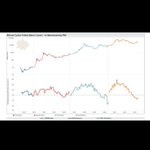
You'll often see charts or visuals illustrating the depreciation of the $USD over time, normalized to $1.00, of which I occasionally share myself.
However, there's an important caveat: these visuals rarely account for short-term yields. Displayed below is the purchasing power of $1, adjusting for annual CPI inflation (in red) versus the purchasing power of $1 accounting for 1-year Treasury yields less annual CPI inflation (in blue), starting from 1962
Notice anything?
The purchasing power of $1 from 1962 to the present equates to $1.85 when accounting for 1-year Treasury yields and inflation. Meanwhile, adjusting for inflation alone leaves you with just $0.10 of purchasing power.
Quite the massive difference.
However, there's more nuance to consider:
1) Let's separate the data into distinct eras,
From 1962 to start of 2009:
- Average annual inflation: 4.40%
- Average 1y yields: 6.22%
- Average difference: +1.82%
Real gains in purchasing power.
From 2009 to Present:
- Average annual inflation: 2.34%
- Average 1y yields: 1.00%
- Average difference: -1.34%
Real losses in purchasing power.
2) The data doesn't include the 1940s where financial repression massively devalued the USD to erode real debt burdens (the data I quickly threw together only went back to 1962) in the post war period.
3) Why 2009 for the change in eras? What has changed? If the U.S. can just pay a nominally higher yield than the inflation rate in perpetuity, are the fiat doomers really just delusional?
In my view:
- Positive real yields can be sustained with a clean balance sheet. It's feasible for the government to pay creditors a positive real interest rate when real debt burdens are low, demographics are booming, and the global GDP is exploding as the world industrializes.
- With Debt to GDP meaningfully > 100% and other tailwinds reversing, this is no longer the case. Post GFC and the introduction of ZIRP + QE to facilitate "growth", has the positive real yield era behind us, at least until real debt burdens have been eroded - which will take either explosive real growth, or a steady dose of inflation above yields, debasing creditors in the process.
The Bottom Line: The reality is that the average/median American individual or family often doesn't have much disposable income to capture such yields. The ones that do, benefit; and the ones that don't are the ones that pay for it.
When you look at charts showing record wealth disparity, or are wondering why the political landscape is more polarized than ever, keep this chart in mind.
Fiat inflation didn't bother the investor class from for forty years as yields outpaced inflation. Currency devaluation wasn't felt in the slightest by this cohort, they didn't just escape the devaluation, but outpaced it significantly.
Now, with Debt to GDP levels domestically and globally near record levels, expect the post 2009 dynamic to continue into the future on a longer time frame. Don't let the current tightening cycle fool you as to what must occur.
Inflation > Yields, over a sustained period of time, is the only way global governments can mask their insolvency.
Thanks for coming to my Ted Talk.

68
Wild statistic.
Poverty is, and always has been the #1 killer globally.
Did we really save lives with our response to Covid? It's very much not clear to me that we did.

Good to be aware of the stats.
Accounts for ~0.5% reduction in consumer spending per year.

Student loan payments are set to resume in October for the first time since 2020.
There are now a total of 45 million people in the US with student loans and $1.6 trillion of student loans outstanding.
The average monthly student loan payment is ~$200.
This means roughly $9 billion in consumer spending will be subtracted every month.
Roughly $100 billion per YEAR will be substracted from consumer spending, mainly with an impact on younger consumers.
Another large shift in consumer spending is coming.

88

