

Japanese art, history, and ukiyoe/antique woodblock prints. We sell art and antiques in London. #LAPADA members
66E Kensington Church Street
Joined August 2009
- Tweets1.3K
- Following416
- Followers1.1K
- Likes691




Why are there 46 prints in Hokusai’s 36 Views of Mount Fuji?
The original 36 designs became so popular that ten more were added, bringing the series to 46 prints in total.
So why was it such a success?
One reason was colour. Many of the early designs made striking use of Prussian blue, a relatively new imported pigment that had become highly fashionable in Japan.
Another was Mount Fuji itself. In Edo-period Japan, Fuji was not simply a beautiful mountain, but an important object of religious and cultural devotion.
Yet Hokusai rarely treated Fuji in the same way twice.
In Musashi Senju, the mountain appears quietly in the distance beyond a farmer, his horse and two men fishing near the Motojuku Weir.
Fuji may be small in the composition, but once you notice it, the whole image changes. Everyday life unfolds in the foreground, while the mountain remains still and unmistakable in the distance.
That contrast is part of what makes Hokusai’s Thirty-six Views of Mount Fuji so compelling: Fuji is always there, but never quite the same.
Today we’re sharing Musashi Senju from this celebrated series.
--
◆Highlight Item
Artist: Katsushika Hokusai (1760 - 1849)
Title: Musashi Senju
Series: Thirty-six Views of Mount Fuji
Publisher: Nishimuraya Yohachi
Date: circa 1829-1833
Size: 37.2 x 24.4 cm
--
#hokusai #katsushikahokusai #36viewsofmountfuji #ukiyoe #japaneseprint

Over 2 metres tall, fierce-tempered and famed for his extraordinary skill with the bow, Minamoto no Tametomo was known as Chinzei Hachiro.
Disowned by his father at 13 and sent to Kyushu, he is said to have brought much of the region under his control within just 3 years.
During the Hōgen Rebellion, one of his arrows reportedly passed through a warrior and struck the armour of another behind him.
Later exiled to Izu Ōshima, Tametomo’s legend only grew: when a fleet was sent against him, a single arrow was said to have pierced and sunk one of the ships.
More legend than man.
--
Artist: Katsukawa Shuntei (?-1824)
Title: Portrait of Warrior Chinzei Hachiro Tametomo
--
#samurai #ukiyoe #japaneseart #japaneseprint #warriorprint

Paul Binnie’s Autumn, from his The Four Seasons series, captures the quiet atmosphere of autumn in Japan.
Against a soft background of falling maple leaves, large red spider lilies flow down the sleeves of the kimono, gently drawing the eye through the composition and enhancing the elegance of the sitter.
The classical kimono is paired with a modern hairstyle, giving the traditional bijin-ga format a subtle contemporary touch.
--
Artist: Paul Binnie (1967-)
Title: Aki (Autumn) A/P
Series: The Four Seasons
--
#paulbinnie #japaneseculture #ukiyoe #modernprint #japaneseart

Japanese Gallery Kensington retweeted

Our “Fine Japanese Art and Antiques Autumn Sale” live auction takes place tomorrow.
The catalogue is available now. Visit JGAuction.com to register to bid or leave an absentee bid.
-
300 lots | Saturday, 10 October | 1:00 PM BST
-
#Kuniyoshi #Ukiyoe #JapaneseArt

We’re delighted to announce that Japanese Gallery will be returning to Japan Matsuri this year!
One of the UK’s biggest celebrations of Japanese culture and food, Japan Matsuri returns to Trafalgar Square on Sunday 4 October.
Come and visit us on the North Terrace, on the National Gallery side of Trafalgar Square, where we’ll be showcasing a wide selection of Japanese art, anime collectibles and traditional items.
We look forward to seeing you there!
📅 Sunday 4 October
⏰ 10am–8pm
📍 Trafalgar Square
🏛️ National Gallery side
@japan_matsuri
#JapanMatsuri #JapaneseCulture #JapaneseArt #LondonEvents #TrafalgarSquare #JapaneseGallery


Our “Fine Japanese Art and Antiques Autumn Sale“ live auction takes place on 10th October.
In the catalogue, you will find 300 lots of Japanese art and antique items including Japanese woodblock prints, original anime posters and production cels (cel-ga), various sets of cels and many more.
The countdown has begun. View the full catalogue and register at JGAuction.com

Japanese Gallery Kensington retweeted
“Fine Japanese Art and Antiques Autumn Sale“ live auction takes place on 10th October.
In the catalogue, you will find original anime posters and cel-ga, various sets of cels and many more.
The countdown has begun. View the full catalogue and register at JGAuction.com


50 warriors. 50 stories. One of Kuniyoshi’s great series of warrior prints.
Created from 1848, Heroes of the Grand Pacification brings legendary warlords, strategists and warriors to life through bold portraits, dramatic settings and short biographies.
Working under the restrictions of the Tokugawa shogunate, Kuniyoshi used altered names while giving each figure a distinctive identity and story.
#ukiyoe #kuniyoshi #samurai #japaneseart #japaneseculture
Tsukimi is the Japanese autumn tradition of admiring the moon, especially the Chushu no Meigetsu, the harvest moon.
In this triptych, Chikanobu Yoshu depicts high-ranking ladies enjoying a moon-viewing gathering, with susuki grass and tsukimi dango offered for the occasion.
The round dango represent the full moon and are offered in gratitude for the autumn harvest, while susuki, resembling ears of rice, symbolise a good harvest and is traditionally believed to ward off evil.
A beautiful glimpse into one of Japan’s most cherished autumn traditions.
--
◆Highlight Item
Artist: Chikanobu Yoshu (1838-1912)
Title: Moon Festival
Series: Court Ladies of the Chiyoda Palace
--
#ukiyoe #japaneseculture #moonvieing #japanesehistory #japaneseart

Tomorrow, 9 September, is Choyo no Sekku, one of Japan’s five traditional seasonal observances and a day closely associated with chrysanthemums.
Chrysanthemums have long symbolised longevity and good fortune in Japan, and the occasion was traditionally marked by appreciating the flowers.
This print, Chrysanthemums Viewing by Chikanobu Yoshu, depicts women of the Ōoku, the inner quarters of Edo Castle, enjoying chrysanthemums in bloom.
A fitting scene for this elegant seasonal tradition.
-
Artist: Chikanobu Yoshu (1838-1912)
Title: Chrysanthemums Viewing
Series: Court Ladies of the Chiyoda Palace
-
#Ukiyoe #JapaneseArt #Chikanobu #Chrysanthemum #japaneseculture

Japanese Gallery Kensington retweeted

Finally met the designer of this fantastic post card combining Hokusai’s Great Waves with Sumo wrestlers.
David Wertheim, came with his brother Eddy, also combines woodblock prints by Matsumoto Hoji with British scenery. Find this frog 🐸 with many variations at major museum shops across the UK!!👀


From paper to skin.
Kuniyoshi’s tattooed Suikoden heroes became hugely popular in Edo Japan, with their designs inspiring real tattoos and spreading across ukiyo-e, kabuki and tattoo culture.
#Ukiyoe #japanesetattoo #samurai #irezumi #japaneseart – at Kensington, London
“Those who do not learn from yesterday, nor know what tomorrow may bring, may have only today to live.”, attributed to Yoshimoto Imagawa
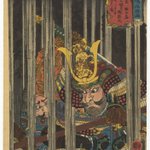
In 1560, Yoshimoto Imagawa led a powerful army into Owari, where he faced the much smaller forces of Nobunaga Oda.
At Okehazama, heavy rain swept across the battlefield before Nobunaga’s forces reached Yoshimoto’s position. Yoshimoto fought back, but ultimately lost his life in the clash.
Nearly three centuries later, Kuniyoshi Utagawa depicted his final moments in Night Rain at Narumi.
Under driving rain, Yoshimoto makes his final stand. The verse inscribed above the scene also recalls the rain at Okehazama and Mōri, the warrior traditionally credited with ending Yoshimoto’s life.
---
◆Highlight Item
Artist: Kuniyoshi Utagawa (1798-1861)
Title: Night Rain at Narumi, Inagawa Yoshioto
Series: Eight Views of Military Glory
---
#samurai #katana #ukiyoe #japaneseart #japanesehistory

As September approaches, we look at the special place the moon has long held in Japanese culture.
From tsukimi and the many names given to the moon, to Tsukioka Yoshitoshi’s One Hundred Aspects of the Moon, its changing forms have inspired generations of Japanese artists.
#ukiyoe #japaneseart #japaneseculture #moon #yoshitoshi – at Kensington, London
This triptych captures spring at Mount Arashi, where elegance and nature intertwine in classic ukiyo-e style.
Created in 1862 by the joint brushes of Toyokuni III Utagawa and Hiroshige II Utagawa, this print is inspired by The Tale of Genji. It blends courtly romance with sweeping landscapes: flowing robes, delicate blossoms, and a serene springtime scene.
Known as history's first novel, The Tale of Genji is a Japanese literature classic from the Heian period. The story revolves around Hikaru Genji, the son of the emperor. The Tale has 54 chapters which were often depicted in woodblock prints during the late Edo period.
Artist: Toyokuni III Utagawa (1786-1865)/ Hiroshige II Utagawa (1826-1869)
Title: Spring at Mount Arashi
Series: Four Seasons of Genji by Joint Brushes
Publisher: Fujiokaya Keijiro
Date: 1862
Visit japanesegallery.com for more information on this print.


As we will soon step into the Year of the Horse, a symbol of vitality, forward motion, and bold spirit, we are reminded of a timeless scene from one of Japan’s greatest artists, Katsushika Hokusai’s Musashi Senju from Thirty‑six Views of Mount Fuji.
In this print, travellers and a horse pause on the riverside, gazing toward the majestic Mount Fuji in the distance.
Here’s to a year filled with strength, curiosity, and forward motion - just like that horse in Hokusai’s landscape, looking toward the towering beauty of new possibility.
Artist: Katsushika Hokusai (1760 - 1849)
Title: Musashi Senju
Series: Thirty-six Views of Mount Fuji
Publisher: Nishimuraya Yohachi
Date: circa 1829-1833
This print is available at japanesegallery.com

Celebrate the winter season with this enchanting 1882 masterpiece by Yoshitoshi Tsukioka! 'Playing in the Snow' from the celebrated Snow, Moon, and Flowers series captures pure holiday joy as elegant ladies frolic in freshly fallen snow beneath blooming plum blossoms, while a high-ranking lady watches the delightful scene unfold.
Warm festive wishes from the Japanese Gallery Team! We wish you joy, peace, and beauty this holiday season. May this exquisite artwork bring warmth to your heart during these festive days. 🎎❄️
Find more stunning pieces at japanesegallery.com 🌸
—
#JapaneseArt #Ukiyoe


Witness the fearless Sato Tadanobu mid-air in this dramatic snowy duel, leaping down in Yoshitsune’s armour to confront Yokogawa Kakuhan. A striking moment captured by master ukiyo-e artist Utagawa Kuniyoshi from his Courageous Leaders in Thirty-six Battles series.
The contrast between the quiet winter landscape and the intensity of the action makes this piece especially captivating.
See more details about this print at japanesegallery.com


In Hour of the Snake by Toyokuni III (also known as Kunisada), we step into one hour from his elegant triptych series ‘Twelve Hours with Genji’. This print, published in 1859, reflects Kunisada’s deep engagement with The Tale of Genji.
Through fine lines and layered colours, he brings to life a refined scene of courtly beauty and quiet emotion. The way the figures are arranged and the space is rendered captures the calm yet playful atmosphere of a moment in time.
See more of Genji-inspired art at japanesegallery.com


Japanese Gallery Kensington retweeted

December is just around the corner, and it's getting chilly. 🎄❄️
Make sure to wear your straw hats and come warm yourself up on Dec 1st at Kanada-Ya. On Monday, we will be exhibiting our original One Piece posters and hand-drawn sketches used in the series' animation process!
