
Postdoctoral research scientist at @BrainGateTeam. I post science and shower thoughts.
Joined July 2012
- Tweets50
- Following208
- Followers107
- Likes574


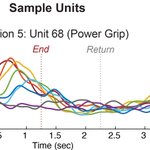
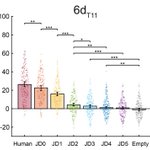

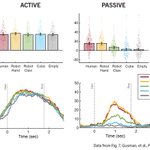


I’m excited to share that one of the manuscripts from my PhD work, “Observation-Related Activity in the Human Motor Cortex Increases with Effector Anthropomorphicity,” is now published in @PNASNews. (1/12)
Link: pnas.org/doi/10.1073/pnas.25…
#NeuroTech #BCI @BrainGateTeam
Within seconds of T11 “figuring it out”, neural responses to watching the dot stimulus became much stronger – and more hand-like. This suggests that mirror-like activity is not just a bottom-up process but can be substantially affected by top-down contextual cues as well. (11/12)
Huge thank you to the BrainGate participants, especially T11 and T17, and to all of my co-authors, collaborators, and mentors. 🙏🧠 (12/12)
pnas.org/doi/10.1073/pnas.25…

Jake Gusman retweeted

Congrats to @JakeGusman, Carlos Vargas-Irwin, @neuroleigh, et al. on their publication in @PNASNews , “Observation-related activity in the human motor cortex increases with effector anthropomorphicity”!
pnas.org/doi/10.1073/pnas.25…
@brownengin
@MGH_CNTR
@CarneyInstitute
#BCI #neuro
The Latch decoder enabled major improvements in a challenging closed-loop multi-gesture drag-and-drop task. Participant T11 dragged icons across a screen with no gesture misdecodes in 79% of trials - compared to just 3% if a Gesture decoder was used on its own. (6/9)
This makes the Latch decoder a versatile and generalizable approach for neural control of sustained actions — with potential to enable not only better 'drag-and-drop' with a cursor, but also more intuitive and reliable operation of assistive and rehabilitative robotics. (8/9)
Decoding sustained actions like grasping and holding an object can be a challenge for iBCIs. Intracortical signals from motor cortex tend to reflect transient, dynamic phases of movement — not stable postures or holds — making tasks like “drag-and-drop” of a cursor tricky. (2/9)

Sweeping a standard, multi-class LDA decoder over trial durations revealed a marked decrease in the discriminability of gestures sustained beyond 1s.
But a binary attempt/no attempt LDA was more reliably accurate over longer gesture attempts. (4/9)
