

JWST Observer is managed by STScI and provides astronomers with the most up-to-date information, news, and events related to observing with JWST.
- Tweets1.1K
- Following9
- Followers17.3K
- Likes186






ALT In a field crowded with stars, a funnel-shaped region of space appears darker than its surroundings with fewer stars. It is wider at the top edge of the image, narrowing towards the bottom. Toward the narrow end of this dark region a small clump of red and white appears to shoot out streamers upward and left. A large, bright cyan-colored area surrounds the lower portion of the funnel-shaped dark area, forming a rough U shape. The cyan-colored area has needle-like, linear structures and becomes more diffuse in the center of the image. The right side of the image is dominated by clouds of orange and red, with a purple haze.

ALT The Crab Nebula. An oval with complex structure extends from lower left to upper right against a black background. On the oval’s exterior lie curtains of glowing red and orange fluffy material. Its interior shell shows large-scale loops of mottled filaments of yellow-white and green, studded with clumps and knots. Translucent thin ribbons of smoky white lie within the remnant’s interior, brightest toward its center. The white material follows different directions throughout, including sometimes sharply curving away from certain regions within the remnant. A faint, wispy ring of white material encircles the very center of the nebula. Around and within the supernova remnant are many points of blue, red, and yellow light.

ALT Jupiter dominates the black background of space. The image is a composite, and shows Jupiter in enhanced color, featuring the planet’s famous Great Red Spot, which appears white with light pink around the edges. The planet is striated with swirling horizontal stripes of green, periwinkle, light pink, and cream. Horizontally across the equator is a wide cream-colored band, whose height extends about 1/7 of the planet. This is the planet’s equatorial zone. The stripes across the planet interact and mix at their edges. Along both of the northern and southern poles, the planet glows in green. Bright red auroras glow just above the planet’s surface at both poles.
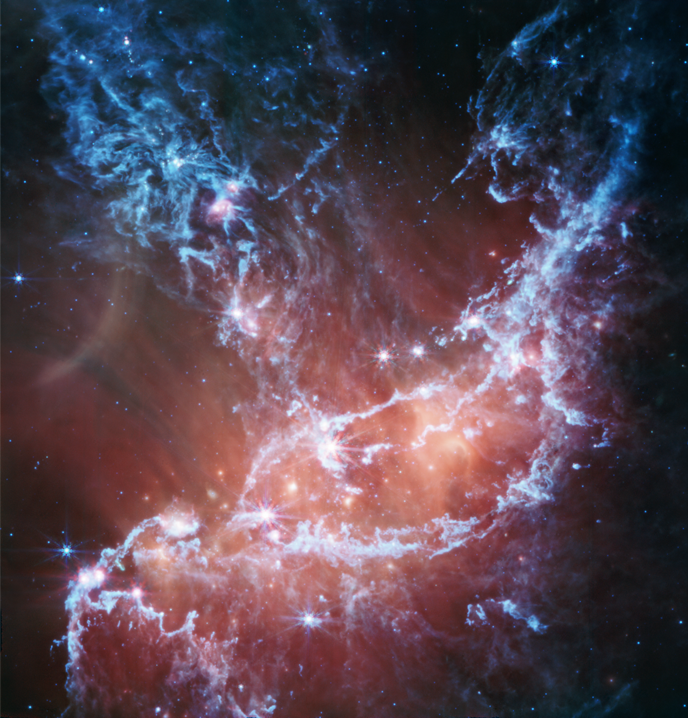
ALT The lower half of this image contains arcs of bluish material that form a boat-like shape. One end of these arcs points to the top right of the image, while the other end points toward the bottom left. Another plume of blue filaments expands from the center to the top left, resembling the mast of a sailboat. Within and extending beyond the boat shape are translucent curtains of pink, which appear atop the boat shape as well and cover most of the image. Stars are noticeably scarce. A couple dozen bright pink patches with six short diffraction spikes are scattered within the blue filaments. Many faint blue dots, or stars, also speckle the background, which is black or dark gray.

ALT The majority of the image shows the black background of space. Two large, very bright galaxies dominate the center of the image. The elliptical galaxy at left is extremely bright at its circular core, with dimmer white light extending to its transparent circular edges. At right is a bright spiral galaxy. It also has a bright white core, but has red and light purple spiral arms that start at the center and turn clockwise going outward. They end in faint red and appear to overlap the elliptical galaxy at left. Throughout the scene are a range of distant galaxies, the majority of which are very tiny and red, appearing as splotches.


ALT At the center is a thin horizontal, two-lobed, pinkish cloud known as Herbig-Haro 211. It is uneven with rounded ends, and tilted from bottom left to top right. It takes up about two-thirds of the length of this angle, but is thinner and longer at the upper right. At its center is a fuzzy dark spot. On either side of the dark spot there are orange-yellow wisps that extend to light blue wisps. Within the center of those clouds, a pink fluffy streak runs through each lobe. At the end of each lobe, pink becomes the dominant color. The lobe to the left is fatter. The right lobe is thinner, and ends in a smaller pink semi-circle. Just off the edge of this lobe is a slightly smaller pink semicircle, then a pink sponge-like blob. The background contains several bright stars, each with eight diffraction spikes extending out from the central bright point.

ALT A dense field of stars with clouds of gas and dust billowing across it. The clouds are yellow-green, patchy, and wispy. Dense and glowing parts of the cloud obscure the center. Bright galaxies with various shapes and sizes shine through the gas and stars. Some of the stars are a bit larger, with visible diffraction spikes.

ALT Webb Senior Project Scientist Jane Rigby is standing in an auditorium speaking to a crowd, where at least three rows of people can be seen. Rigby is standing next to a podium with the words “STScI Space Telescope Science Institute.”

ALT STScI and ESA’s Macarena Garcia Marin stands behind a podium with the words “STScI Space Telescope Science Institute.” She is speaking to a crowd, where at least two rows of people can be seen. Toward the right, is a portion of a large screen.

ALT Webb Senior Project Scientist Jane Rigby speaks to a crowd in an auditorium, where multiple rows of people can be seen. Rigby is standing next to a podium with the words “STScI Space Telescope Science Institute.” Toward the right is a portion of a large screen displaying a presentation slide titled “Summary.”

ALT STScI and ESA’s Macarena Garcia Marin stands behind a podium with the words “STScI Space Telescope Science Institute.” She is speaking to a crowd, where multiple rows of people can be seen. Toward the right, a large screen is displaying a presentation slide titled “Outline.” The slide text reads, Data to Papers Initiative, JWST Users Committee, Cycle 3 timeline, Proposals resources, and Do you have a News-Worthy result?

ALT Illustration of a planet and its cool red dwarf star. In the foreground on the right is the planet, which fills most of the frame. The planet is various shades of blue, with wisps of white scattered throughout. The left edge of the planet (the side facing the star) is lit, while the rest is in shadow. In the background at the lower left is the star, which appears smaller. The star has a bright red glow. Also in the background is another planet, which appears as a small crescent. The black background of space is speckled with a few small stars.

ALT A supernova remnant. The center contains a dense green cloud, shaped like a keyhole. Within this keyhole is a dark spot composed of even denser gas. Outside this is a ring of dense orange gas and dust that becomes more diffuse as it travels further away from the center. The innermost part of this dense orange ring contains brighter orange clumps of glowing gas, which appear as bright orange dots close to one another, like pearls on a necklace. Outside these structures, both above and below, are very faint orange rings of gas and dust, which form a figure 8 pattern. Nearby, there are several bright white stars, three of which show Webb’s eight-pronged diffraction pattern. Several other white stars, which are smaller and more distant are strewn throughout the image, but do not have spikes.

ALT A large spiral galaxy takes up the entirety of the image. The core, just below center, is mostly bright blue, but there are also swirling, detailed structures in tan that resemble water circling a drain. There is white and pale blue light that emanates from stars and dust at the core’s center, but it is tightly limited to the core. The detailed spiral arms, which follow clockwise directions, feature bands of deep orange and cloudy grey, becoming darker as the arms extend to the edges of the images. The spiral arms are interspersed by darker regions in more complex patterns of filaments and voids.

ALT The image is split in half vertically to create two images. In the left image, a black background is scattered with hundreds of small galaxies of different shapes, ranging in color from white to yellow to red. Some galaxies, mostly the redder galaxies, are distorted, appearing to be stretched out or mirror imaged. Just a little bit above the center, there is a bright source of light, a star, with 8 bright diffraction spikes extending out from it. The right image is a zoomed-in portion of the image at the left, showing a particularly long, red, thin line that stretches from 1 o’clock to 7 o’clock. There are several bright dots, some thicker than others, along this line, with one labeled as Earendel.

ALT A black background is scattered with hundreds of small galaxies of different shapes, ranging in color from white to yellow to red. Some galaxies, mostly the redder galaxies, are distorted, appearing to be stretched out or mirror imaged. Just a little bit above the center, there is a bright source of light, a star, with 8 bright diffraction spikes extending out from it. Below the star are several noticeably fuzzy white galaxies that resemble cotton balls – these are part of a galaxy cluster. To the lower right of the star is a particularly long, red, thin line stretching from one o’clock to 7 o’clock. This is the Sunrise Arc.

ALT At the center is a thin horizontal orange cloud known as Herbig-Haro 46/47. It has two lobes that are uneven with rounded ends, and tilted from bottom left to top right. It takes up about two-thirds of the length of this angle, but is thin at the opposite angle. At its center is a red-and-pink star with prominent, eight-pointed diffraction spikes. It has a central yellow-white blob. Just off the edge of the left lobe is a tiny red arc that curves in the opposite direction. The right lobe is thinner, and ends in a smaller orange semi-circle that has a faint purple outline. Just off the edge of this lobe is a slightly smaller orange sponge-like blob. A thin, undulating blue line runs from the central stars through the right lobe. A delicate, semi-transparent blue cloud known as a nebula drifts toward the top of the image and peters out toward the left of the frame, but toward the right and bottom, the nebula ends in a soft ridge set off in a translucent orange.

ALT Left of center, a bright light source illuminates a surrounding disk colored dusky red. The disk is tilted from upper left to lower right, and has spiral features that are most prominent near the star. Small, rocky objects are scattered throughout the inner disk. At upper right, there is a gap through which background stars can be seen. At the outer edge of this gap is a dusky globe representing a gas giant planet. Beyond it, in the top right corner, is additional outer disk material, some of which is falling onto the planet.

ALT Thousands of galaxies appear in this view, which is set against the black background of space. There are many overlapping objects at various distances. They include large, blue foreground stars, some with eight diffraction spikes, and white and pink spiral and elliptical galaxies. Numerous tiny red dots appear throughout the scene. This is a portion of a vast survey known shorthand as CEERS.

ALT The background is mostly dark. At the center is a dark orange-brownish circle, surrounded by several blazing bright, thick, horizontal whiteish rings. This is Saturn and its rings. There are three tiny organ-like dots in the image—one to the upper left of the planet, one to the direct left of the planet, and the lower left of the planet. They are labeled Dione, Enceladus, and Tethys. There is a slightly darker tint at the northern and southern poles of the planet. The rings surrounding Saturn are mostly broad, with a few singular narrow gaps between the broader rings. At the right side of the planet, labels are applied to the rings. The innermost, thicker ring is labeled “C ring.” Next to that, a brighter, wider ring is labeled “B ring.” Traveling farther outward, a small dark gap is labeled “Cassini division” before another thicker ring labeled “A ring.” Within the “A ring,” a narrow faint band is labeled “Encke gap.” The outermost, faintest, thinnest ring is labeled “F ring.”