
Investing in the future
Brooklyn, NY
Joined April 2020
- Tweets359
- Following680
- Followers111
- Likes949






Excited that the results are finally out! We’re releasing MEMOIR, our new benchmark for memory over longitudinal patient data.
We wanted to test a simple hypothesis: How do general-purpose memory systems perform when an AI needs to reason across a patient’s history, and how does a purpose-built patient representation compare?
We evaluated @olirainc alongside mem0, Graphiti, and Letta across thousands of clinical questions grounded in longitudinal oncology records.
Check out the blog post to see how Olira held up against the other approaches (spoiler alert below 👇).
lnkd.in/eiCZFQxK

We’re excited to share MEMOIR, an open-source benchmark for evaluating representations of longitudinal clinical memory.
MEMOIR: Memory Evaluation over Multi-year Oncology Inference & Retrieval includes 117 synthetic oncology patients, 65,377 clinical events, and 3,617 questions spanning factual retrieval, rare-event detection, clinical episode reconstruction, and longitudinal reasoning.
Clinical memory has a different structure from conversational memory. A patient’s history is assembled from events across many systems, at very different frequencies, over months or years. Answering a question may require finding a single event, reconstructing a time series, or connecting observations across an entire treatment episode.
We evaluated several memory and retrieval approaches, including vector-based memory (mem0), temporal knowledge graphs (Graphiti), agent-managed memory (Letta), direct retrieval over Olira’s typed clinical events, and materialized patient state (Olira State).
The clearest differences emerged when an agent had to reason across time. Reconstructing a time series, connecting events across a treatment episode, or understanding how a patient changed over time made the underlying representation much more consequential.
Blog: olira.ai/blog/the-wrong-shap…
GitHub: github.com/olira-ai/memoir-b…

First @olirainc HH in the books!
Was really great to be apart of these conversations, three key takeaways I had:
1. Having patient data doesn't mean it is always useful: Companies to need to makes sure they are tracking the metrics valuable to their buyers, not just to their respective companies
2. Data monetization is becoming an important pillar of early commercialization. Thinking about data monetization early positions teams for lucrative partnerships (especially pharma, research and devices!)
3. The value of healthcare data is in the context, not just the volume. Having millions of records sounds impressive, but the real value comes from understanding what’s actually in them, like how longitudinal the data is, which populations are represented, or how complete the patient histories are.
And if you haven't already, check us out @ olira.ai !


1
49
Jillian Jones retweeted

Anyone who thinks AI is destroying culture has not fucked with video models hard enough, we are entering a superarc of creative surplus

💯

Every healthcare organization already lives with fragmented patient data. CMS’s ACCESS model is the first time that fragmentation shows up directly in what an organization gets paid.
Under fee-for-service, a care team could work around missing context and still get paid for the visit. Under ACCESS, payment depends on actually knowing what happened to the patient.
Data fragmentation was always an operational tax. ACCESS is the first model that turns it into a payment risk.
87

Jillian Jones retweeted

this is the way

⚪️ New App: Slate — a voice journal built on one rule: nothing leaves your phone.
100% Apple, top to bottom. Transcription by SpeechAnalyzer on device. Reflection by the 3 billion parameter Apple Intelligence model on the Neural Engine. Storage in SwiftData. Swift 6, SwiftUI, Liquid Glass. Zero third-party code in the binary.
There's no account. No analytics. No tracking. No third party SDKs. No network calls. The app is private because there is nothing to collect. Turn on airplane mode and everything still works. There's no server.
You speak your mind and slate writes it down. It notices patterns and reads your week back to you in a summary every Sunday.
The local model is an observer. It never replies or advises or comforts. When it has nothing real to say, it says nothing.

Jillian Jones retweeted

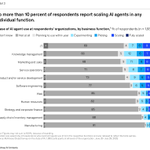
McKinsey's 2025 State of AI survey found 88% of organizations now use AI in at least one business function and 62% are experimenting with agents ...but only 7% report fully scaling agents in any individual function. Most of the market is still early enough that the default architecture holds up.
Curious how that translates in healthcare - one of the highest-stakes, most regulated, most data-complex environments agents are being deployed into. The architecture that served early experimentation doesn't automatically survive contact with longitudinal clinical care. Most teams won't find that out until it matters.


Jillian Jones retweeted

apps as content

‘SCARY MOVIE’ has launched a website where fans can make Ghostface do whatever they want.
🔗: subservientghostface.com
Jillian Jones retweeted

Half of America's AI data centers planned for 2026 are delayed or cancelled. They're waiting on transformers. I build chemical plants. Transformer prices have tripled in the last four years. Lead times are 2 to 4 years. Each new plant we build competes with AI data centers for the same grid equipment. Every large power transformer in America runs on grain-oriented electrical steel. It's made by rolling iron and silicon together until their crystals align in one direction. No other alloy works at utility scale and only one US company makes it: Cleveland-Cliffs. The average large power transformer on the grid is 38 years old. Service life is 40. Amazon, Google, Meta, and Microsoft committed $650 billion to AI infrastructure this year. Nvidia's most expensive GPU is useless without a transformer.

Jillian Jones retweeted

BREAKING: ADM Paparo, 4-star Admiral and Commander of U.S. Indo-Pacific Command, just testified before the Senate that “Bitcoin shows incredible potential” as a tool for U.S. national security. Watch the full exchange:

