

✝ 🇰🇷 Seoul. Watching from the ground. Markets, money flows & life as I see it. Independent observations. No noise.
Seoul, Republic of Korea
Joined August 2025
- Tweets4.5K
- Following691
- Followers992
- Likes4.2K



Pinned Tweet
SK HYNIX EXECUTIVE BUYS ₩1.62 BILLION IN SHARES AMID MARKET SELLOFF
The timing is interesting...
November 23, 2026
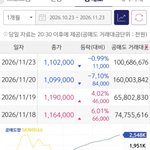
Yoon Poong-young, President and Head of SK hynix's Corporate Center, purchased 1,500 shares at an average price of ₩1,077,263.
Total investment: approximately ₩1.62 billion.
SK hynix fell 2.52% in regular trading today, with foreign investors selling a net ₩151.9 billion.
Meanwhile, a senior executive responsible for the company's corporate strategy has committed personal capital to its shares.
Source: Yonhap News, November 23, 2026.
yna.co.kr/view/AKR2026112312…

BLACK TUESDAY FOR KOREAN SHORT SELLERS? - Short Squeeze
$NVDA +27.95%
$MU +13.97%
Quite a reversal from Friday's semiconductor selloff.
Earlier today, I noted that short-selling turnover in Samsung Electronics and SK hynix had already fallen 42%.
If this US rally holds, Tuesday could put additional pressure on short positions in Korea.
$SKHY $EWY $SOXL $NVDA


KOREA SEMICONDUCTORS: SHORT-SELLING TURNOVER FALLS 42% AFTER FRIDAY'S SELLOFF
Short-selling activity surged in Samsung Electronics and SK hynix during the November 20 market selloff.
November 20:
- SK hynix: ₩160.0B (2.94% of trading value)
- Samsung Electronics: ₩135.6B (2.57%)
November 23:
- SK hynix: ₩100.7B (1.50%)
- Samsung Electronics: ₩70.2B (1.22%)
Combined short-selling turnover fell from ₩295.6B to ₩170.9B, a 42.2% decline.
Both stocks finished lower on Monday, but short-selling activity declined sharply in both absolute and relative terms.
My read: Friday's aggressive short-selling activity did not persist at the same intensity on Monday.
That is worth watching, but it isn't evidence of short covering. We would need outstanding short-position data to establish whether bearish positions are being reduced.
Source: Kiwoom Securities, Nov. 23, 2026.


2
KOREAN STOCK INDEX FUTURES SURGE 8% IN OVERNIGHT TRADING
November 23, 11:30 PM KST.
All three major Korean equity index futures contracts are showing exactly +8.00%.
- KOSPI 200 futures: +8.00%
- Mini KOSPI 200 futures: +8.00%
- KOSDAQ 150 futures: +8.00%

2
118
JENSEN HUANG IS BACK. SEMICONDUCTOR STOCKS ARE SURGING.
NVIDIA has announced Jensen Huang's reinstatement as president and CEO, effective immediately.
The market reaction has been extraordinary.
At approximately 9:27 AM on November 23, my trading screen showed:
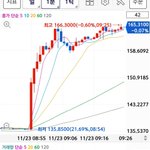
- $NVDA : +31.69%
- $SOXL (3× semiconductor ETF): +46.31%
- $SKHY hynix ADR: +23.20%
After the sharp selloff in semiconductor stocks, this is a remarkable reversal in sentiment.
But one question remains: How much of the leadership uncertainty has actually been resolved?
$MU $TSM


1
91
This guy is a market wizard - I told you INTERESTING TIMING! 1500 SHARES
xitter.cf/J2Wick/status/21247621…

BREAKING: NVIDIA REINSTATES JENSEN HUANG AS CEO — $NVDA SURGES 27% IN PREMARKET
NVIDIA announced on November 23 that its board has reinstated Jensen Huang as President, CEO and Board Director, effective immediately.
The decision reverses the board's position from just six days earlier.
$NVDA was quoted at $159.95 in premarket trading, up 27.42% from its previous close of $125.53.
Source: NVIDIA Newsroom, November 23, 2026.
Premarket quote


2
191
BREAKING: NVIDIA REINSTATES JENSEN HUANG AS CEO — $NVDA SURGES 27% IN PREMARKET
NVIDIA announced on November 23 that its board has reinstated Jensen Huang as President, CEO and Board Director, effective immediately.
The decision reverses the board's position from just six days earlier.
$NVDA was quoted at $159.95 in premarket trading, up 27.42% from its previous close of $125.53.
Source: NVIDIA Newsroom, November 23, 2026.
Premarket quote
Watching Korean retail investors buy leveraged ETFs into this selloff reminds me of baccarat.
The Banker keeps winning. You keep betting on Player.
Not because the odds have improved.
Because you've lost so much that you feel you have no choice but to keep betting.
A Hail Mary.
I've been there. Done that.
And in my experience, it never ends well.

KOREA'S LISTED-COMPANY OWNERSHIP RATIO IS 224× AMERICA'S
A new iM Securities report highlights a striking difference in corporate ownership structures.
Listed-company cross-holdings as a share of total market capitalization (end-2025):
🇰🇷 South Korea: 11.2%
🇯🇵 Japan: 4.0%
🇹🇼 Taiwan: 2.7%
🇨🇳 China: 2.4%
🇺🇸 United States: 0.05%
Korea's ratio is 2.8× Japan's and 224× America's.
This helps explain one of the structural concerns behind the Korea discount: overlapping listed-company ownership and potential conflicts between controlling and minority shareholders.
New restrictions on subsidiary listings could improve shareholder protections and narrow holding-company discounts.
But regulation alone won't eliminate the valuation gap. What matters is how companies change their behavior.
Source: iM Securities, Minority Shareholders Strike Back, Nov. 23, 2026.


2
263
87% OF NEW DRAM CAPACITY IN 2027 COULD GO TO HBM — SK SECURITIES
SK Securities' 2027 semiconductor outlook offers an interesting counterpoint to the recent selloff in Korean memory stocks.
The report estimates that #SamsungElectronics , $SKHY hynix, and $MU will collectively add 230,000 DRAM wafer starts per month in 2027.
But the allocation matters:
• HBM: 200,000 wafers/month (87%)
• Conventional DRAM: 30,000 wafers/month (13%)
In other words, nearly all the incremental capacity is expected to be absorbed by HBM.
That could leave conventional DRAM supply tight even as PC and smartphone demand weakens.
SK Securities also forecasts a 122% increase in the industry's blended HBM average selling price in 2027.
My takeaway: The market is questioning whether AI demand can sustain today's memory profits. SK Securities is arguing that supply constraints may matter just as much as demand.
The key question for 2027 may not be how high memory profits can go, but how long they can stay elevated.
Source: SK Securities Research Center, 2027 Annual Outlook, Nov. 23, 2026, pp. 9–12.


KOREA SEMICONDUCTORS: SHORT-SELLING TURNOVER FALLS 42% AFTER FRIDAY'S SELLOFF
Short-selling activity surged in Samsung Electronics and SK hynix during the November 20 market selloff.
November 20:
- SK hynix: ₩160.0B (2.94% of trading value)
- Samsung Electronics: ₩135.6B (2.57%)
November 23:
- SK hynix: ₩100.7B (1.50%)
- Samsung Electronics: ₩70.2B (1.22%)
Combined short-selling turnover fell from ₩295.6B to ₩170.9B, a 42.2% decline.
Both stocks finished lower on Monday, but short-selling activity declined sharply in both absolute and relative terms.
My read: Friday's aggressive short-selling activity did not persist at the same intensity on Monday.
That is worth watching, but it isn't evidence of short covering. We would need outstanding short-position data to establish whether bearish positions are being reduced.
Source: Kiwoom Securities, Nov. 23, 2026.
SK HYNIX: FOREIGN INVESTORS NET SELL ₩2.87 TRILLION ($1.98 BILLION) OVER EIGHT CONSECUTIVE SESSIONS
Foreign investors have been net sellers of $SKHY SK hynix every trading day from November 12 to November 23.
Cumulative net selling: ₩2.87 trillion (approximately $1.98 billion, assuming ₩1,450/USD).
Over the same period, SK hynix continued to lose ground, hitting an intraday low of ₩1,037,000 on November 23.
That's roughly 44% below its October 2 peak of ₩1,855,000.
What concerns me is the persistence of foreign selling, even after such a substantial correction.
TrendForce's latest supply-chain data still shows severe DRAM shortages, with lead times at 18 weeks versus a balanced level of 8 weeks.
Yet foreign investors continue to reduce their exposure to SK hynix.
Strong industry fundamentals and weak equity demand can coexist. Right now, the selling pressure is difficult to ignore.
Sources: Kiwoom Securities; TrendForce, November 23, 2026.


3
930
AI SUPPLY CHAINS REMAIN TIGHT — EVEN AS SEMICONDUCTOR STOCKS SELL OFF
TrendForce's November 23 supply-chain update shows shortages across seven major hardware components.
DRAM lead times have reached 18 weeks, compared with a balanced level of 8 weeks.
Enterprise SSDs: 16 weeks vs. 8 weeks.
But the more striking numbers are elsewhere:
• HDD: 50 weeks vs. 16 weeks
• ABF substrates: 48–56 weeks vs. 12 weeks
• MLCC: 40 weeks vs. 12 weeks
These are not minor supply constraints.
Meanwhile, Korean semiconductor stocks are under heavy selling pressure.
The contrast is worth examining. Supply-chain tightness tells us something about current hardware availability. Equity prices reflect expectations about what comes next.
Both signals matter, but they are not telling us the same thing.
Source: TrendForce, November 23, 2026.

2
311
76% OF KOREAN RETAIL INVESTORS' NET BUYING OCCURRED ABOVE KOSPI 7,000
According to iM Securities, Korean retail investors have made ₩100 trillion in net purchases this year. Of that, ₩76 trillion occurred when the KOSPI was above 7,000.
The breakdown:
- ₩39T at KOSPI 7,000–8,000
- ₩34T at 8,000–9,000
- ₩3T above 9,000
The KOSPI is now around 4,700.
This article explains a lot about Korea's stock market right now.
Many people I know bought Samsung Electronics above ₩300,000. That's a personal observation, not representative data, but it makes these numbers feel less abstract.
Today, retail investors sold a net ₩366.9 billion, exceeding foreign investors' net selling of ₩247.2 billion.
Retail investors have repeatedly stepped in to absorb foreign selling. But today's trading raises a different possibility: what if those buyers are now becoming sellers?
My concern is that retail selling pressure could become another obstacle to a sustained recovery.
Source: iM Securities, via Seoul Shinmun (Nov. 23, 2026).
m.seoul.co.kr/news/economy/s…

1
4
603
TWO MORE WALL STREET BANKS CUT SAMSUNG ELECTRONICS AND SK HYNIX PRICE TARGETS TODAY
Goldman Sachs and Citi both lowered their targets on November 23, following Morgan Stanley's cuts earlier this month.
Goldman Sachs (Nov. 23)
- Samsung Electronics: ₩500K → ₩350K (−30.0%)
- SK hynix: ₩3.50M → ₩2.00M (−42.9%)
Citi (Nov. 23)
- Samsung Electronics: ₩430K → ₩350K (−18.6%)
- SK hynix: ₩3.00M → ₩2.43M (−19.0%)
Morgan Stanley (Nov. 9)
- Samsung Electronics: ₩381K → ₩309K (−18.9%)
- SK hynix: ₩2.60M → ₩1.60M (−38.5%)
Three major Wall Street banks have now cut their price targets for both Korean memory chipmakers within two weeks.
The concern is shifting toward 2028: memory supply growth, pricing pressure, and whether today's elevated profitability can last.
These are substantial revisions, particularly Goldman Sachs' 42.9% cut for SK hynix.
The banks are not necessarily questioning near-term AI demand. They are reassessing how long the memory upcycle can sustain current earnings expectations.
Source: Brokerage target revisions reported by Korean financial media, Nov. 9–23, 2026.

SAMSUNG PLANS TO INCREASE V9 NAND CAPACITY AT ITS XI'AN FAB BY 5–6 TIMES
According to an exclusive report by Seoul Economic Daily, Samsung Electronics plans to expand monthly V9 NAND wafer capacity at its Xi'an X2 facility from approximately 10,000 to 50,000–60,000 wafers.
The expansion is aimed at enterprise SSDs used in AI data centers.
The plan includes a new production line and conversion of existing V6 capacity to V9.
Equipment installation is expected to begin in February 2027, with completion targeted for November.
The report also cites an industry source saying Samsung's V9 NAND yields have improved to the low-90% range.
One interesting detail: Samsung is planning additional V9 capacity in Pyeongtaek as well.
While Korean semiconductor shares face heavy selling pressure, Samsung appears to be moving ahead with investment in higher-density NAND.
The question is whether enterprise SSD demand and pricing will justify that additional capacity when it comes online.
Source: Seoul Economic Daily, November 23, 2026.
m.sedaily.com/article/201178…

Interesting that Chinese financial media are questioning South Korea's stabilization measures as well.
Wallstreetcn points to a fund that hasn't been deployed since 2008, limited additional buying capacity from the National Pension Service, and selling pressure tied to the global AI trade.
The question isn't whether Korea has a stabilization fund.
It's whether the government has the capacity and willingness to use it effectively in today's much larger market.
Source:
wallstreetcn.com/articles/37…
3
469
SOUTH KOREA'S MARKET STABILIZATION PLAN: THREE MEASURES, LITTLE SUBSTANCE...
Bloomberg reports that Korea's finance minister expects the latest measures to restore investor confidence. I'm struggling to see how.
1. ₩10.76 trillion stabilization fund
The fund assembled in 2020 was never deployed. Neither was it activated in 2022.
Now, amid another market crisis, the government is still preparing.
No deployment date. No committed amount.
2. Three months of intensified monitoring of illegal short selling
Enforcing existing rules is necessary. But how does additional monitoring address the current selling pressure?
Is there evidence that illegal short selling is driving the decline in Samsung Electronics or SK hynix?
3. Higher daily share buyback limits
SK hynix has recently been buying back shares well below its existing daily limit.
Raising a ceiling that isn't being reached accomplishes very little.
Meanwhile, November 23:
Taiwan: +2.35%
South Korea: −3.31%
A 5.66 percentage-point gap.
I'm not expecting the government to stop every market decline.
But I do expect it to explain how these measures will actually work.
A stabilization fund on standby is not market intervention. And announcing measures is not the same as restoring confidence.

South Korea’s finance minister said the government’s latest market-stabilization measures should help restore investor confidence, even as the benchmark Kospi slumped another 5% on Monday following last week’s selloff bloomberg.com/news/articles/…

BREAKING: SK GROUP CHAIRMAN OFFERS ₩944 BILLION TO END NINE-YEAR DIVORCE BATTLE - Reduced ownership uncertainty?
SK Group Chairman Chey Tae-won has asked South Korea's Supreme Court to facilitate a settlement with Roh So-young, offering to pay the full ₩944 billion ($944 billion in won terms) property division award.
The amount has changed substantially through the courts:
• First trial: ₩66.5 billion
• Second trial: ₩1.381 trillion
• July 2026 retrial: ₩944 billion
Chey had previously contested ₩244 billion of the latest ruling. He is now offering to pay the entire amount.
For investors, the question is whether a settlement could finally reduce the legal uncertainty surrounding SK Group's ownership structure.
One issue remains: how the payment would be financed, and whether any SK shares would need to be sold or pledged.
Roh has not yet accepted the proposal. The case is not over.
Source: Korea Economic Daily, November 23, 2026
hankyung.com/article/2026112…

4
679
KOSPI AT 4,206? NH INVESTMENT & SECURITIES MAPS OUT DEEPER DOWNSIDE
NH Investment & Securities released a 32-page emergency report today titled “Surviving the AI Leadership Battle Triggered by Nvidia.”
One section deserves particular attention: historical crisis scenarios for the KOSPI.
Using past maximum drawdowns, NH calculates the following index levels:
• IT bubble: 4,311
• Global financial crisis: 4,183
• Historical crisis average: 4,206
• Enron-related scenario: 3,955
• IMF crisis: 3,217
These are stress scenarios, not official index targets.
The report also examines Taiwan's stock market stabilization measures and suggests that Korean authorities may need to consider further intervention.
My concern is the gap between preparing to intervene and actually deploying capital.
Korea has announced preparations for a ₩10 trillion market stabilization fund. NOTE HAVEN'T BEEN DEPLOYED SINCE 2008...
I don't know where the bottom is. What interests me is that a major Korean brokerage is now explicitly modeling crisis-level downside while discussing the potential need for government intervention.
Source: NH Investment & Securities Research Center, November 23, 2026.


1
3
421
SAMSUNG ELECTRONICS AT 2.8× EARNINGS. SK HYNIX AT 2.4×.
SK Securities' November 23 update puts both Korean memory producers below 3× their estimated next-12-month earnings.
The comparison:
Samsung Electronics: 2.8×
SK hynix: 2.4×
$MU (Micron): 3.4×
CXMT: 9.5×
On November 3, Samsung traded at 3.6× and SK hynix at 3.2×, according to SK research team's estimates.
The compression has been substantial.
But a low forward P/E in a cyclical industry raises an important question.
SK Securities argues that supply constraints, AI memory demand, and longer-term supply agreements could make earnings more resilient than in previous cycles.
That is the argument investors will need to test against actual earnings.
I find the valuations remarkable. But the durability of those earnings matters more than the multiples themselves.
Source: SK Securities November 23, 2026.
Note: Korean company multiples use SK Securities estimates; Micron and CXMT use Bloomberg consensus.

