

IGSA provides an interdisciplinary forum for graduate students focusing on topics spanning the Islamicate world at UNC-Chapel Hill and Duke University.
Chapel Hill
Joined August 2020
- Tweets181
- Following51
- Followers196
- Likes38

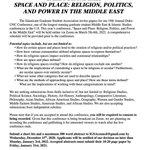



Hello friends! For those who are interested in submitting, we are extending the deadline until (almost) the end of the year. Looking forward to seeing all of the exciting scholarship and ideas!
Please send in your abstracts by Dec. 30th.

We are onto our final panel with a paper by Yotam Yzraely entitled: “The Prophetic Politics of A.D. Gordon: Reconfiguring Theology of Land, Scripture and the Political Body in Early 20th century Zionist Thought”
And our panel will come to end with Dilyara Agisheva’s talk on Islamic Law and the transformation of Crimea’s physical space after the Russian annexation of 1783.
We have now been joined by our next speaker, Muhamed Riyaz who is speaking on the south Asian Hajj experience!
He begins his talk with an anecdote of Sufis on their way to Mecca.
After our break and amazing keynote, we have started our next panel with Haldun Karahanli starting with a discussion on space and networks.
“Why does the story matter?”
Ziad argues that the story matters because it focuses on the overturning the decline and isolation narrative. It also situates the conversation as a “Central Asia” versus “South Asia” narrative.
Ziad has now shifted his convo to the Naqshbandi-Mujaddidi Sufi paths who acted as “synthesizers” in the region.
Began to emerge.
Ziad suggests that Ahmed Shah’s Durrani Empire was the most important one to fill the void after Nadir Shah’s death.
Waleed has taken us to Afghanistan and Pakistan today!
The Mughals, the Safavids, and the Uzbeks, were the key political entities of the time who were actively changing the political terrain of the region. With the death of Nadir Shah, smaller political entities
We have now shifted to our Keynote by the fantastic Dr. Waleed Ziad (UNC) delivering his talk from Pakistan today.
He is discussion his recent book, Hidden Caliphates which focuses on the Eastern Persianate World (circa 1800).
The “exotic other” plays a crucial role in how the West perceives foreign lands. Rebekah also includes a discussion on the “Magesterial Gaze,” a visual practice in which the viewer is placed at the position of the Divine, presenting the visual as something that is to be claimed.
Coffman begins with a discussion on colonialism, imperialism, and orientalism in visual art depictions. The notion of self-identity plays a crucial role here.
Rebekah goes on to discuss American ideas of dominion and empire as a means of travel and exploring.
We have now been joined by our second speaker, Rebekah Coffman joining us from Minneapolis. Her work focuses on the visualizations of sacred space in art. She begins her conversation with a visual of a “Visit Palestine” poster.
Constanze also reflects on Lefebvre’s notion of “marks” as a a means of signifying value to space. Space can be marked physically and abstractly giving it social and symbolic value.
Marks structure and signify space even if they are not clearly marked.
Constanze reflects on Lefebvre’s Triadic notion of representational spaces, spatial practice, and representations of space. The three approaches overlap and lend to the construction of shared and collective memory.
Constanze reflects on Lefebvre’s work on the production of Space. She focuses on the notion of interactions between individuals and between one and god.
“A Musalla is not just a sacred but a consecrated space.”
Our first speaker is Constanze Fertig from Berlin who is presenting her research on Musallas and nomadic forms of worship. She focuses on rituals and practices of those who are constantly on the move for social and professional reasons.
Excited to see everyone this morning!

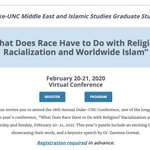
The Duke-UNC Annual consortium is coming up this Saturday! Sign up here to partake in the webinar. There will be presentations by many scholars throughout the world and a keynote by UNC's own Dr. Waleed Ziad (UNC-Religious studies)
Registration link: duke.is/57mby

UNC-Duke Islamicate Graduate Students Association retweeted

Yaay!
Glad to share this happy news. I'm presenting a chapter-in-progress of my research on hajj.
Check out this exciting consortium!
#AcademicChatter #religion #AcademicTwitter #Islam
The Duke-UNC Annual consortium is coming up this Saturday! Sign up here to partake in the webinar. There will be presentations by many scholars throughout the world and a keynote by UNC's own Dr. Waleed Ziad (UNC-Religious studies)
Registration link: duke.is/57mby
The Duke-UNC Annual consortium is coming up this Saturday! Sign up here to partake in the webinar. There will be presentations by many scholars throughout the world and a keynote by UNC's own Dr. Waleed Ziad (UNC-Religious studies)
Registration link: duke.is/57mby