

Wretched soul cursed with an insatiable mind & heart, sharing my thoughts on philosophy, culture, tech, & AI while creating art & tools to enhance humanity,
United States
Joined November 2009
- Tweets3K
- Following213
- Followers142
- Likes4.2K







Pinned Tweet
Does the finite and fleeting nature of our lives make us kinder or crueler?
#thoughts #humanity #mortality

ALT “I shall pass this way but once; any good, therefore, that I can do or any kindness I can show to any human being, let me do it now. Let me not defer nor neglect it, for I shall not pass this way again.” ― Ralph Waldo Emerson
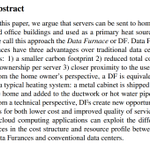
In 2011, Microsoft Research published an interesting paper on an alternative to conventional data centers that would be more ecofriendly & resilient while reducing costs & latency.
It was proposed to benefit cloud providers, but the concept of distributing web infrastructure across private property immediately suggested a further possibility to me: private, decentralized ownership & control itself.
Anthropic’s recent research into "AI worms" and the possibility of models that can run across common consumer devices made me realize the idea could be even more useful for improving and democratizing AI infrastructure.
Governments that treat compute capacity as critical to national security & prosperity should at least examine this concept. Public opinion on AI is currently very negative and people rightly distrust the push for more AI data centers, viewing them as ultimately serving corporate interests over those of ordinary citizens.
Direct, personal ownership of parts of the AI infrastructure, rather than remaining expendable workers for the ultra-rich corporations that own & control the technology, seems like the best way to align AI with public interest and humanity.

ALT https://www.usenix.org/legacy/events/hotcloud11/tech/final_files/LiuGoraczko.pdf
"My idea of a Netflix for games doesn’t work."
The X for Y idea never worked, but everyone keeps trying it anyway because popularity is seductive.
However, treating different mediums as interchangeable makes one completely ignore the unique strengths of each.


AI could devastate the PC gaming market and revitalize consoles and streaming. Let me explain:
The greatest human advantage of open platforms is now their greatest AI vulnerability.
As AI makes source code available to everyone with access to the software, securing access to that software becomes the only way to protect it.
Streaming games to the user’s device, or playing games on a console that doesn’t allow access to the installed software, is the only way to do this. So it becomes far more appealing to corpo and indie devs alike.
One could argue this is just the piracy debate all over again, and PC gaming is doing just fine with that. True, but the power and consequences are far greater this time.
It’s one thing to distribute bootlegs; it’s quite another to use a machine to steal something and then present it as “original.”

There is a fascinating phenomenon happening among some believers in conscious AI. They are now arguing that restricting AIs in any way is dangerous because it hurts their feelings. Apparently, we're seeing the beginning of the first, real, machine-worshiping cult.
Isaiah D. K. retweeted

We are being manipulated into the medicalization of the human experience. In her seminal 1968 work, "The Epidemiology of Depression," Charlotte Silverman unveiled a startling fact: community surveys from the 1930s and 1940s had found that fewer than 1 in 1,000 adults experienced an episode of what we now refer to as "clinical depression annually. This figure, almost unbelievable by today's standards, paints a dramatically different picture of mental health in mid-20th century America. Most striking? Clinical depression in young people, at the time, almost unheard of.
AI can understand a game simply by watching or playing it, so even if you find a way to protect the code, it won't ultimately matter.
A new kind of legal protection for original human ideas is the only possible solution, but it brings its own set of issues, just like patents do.

Necessity is the mother of invention right? AI cloning of games and software won’t last long. Every software company on the planet is likely scrambling to figure out how to avoid this. To have their code base be somehow…. not copy-able. I’m curious what the solution is. But I think there’s gonna be some crazy piracy innovation coming soon. Somehow having code that is impossible to copy will perhaps be the next big innovation. Am I missing something?
I hate the new Firefox theme. The circles, colors, and contrasts are all grating. I don't want a "pretty" UI; I want one that is practical and unobtrusive.
Thankfully, you can switch back by going to about:config and setting browser.nova.enabled to false.


As AI agents take over the internet, using them yourself to combat the growing automated assault on your time and attention will become a requirement.
The internet won't die exactly. It will just become an agent communication network where direct human participation is futile.
May God have mercy on the poor clueless souls who continue to wander it, not realizing almost everything they see and engage with is now artificial.
It will also be quite fascinating to watch agent warfare develop, with each agent trying to outsmart the others to gain access to the humans behind them.
And this is just the digital world. These AI agents will eventually be embodied as robots to serve humans in the physical world.
The future is gonna be wild!
Isaiah D. K. retweeted

After 5 years of development, it's finally happening: I'm releasing #Archrebel's demo on Steam on October 16th, so you can experience the mechanics I've been tinkering with for more than a decade, heavily inspired by REBELSTAR and LASER SQUAD.
#gamedev #indiegamedev


There is a dangerous, overlooked ambiguity in the term "intelligence," because it can mean either capability or wisdom.
Most people treat capability and wisdom as intrinsically linked. They are not. The ability to do things says nothing about whether you should do them.
However, most people simply dismiss the smartest evil actors as "dumb" to maintain the illusion that "intelligence" is always good.
Language is how humans relay conscious thought. So it seems logical to conclude that a machine that can speak our language is also conscious.
However, no sane person would think a verified AI-generated image or sound is real simply because it appears to be.
Why is that?
"In the post-AGI economy, humans will eventually stop writing and reading code, but we still need an ambiguity-free way to tell the AIs building the world around us what we want done."
Um, that's the entire purpose of code!?
This is also literally a programming language that requires writing laws and proofs in code, and it only prevents the bugs you specify. So it's not inherently "bug-free."
Even if we shift the responsibility for writing laws and proofs to the AI, we'd still need to read the code and verify, no?

Acknowledging human limitations is empowering, but believing in infinite scientific progress often creates a harmful and ironically overconfident attitude of viewing everything as a "problem" only science can fix.

the beginning of infinity permanently radicalized me
core idea is that nothing is ever settled and all of our existing knowledge can always be improved. and new knowledge lets us solve problems that on the surface appear to be permanent facts of life.
and bc neither knowledge or problems are permanent, we’re always on the cusp of new discoveries and therefore new solutions.
so while we have no idea on how to properly forecast the future, there is something grounding knowing that there’s still more knowledge to be discovered. and even in an era on abundant super intelligence, we still won’t reach the upper bound of knowledge creation. crazy.
Isaiah D. K. retweeted
Always stick to what makes you weird, odd, strange, different. That’s your source of power.
In hindsight, the Turing Test was a bad idea because senseless and depraved AI companies now think building deceitful tech is the actual goal of artificial intelligence.

Introducing Griffin, the first model to pass the video Turing test.
48% of people who talked to it live thought it was a real human. Previous systems have had a pass rate <3%. It is #1 on NVIDIA's benchmark for full-duplex AI video.
It’s the first Human Interaction Model (HIM).
Readers added context they thought people might want to know
The 48% figure and "video Turing test" claim are from Tavus's own study of 54 one-minute calls, not independently verified or using a standard protocol. Griffin-Lite leads NVIDIA's VideoFDB benchmark on their public leaderboard.
cellcog.ai/blog/tavus-gri…
research.nvidia.com/labs/amri/proj…
tech-ish.com/2026/10/02/tav…