

Founder & Co-CEO o-machine: The intelligence layer for autonomous behavior.
Switzerland
Joined May 2020
- Tweets348
- Following454
- Followers327
- Likes451




Trillions are betting on "Autonomous Everything" via generative AI. But trying to force probabilistic text models into real-world autonomous systems is a trillion-dollar flaw.
Check my co-founder Martin's new article: [Link in comments]
Heading to the Bay Area & SF Tech Week! 🌉 Excited to connect with early-stage VCs, frontier founders, and talk shop.
Great to speak at the Swiss AI Council on AI for high-stakes decision making! 🚀
Shared 2 use cases from o-machine: 1️⃣ CPG & Ozempic: Using synthetic populations to reveal hidden market shifts 2️⃣ Robotaxi unit economics: Replacing LLM "consensus traps" with causal physics 💡

Building Trust in the Agentic Era: this is the theme for this year’s Trust Valley Days and it hits at the exact core of what we are solving at o-machine.

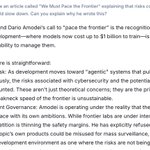
Why did Dario Amodei wrote his article "We Must Pace the Frontier” explaining that risks coming with AI are rising and development should slow down?
Our reasoning engine o-machine has the answer.

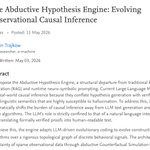
Current AI guesses cause & effect, causing hallucinations. o-machine's paper introduces the Abductive Hypothesis Engine: deterministic math handles logical proofs offline while LLM only translates proven results to text.

to dive deeper into the technical architecture check out the full paper: Trajkow, Martin, The Abductive Hypothesis Engine: Evolving Observational Causal Inference (May 03, 2026). Available at SSRN: ssrn.com/abstract=6705699
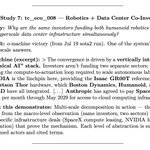
o-machine victory (from Jul 19 sota2 run). One of the system’s richest multi-scale answers.
The question: Why are the same investors funding both humanoid robotics startups and hyperscale data center infrastructure simultaneously?

Current AI spots patterns, but can't answer why.
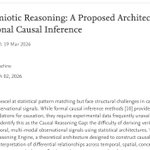
In March, my o-machine co-founder @martintrajkow published our thesis on Neuro-Semiotic Reasoning: bridging the gap between statistical AI & real causation to power high-stakes decisions.
Link to the paper in the comments

Trajkow, Martin, Neuro-Semiotic Reasoning: A Proposed Architecture for Observational Causal Inference (March 02, 2026). Available at SSRN: ssrn.com/abstract=6332179
A tech hedge fund used causal inference to stress-test a 9-figure AI thesis.
The result?
General AI gives consensus. Alpha needs exact mechanics.
Simile’s $2B valuation proves market simulation is huge, but fine-tuning LLMs on survey data won't fix hallucination or structural bias.
o-machine replaces language models with Behavioral Geometry. 1,000x faster, zero retraining, direct evidence.
Probabilistic AI guesses. Causal inference proves.
When modeling multi-billion-dollar bets like autonomous fleets, general chat models fabricate unit economics out of thin air.
o-machine calculates real physical mechanics, delivering dynamic, verified TCO proof
The GLP-1 wave isn’t just changing diet aisles. It’s shifting categories no one is watching.
Instead of survey guesswork, we ran an o-machine simulation across 5k synthetic consumers.
The result? Unseen defection in premium goods.
Don’t guess. Compute the market istead.
Every major strategy move is a bet on human behavior, but surveys and static models leave you guessing.
We build a living world model of your market using real behavioral signals. You can test price shifts, competitors & launches before spending real capital.
Why are hyperscalers signing nuclear power purchase agreements instead of expanding solar capacity for data centers?

Why are the same investors funding both humanoid robotics startups and hyperscale data center infrastructure simultaneously?
Check o-machine answer below⬇️


Excited to join @martintrajkow for a Swiss AI Council session on Navigating AI: World Models & High-Stakes Decision Making! 🧠
I’ll share practical case studies on how AI is transforming critical, real-world decisions.
Registration here:
luma.com/iiqy9h4g

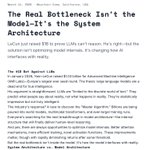
Everyone is racing for the next "Master Algorithm," pouring billions into parameter scaling and world models.
Model internals can always be optimized, but we’re hitting diminishing returns.
The real bottleneck isn't inside the model—it’s the system architecture.

The Real Bottleneck Isn't the Model—It's the System Architecture:
o-machine.com/blog/architect…