
Build Wealth with Direction. Fundamental Investing across AI, FinTech, Ecommerce, & Emerging Markets. $AMD $NBIS $SOFI $HOOD $META $NU $IREN $SNOW $CELH $MELI

United States
Joined April 2025
Our new $NBIS asset light model is here and the report is free for all shareholders.
I've been adding to $NBIS during this correction because I think the market is still underestimating the business Nebius is building. The demand matters enormously, but so does the question of who pays for the infrastructure needed to serve it. That is why I've spent so much time on the asset-light program. Nebius wants partners to fund and own the data centers and GPUs while it provides the cloud platform, operating standards and customer access. If that works, growth can reach beyond what Nebius can finance on its own balance sheet. Partners supply the heavy capital, and Nebius earns a fee from making their infrastructure useful to customers. I see that as essential to the longer-term investment case. It could reduce the capital Nebius has to supply for each increment of growth, preserve funding for its own campuses, and add a higher-margin stream of platform revenue. Over time, more of the business could depend on the value of the software and service, with less revenue growth tied to another enormous hardware purchase. Our conditional 2030 Base case shows what that could mean: about $11.2 billion in annual asset-light revenue, $7.5 billion in adjusted EBITDA, and $4.5 billion in cash available to Nebius after taxes, reinvestment and liquidity needs. That is roughly a 67% adjusted EBITDA margin for the segment. These are modeled outcomes that require strong execution. Management has not guided to these figures, and more than half of our simulated portfolios landed in the lower outcome band. This connects directly to what I've been discussing recently: higher revenue potential from new hardware, faster deployment through brownfield sites and colocation, and a software stack that gives customers more reasons to choose Nebius. Asset light adds another way to capture that opportunity, provided the economics also work for the partners supplying the capital. The fee is where the hard questions start. Owners still have to earn an acceptable return after financing and replacing their hardware. Nebius has to keep delivering enough value to justify its share. I wanted to understand how those incentives affect the size, timing and cash generation of the business. Our new report, The Cloud Someone Else Pays to Build, works through that question in detail, with a separate 2030 asset-light model and 15 exhibits. Management has provided limited concrete specifics on the program. This is an assumption-driven framework, and I expect us to develop and revise it repeatedly over the next several quarters as contracts, fees and project delivery become clearer. The entire report is free. The companion Excel workbook is Premium and sits alongside our existing 2030 company model, which remains available. Full report in the first reply.
1
4
69
3,921
Our October 9 Base forecast has Meta $META reaching $459.31B of advertising revenue in 2030. Put that next to the size of the market and the ambition becomes clearer. Using the industry benchmark in the report, Meta would represent about 42.9% of global internet advertising if the market grows 7.2% annually. At 12% industry growth, the implied share is still 34.5%. The definitions do not match perfectly. We use this as a test of scale, not a precise market-share prediction. We think better advertiser returns can help Meta win spending and expand the market itself. Even so, our forecast requires a substantial share of the industry's incremental dollars. A good quarter is encouraging; earning that position through 2030 requires years of delivery.
1
567
NVIDIA $NVDA can sell into the same AI workload through several different customers. A company may buy its own equipment, rent a large cloud's capacity, or use an independent provider such as Nebius $NBIS or IREN $IREN. We see that variety as an advantage for NVIDIA. It can participate as customers choose different ways to build and run AI. But more equipment buyers do not automatically mean more independent sources of demand. Several providers can still rely on the same small group of AI developers. That is why we follow the customer behind the customer. A broader route to market strengthens the opportunity. The resilience of the spending ultimately depends on who is paying to use the machines.
1
1
7
1,143
Northwise Project retweeted
Our $NBIS asset light model (ALM) will be dropping shortly! Don’t underestimate the importance of this model for a number of reasons. 1. Nebius is going to need extraordinary capex to develop and equip its data centers. The asset light model offers a high margin avenue for funding these requirements with little additional expenses. 2. The ALM will open up a number of partnership and geographical opportunities where the cost benefit equation didn’t before make sense for a full colocation or greenfield build. 3. With potential licensing of Nebius’s software stack, the team will receive real world data and feedback from an entirely new host of customers, many of which may become much larger long term spenders. 4. Reputation. Nebius has already overcome much of its history in Yandex and less than desirable questions surrounding its ability to be a trustworthy option for sovereign AI. By partnering with $PLTR and others to solve this issue head on, Nebius makes a clear stride to illustrate its status as a trusted collaborator in a growing emphasis to control sensitive internal data. 5. Optionality and diversification. The AI infrastructure buildout will undoubtedly face challenges of physical bottlenecks, as well as potential political roadblocks. The ALM gives Nebius a clear path to going to where access is already secured and a way to generate billions off of the execution of others globally. Very excited to hear more from management on this soon, hopefully providing us with guidance that can be used to better forecast individual deal economics, potential partner sizing, and different avenues of implementation. Cheers to shareholders. Nebius continues to surprise even our aggressive assumptions just about every week.
4
7
1
57
3,578
Amazon $AMZN is both a cloud supplier and an investor in some of the AI companies buying its services. That relationship can strengthen demand and give Amazon a share of a customer's success. It also makes the downside more connected than three separate lines in a spreadsheet suggest. If an AI customer's economics deteriorate, future cloud consumption can weaken, Amazon's investment can lose value, and pressure for additional funding can increase together. A large contract does not remove that connection. The question we find useful is how much spending the customer's own business can ultimately support. Investment funding can give it time to get there. Durable customer economics are what make the relationship more resilient once it does.
3
683
A must read market note on $NBIS from our founder to all shareholders
Despite recent market volatility and the AI selloff, $NBIS remains my highest-conviction investment and is once again the largest holding in our portfolios. It’s rare to find a generational opportunity at the intersection of seemingly insatiable demand, low-cost financing, and management execution that continues accelerating despite the company’s growing scale. The Street expects roughly $16B in exit ARR for 2027. Following Q2, our full-company model projected approximately $31B. I increasingly believe even that may prove too low. Management has discussed short-term capacity deals approaching $50M in annualized revenue per MW. If Nebius can capture more of this demand through short-term auctions rather than locking capacity into lower-priced multiyear agreements, revenue per MW could meaningfully exceed our assumptions. Combined with accelerating capacity deployment, $NBIS could potentially exit 2027 at more than 2x current Street expectations. I’ve been deploying significant cash from our flagship and active Growth portfolios during this selloff. Looking beyond 2027, our models suggest $NBIS could surpass $100B in annual revenue by 2030. I increasingly believe even that extraordinary forecast could be exceeded. Two developments are changing my expectations. First, Vera Rubin could materially increase the revenue potential of newly deployed capacity, particularly in short- and medium-term contracts. Alongside Nebius’s expanding software stack, including Token Factory and zero-day model support, the company is moving further beyond commodity GPU rentals. Second, capacity acquisition is accelerating. Much of our original forecast depended on greenfield developments across the US and Europe coming online in 2028 and 2029. Management’s hybrid approach, incorporating brownfield acquisitions, colocation, and faster near-term deployments, could pull substantial revenue forward. Higher revenue per MW combined with faster capacity deployment creates enormous upside to our existing scenarios. New management announcements continue strengthening the probability of our bull case. Of course, none of this comes cheaply. Our CapEx forecasts are also substantially above Street expectations. But unlike the financing concerns recently surrounding $CRWV , Nebius benefits from a strong cash position, attractive debt terms, and significant flexibility across debt, convertibles, equity, and potential subsidiary monetizations. Management has demonstrated an impressive ability to balance these financing sources without compromising growth. I suspect the upcoming Q3 earnings could be a major catalyst if management provides formal 2027 ARR and CapEx guidance. Both figures could catch Wall Street badly off guard. The market continues to underestimate not only the scale of infrastructure Nebius is building, but also the increasingly valuable software platform sitting on top of it. $NBIS remains my highest-conviction long-term holding, and recent volatility has only strengthened that conviction.
2
6
134
25,667
A shopper who cannot find a favorite Celsius flavor can pick another can in seconds. Getting that shopper back may take much longer. That is why we view Celsius $CELH's shelf reset as a repair with a customer problem attached. The company cut its range before replacement products and shelf space were ready. Restoring availability gives it a route back, but some shoppers may have formed a new habit. We see a credible recovery because products that remained available continued to sell. Our forecast asks the core brand to grow like an established beverage franchise, with its Alani brand carrying much of the faster growth. The evidence we want is sustained growth in what shoppers buy across the Celsius brand after the shelves are repaired. If returning customers need progressively deeper discounts to stay, the recovery will be worth less than it first appears.
2
873
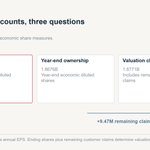
When AMD $AMD offers customers warrants tied to purchases and other conditions, successful hardware sales can also create new ownership claims. A forecast has to follow both sides of that bargain. Our September 23 model uses different share counts for different questions. Average diluted shares measure the ownership spread across a year's earnings. Year-end shares describe the ownership position at the end of that year. Customer claims expected after year-end still need an allowance when assessing the business. For 2030 Base, those economic share measures are approximately 1.831B, 1.868B and 1.877B. The last step reserves about 9.47 million additional modeled claims. These are Northwise assumptions, not a forecast of every future GAAP accounting entry. Using the lowest denominator everywhere would flatter the per-share result. Charging the same future claims twice would distort it in the other direction. The timing is part of the economics.
1
716
Our September 11 forecast for Keel Infrastructure $KEEL shows a $33.3M analytical net loss in 2029 and a $7.3M cash-tax payment in the same year. The model does not treat the U.S. and Canadian businesses as one tax account. It tracks losses and interest-deduction constraints separately, so expenses that reduce consolidated earnings do not necessarily eliminate taxable income in the place and period where cash tax arises. These are simplified planning estimates, not a reconstruction of KEEL's eventual tax returns. We also give no credit for an opening tax-loss asset we have not verified. For a company funding construction before the new properties are fully earning, that distinction belongs in the cash schedule. Setting tax to zero whenever consolidated earnings are negative would make the financing requirement look easier without establishing that the saving is actually available.
1
9
2,040
Meta $META showed 14% more ads in Q2 2026 and earned 12% more per ad. The combination produced roughly 28% advertising growth. We pay attention to those two measures together. More ad inventory gives the business more opportunities to earn. Higher prices suggest advertisers were still willing to compete for that inventory. Better matching can support both: an advertiser who gets more sales from a campaign can afford to bid more. Demand, currency and geographic mix also affect the result, so this quarter does not tell us exactly how much growth AI caused. For our Meta forecast, the important test is whether advertiser returns keep improving as the amount of inventory grows. That is what has to sustain the next several years of pricing gains.
1
3
895
Our work on Nebius $NBIS and IREN $IREN keeps bringing us back to the same conclusion: we are bullish on NVIDIA $NVDA. These companies are building AI data centers, and the cost of filling them with computing and networking equipment is enormous. Add CoreWeave $CRWV, and our forecasts imply more than $415 billion of potential NVIDIA purchases across the three companies from 2026 through 2030. For the cloud operators, that spending creates hard questions about debt, dilution and how much cash will eventually reach shareholders. NVIDIA earns revenue when the equipment ships. The financing burden on one side of the transaction helps explain the growth opportunity on the other. If those buyers lose access to capital, NVIDIA's orders get hit too. We also see NVIDIA capturing more of each data center's equipment budget through CPUs, networking and complete systems. AMD $AMD and custom chips are becoming stronger alternatives, but the purchasing base is broadening across independent clouds, sovereign projects and enterprises. We think the market is still underestimating that combination. Our new NVIDIA report and editable 2030 financial model are live. The operating analysis is free to read, with the valuation, entry prices and workbook available to Premium members. Link in the first reply.
5
3
2
39
8,259
Northwise Project retweeted
I think Celsius $CELH has a credible route back from its shelf reset. I also want to be careful about the numbers that could make the recovery look better than it is. Remove the weakest products and average sales per remaining product can rise even if the surviving products sell exactly the same amount. Grow from a depressed year and the percentage can look encouraging while sales remain well below the earlier level. The two examples in the image illustrate those traps; they are not Celsius's actual sales history. The evidence that would give me more confidence is comparable products selling better across consistent channels, alongside sustained growth in the whole brand. I would become more cautious if the strongest recovery claim were still an improving average over a shrinking range.
1
1
673
AST SpaceMobile $ASTS is trying to keep ordinary phones connected where cell towers stop. We think its technical lead and carrier relationships give it a real chance to turn that promise into a valuable business. We've followed AST for a long time, but valuation kept us cautious even as we liked the business. That discipline has paid off. After the recent selloff, AST is much higher on our watchlist today. A carrier can extend coverage without asking customers to buy a special handset or leave their existing plan. AST gains access to those customers through companies that already handle the billing and distribution. That is a strong starting point for a new network. We see a path to more than $5 billion in annual revenue by 2030, but getting there requires AST to deliver enough capacity where people actually use it. Spare capacity over the ocean does little for a crowded network over Texas. As more customers connect, the quality of service and the terms carriers will accept become central to the economics. Shareholders also have to fund the journey. Launching the constellation, expanding it and eventually replacing aging satellites will consume substantial cash. How much AST needs to raise along the way will shape how much of the growing business belongs to each share. We like the opportunity and would still be patient about a new position while performance under heavy traffic and carrier economics remain early. Our new report, ASTS Stock Forecast 2030: The Capacity Behind the Coverage, is now live. The operating analysis is free to read, with our full valuation, scenarios and editable workbook available to Premium members. Link in the first reply.
5
8
3
90
5,699
Northwise Project retweeted
Big buys across our top neocloud names today, fintech, emerging markets, and a new position for Northwise. Updates pushing to members shortly. Always be ready for opportunities fuelled by short term narratives.
1
9
662
TeraWulf $WULF signs leases before completed data centers begin collecting rent. As the buildout progresses, I would use each operating update to check what the delivered projects teach us about the next ones. When did the customer accept the hall, and when does cash rent start? What did it finally cost against the original budget? After lender obligations and reserves, how much money can leave the project? Is the next campus requiring less owner capital per megawatt? Those answers tell us whether experience is improving the economics: a more predictable build, a smaller contingency or better financing terms. Attracting major tenants is encouraging. If each completed project also makes the next one easier to fund, existing shareholders gain something beyond another location on the map.
1
3
1,056
Northwise Project retweeted
For $IREN, two customers using the same amount of power can create very different economics. An anchor customer brings a long commitment and financing support. A dedicated customer may pay a higher compute rate. A managed customer adds service fees, alongside more work and responsibility for IREN. I like the possibility of earning more from power the company already controls. But I would judge that progress through contract duration, credit quality, renewal terms and funding needs as well as revenue per megawatt. The most attractive customer is the one whose economics hold together across the whole relationship.
2
1
15
3,067
We are bullish on SoFi $SOFI because a larger customer base can earn more through infrastructure and capabilities the business has already spent years building. Our 2030 Base forecast reaches $14.14B of revenue and $4.42B of net income. That implies a 31.3% net margin using the ratio of the two averages, above management's long-term 25% to 30% objective. This is an ambitious Northwise forecast, not company guidance. It does not assume costs disappear. Operating costs before stock compensation and depreciation rise from about $3.34B in 2026 to $6.65B in 2030. Stock compensation, depreciation, credit provisions and taxes still reduce what reaches shareholders. The earnings upside requires revenue to grow faster than that cost base while lending losses and deposit pricing remain manageable. Cross-selling has to produce useful activity, and partner distribution has to retain attractive economics. That is the execution we are backing. The chart shows both the potential reward in the income statement and the operating commitments required to reach it.
3
2
1
32
3,382
Northwise Project retweeted
We see $KEEL $WULF and $CIFR as finally hitting buyable territory this week. We received a lot of flak for calling for caution as most on X pushed their audience to chase hundred percent plus moves. These are exciting companies with real long term opportunities, but there are real risks attached. At the end of the day, financing/dilution and determining how much of the value creation ahead actually reaches shareholders after the banks are paid is essential to crafting real models and valuations for these companies. Excitement and a cool sector are not excuses for abandoning fundamentals; this is a likely major opportunity for those willing to stay patient and to average into increased weakness.
2
23
3,715