

The automation platform that learns Privacy Policy: https://xitter.cf/t.co/jGtE3W9t23 Imprint: https://xitter.cf/t.co/3Ow4PimIIT
Munich
Joined February 2024
- Tweets50
- Following51
- Followers65
- Likes32





Pinned Tweet
We are excited to announce that we have successfully closed our $3M seed round, led by @airstreet and @nathanbenaich. 🚀

👋 Today, we welcome @InterloomAI out of stealth and into the @airstreet family, as we lead a day 1 financing round of $3M.
@fabianjakobi and his team are rethinking the worlds of robot process automation and consultancy to build the foundations for AI-enterprise automation.

Interloom retweeted

welcome to the 9th annual @stateofai report!
ai building better ai, world models, physical ai, geopolitics, cyber defense and 12-month predictions.
read it at stateof(dot)ai or watch my editor’s cut here.
a few of this year’s biggest findings follow:
Our AI team just returned from @aiDotEngineer in Paris 🇫🇷
A few takeaways:
⚡ Sovereign AI was a major theme, spanning the full stack - from energy and data centers to models.
🛠️ Agents in production: search, evals, tracing, and permissions are key for enterprise adoption. Great to see more companies using Zanzibar-style permission models for agents, files, and beyond.
💬 Plenty of discussion around @typesafeai and tabular LLMs, too.
And a highlight for us: spending time at @joinstationf, now home to Interloom as well. Excited to be building from the heart of Paris - with great conversations, food, and sunshine ☀️
🤖 Made with AI


Our AI team is heading to @aiDotEngineer Paris at @joinstationf on September 23–24! 🇫🇷
Looking forward to exchanging ideas and connecting with fellow AI builders. See you there!


More consistent AI starts with relevant experience.
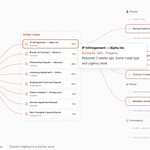
A context graph connects each task to its thread, related cases, and the wider organization. Closer context carries more weight.
This helps agents find successful precedents and build on what worked before.
interloom.com/en/product/con…


5/ This is why "time to iteration" becomes such an important metric.
How quickly can you:
observe a failure → understand it → improve the system → validate the change → deploy it?

GTM Note 05 - Firing the Data Science Bottleneck
Another thing we keep hearing: customers want the promise of AI to become self-sustaining. They do not want to depend on a data science team every time they need to understand what is working, find an optimization, or improve a process.
At Interloom the context graph gives the system the ability to learn from what is happening across the application layer. How are humans, agents, tools, and knowledge interacting? Which patterns lead to better outcomes? Where are processes breaking down or creating unnecessary work?
Over time, that context becomes a continuous optimization loop. The questions become: What could be automated next? Which workflows could be improved? Where are agents consistently getting stuck? What can we learn from how the best cases and precedent are resolved?
Our customers want independence. The system should learn from how work actually happens and surface those improvements itself.
GTM Note 04 - Trust starts with transparency.
Another thing we keep hearing: black-box AI is a hard sell in the enterprise. Customers want to understand what happened, why it happened, and what it cost.
At first, that visibility is about trust. Can we trace how the system reached an outcome? Can we see where humans, agents, tools, and models interacted? Can we inspect what happened at the case level?
Once trust is established, the same transparency becomes an optimization layer. The questions change: How many tokens did this consume? Where did caching help? Which model is driving the cost? Where are humans still involved? Which steps actually improve the outcome?
Transparency is not just about explaining AI. It is how customers learn to operate it better.
GTM Note 03 - Speed only matters if it gets you to ROI.
Another pattern we keep seeing: the window to prove value is getting very small.
Customers do not want a long AI experimentation cycle. They want to move from:
problem → working solution → measurable business value
as quickly as possible.
That changes what the platform needs to optimize for.
It is not just about making models faster or generating a prototype quickly.
It is about helping users make the right decisions along the way: which procedure to follow, which model to use, what to validate, and what to measure.
The end goal is simple:
A customer should be able to walk into a room and say:
"This works end-to-end. Here is the value it creates. And here is how it fits into our existing systems."
Speed gets attention.
Provable ROI gets adoption.
In 1979 IBM wrote in their training materials: "A computer can never be held accountable therefore a computer must never make a management decision".
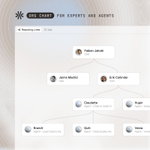
The sentiment is correct: machines can't (and should not) be held accountable… but how do we square this with autonomous agents? The whole point is that they make decisions on behalf of us. Interloom offers an answer that's well known to managers: the org chart. It draws a clear line of accountability from the agent taking the action to the human expert responsible for that agent. A human is always ultimately responsible for all decisions.
Live in Interloom today.

GTM Note 02 - AI prototypes are cheap. Production is hard.
Another thing we are seeing clearly: customers have very little patience for AI prototypes that look great in a demo but fall apart the moment enterprise reality shows up.
The hard parts are rarely the demo itself.
They are everything around it: security, governance, compliance, certifications, legacy systems, production integrations.
A prototype is only useful if there is a credible path from "this works" to "IT can actually deploy this."
That changes what good AI infrastructure looks like.
It should not just help you build the happy path faster.
It should anticipate the constraints that normally appear later - and design around them from the beginning.
For enterprise AI, production-readiness is not the last mile.
It is part of the product.
GTM Note 01 - Customers do not care about the plumbing.
One thing we keep hearing from customers: they do not want to become AI engineers.
They do not want to design workflows, pick models, learn prompt engineering, or stitch together agents and tools.
They have a messy business problem. They want to describe it, provide the context, and get something useful back.
That is increasingly how we think about the role of the AI platform: translating intent into the right tools, procedures, models, and ultimately a working application.
The customer should be the director, not the mechanic.
They provide context, steer, and give feedback.
The platform handles the plumbing.
Interloom retweeted

I love products like @LiteLLM and @OpenRouter . They make it possible to stay model-independent and switch models based on cost, latency, or capability.
That worked well with Chat Completions API. With Responses-style APIs, the abstraction is starting to break down.
Interesting to see @linear take a very similar approach to agent harness design.
Custom harness, dynamic tool/skill loading, contextual permissions, and matching the execution environment to the work.
Feels like strong validation of the direction we have been taking at @InterloomAI:
interloom.com/en/blog/harnes…


Our perspective on agent design.
Matthijs Wolting on the prompt, tools, and harness behind Linear Agent:
linear.app/now/how-we-built-…
