

All great companies started as small companies. CIO @iancassel. https://xitter.cf/t.co/CL86Hwf2go
Lititz, PA
Joined September 2018
- Tweets255
- Following2
- Followers9.2K
- Likes417




IFCM MicroCap retweeted

New Article
Buffett started as a short-term cigar butt stock trader. He then started taking control of companies. He then realized it’s better to take control of companies of higher quality, so he doesn’t have to fix or sell them. The point is he kept evolving, pushing out his circle of competence. If he stayed a cigar butt investor, he would have become a relic of the past by age 40 instead of a legend.
microcapclub.com/keep-evolvi…

We continue to like $USIO even after the recent runup.
The company should continue to grow 15%+ simply from its existing customers growing. Then you layer on top of this new partnerships like Harris, new opportunities like the state and school voucher programs, and new products like Usio Ion (rolled out 2027 could materially impact bottom line) and there are several green shoots that could be additive.
To give a sense of how big the green shoots are. If USIO was able to secure just one medium to large sized Utility, for example, CPS Energy out of San Antonio has 1.3m customers average bill $175/month that is $2.75 billion in annual processing. USIO did 9 billion in total processing in 2025.
In addition, we believe this company will eventually be acquired (within 3 years) by someone like Harris. USIO currently doing ~$100 million in sales. The average multiple in this space for a company 100m-300m is ~2x sales.
Disc: Long and wrong a lot
IFCM MicroCap retweeted
New Article - From Speculation to Investment
How microcap companies become higher quality as they grow
microcapclub.com/from-specul…

IFCM MicroCap retweeted
📗Stock Picker is officially published! lnk.to/stockpicker
The world didn't need another "invest like me" or instruction manual for successful investing. What time has proven is all great investors and stock pickers invest differently. In fact, that is what makes them great. I wrote this book to inspire and motivate you to invest like you. To do it your own way. That is my story and it can be your story too.
I also wrote the book to educate the masses on microcap investing, a space that has been largely forgotten by most of the financial industry. My mission is to pull quality investors, companies, stakeholders into microcap. That is how we make a positive impact on this investment class.
Help me spread the word. Tell a friend. Leave a positive review. Thank you. 🙏

Good for $RNGE
"In Loudoun County, Virginia, a data center developer reportedly offered $4.4 million per acre for land."
Disc: Long and wrong a lot
cnbc.com/2026/09/06/ai-data-…

Liberty Stream $LIB.V $VLTLF is an interesting setup into year end. Producing battery grade lithium in the US from US oil/gas fields is about as pro America as a story stock can get. The company has stated it is expecting a few validating events, mainly additional off-takes and midstream announcements which should cause the latest project financing to go to final agreement. The Nasdaq IPO timing is somewhat outside of the company’s control as it has more to do with the amount of back and forth with the SEC (30 days for every question set) to approve the registration statement. It could be November. It could be January. But there could be other positive surprises between now and then.
Disc: Long and wrong a lot

A great update from Paragon Advanced $PALS.V
Things look to be coming together nicely now.
Disc: Long and wrong a lot


Interest shifting to coal states $RNGE that have the land, water, infrastructure and zero NIMBY concerns.
Disc: Long and wrong a lot

BREAKING: I just signed an Executive Order implementing the strictest standards in the nation for AI data centers — because I will not allow Pennsylvanians to be bullied by greedy developers and bulldozed by the lawyers working for these big tech companies.
Effective immediately, we’re requiring AI data centers to commit to strict environmental and transparency requirements AND receive approval from the local community if they want to build here.
That’s not all: We’re also removing ALL data centers from our Fast Track permit program and stopping any office or agency under my jurisdiction from signing an NDA with AI data center developers.
I’m putting these developers on notice and letting them know that we will not let them bully Pennsylvanians, disregard our constitutional right to clean air and pure water, and drive up our utility bills.
I’m using the full weight of my executive authority to block the objectionable, unwarranted projects and put the nation’s strictest set of protections in place.

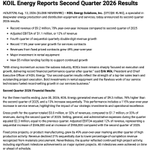
$OML.V - another good quarter with a record backlog which points to strong H2
Disc: Long and wrong a lot


Good quarter by $USIO, operating leverage starting to show. Setup well for another beat and raise in Q3. Low expectations are being exceeded.
Disc: Long and wrong a lot
IFCM MicroCap retweeted
I first met John Swallow of $IDR in 2005 when he was building another public company. Both of his sons were young children. I’ve now attended both of their weddings. Hard to put into words how fulfilling it has been on an investment and personal level.

$PALS.V - a nice addition getting the previous Vice President of Global Growth from Chrysos Corporation $C79.ASX
Disc: Long PALS and wrong a lot

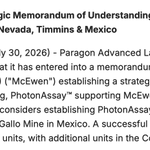
Great to see this commercial expansion agreement from Paragon Advanced $PALS.V with McEwen $MUX. We continue to like this “low expectations” set up. Q1 2026 was weaker than the market predicted which is why the stock retraced from $4.00 to $2.00 per share, but we believe utilization is rising rapidly in Q2 2026, and could see sales increase 50%+ sequentially from Q1 to Q2 and could increase 50%+ again from Q2 to Q3. We think this revenue growth will take the market by surprise while inflecting on profitability in Q3.
Disc: Long and wrong a lot

In late 2025, we invested in Cybeats Technologies $CYBT.CN $CYBCF via private placement at $0.12 CAD and lead the follow on this month at $0.17 CAD).
Cybeats - Every Government Is Writing the Same Law. One Company Has the Solution.
Imagine buying a snack with no ingredient list. No idea if it contains something you're allergic to. No idea if it's healthy. Do you just trust and hope? I don’t think so.
That's how software has worked for forty years.
Big companies use hundreds of software vendors. Each vendor's product is made of thousands of pieces of code borrowed from other places. Most of it is free, open-source, and untracked. Nobody actually knows what's inside anything. When a dangerous bug shows up in one of those hidden pieces, companies spend weeks trying to figure out if they're affected. Attackers exploit the same blind spots to break in.
The industry finally gave the fix a name: Software Bill of Materials. SBOM for short. An ingredient list for code.
Seven years ago, SBOMs were a nice idea nobody was forced to care about. That changed.
The Regulatory Hammer
Three governments got tired of waiting.
The United States kicked it off with Executive Order 14028 in 2021, requiring SBOMs from any software supplier selling to federal agencies.
The European Union followed with the Cyber Resilience Act. It entered into force December 10, 2024. Vulnerability reporting becomes mandatory September 11, 2026. SBOMs become mandatory December 11, 2027. Fines run up to €15 million or 2.5% of global revenue.
Then the rest of the developed world lined up. South Korea in October 2025, effective 2027. Japan already requires SBOMs for medical devices through PMDA and is expanding scope. India is phasing in requirements through CERT-In guidelines (published July 2025) and SEBI's cybersecurity framework for regulated financial entities.
If you sell software into any of these markets, you will need an SBOM solution. It's no longer a debate.
Why Cybeats?
Cybeats is a market leader. Their CTO, Dymitry Raidman, is one of the earliest voices in the SBOM movement and sits on multiple standards bodies shaping how the industry works. Gartner has cited Cybeats in the past. Their customer list includes Emerson, Schneider Electric, Rockwell Automation, Orange which is exactly the industrial and telecom base that regulation will hit first.
Most competitors only generate an SBOM. A one-time snapshot. A photo of the ingredients the day the product ships.
Software doesn't stay still. New vulnerabilities are discovered every week in code that's already sitting inside products customers bought years ago. A snapshot rots the moment it's taken.
Cybeats' SBOM Studio does something different. It ingests SBOMs, enriches them, distributes them, and monitors them continuously for the entire life of the software. Policy-based alerts. DevSecOps integration. Most importantly, verifiable audit trails for regulators.
Customers cut vulnerability review from days to minutes.
What about AI?
You'd think AI would solve this. It's making it worse.
Every AI model is itself software. It's built on hundreds of open-source dependencies like PyTorch, CUDA libraries, model weights of unclear provenance, training data of unclear licensing. Regulators noticed. New rules for "AIBOMs", AI-specific bills of materials, are already being drafted in the US, EU, and G7.
Cybeats already has the plumbing. Competitors are starting from zero. AI doesn't shrink the problem. It multiplies it.
The MOAT
If you search SBOM solutions in Google, you’ll find other companies with SBOM solutions, but they are only SBOM generators. A company deploying multiple SBOM generators still have a manual process that forces them to scramble every time something changes. New SBOM’s are generated every day, and the quality of the SBOM is critical.
SBOM’s is easy. Managing them is where organizations fail. Cybeats SBOM studio absorbs SBOM’s from any generator, organizes them, gives each SBOM a quality score, and updates missing or incorrect component versions in real time.
Cybeats now has a five-year data lake of SBOM data which is its growing competitive advantage. The product isn’t the software. The product is the accumulated context that makes the software useful. Any competitor spinning up an SBOM platform today starts with an empty database. They can generate SBOMs on day one, but they can’t tell you:
· Which open-source components have historically shipped with the most vulnerabilities
· Which vendors patch quickly versus which ignore CVEs for years
· Which software libraries are actively maintained versus quietly abandoned
· How specific components have evolved across versions over time
· Which combinations of dependencies correlate with security incidents
Cybeats can. They've been ingesting, enriching, and monitoring SBOMs since before most competitors existed. That history is the product. In addition, the vulnerability response time gets faster with more history.
SBOM Studio software can theoretically be replicated. Give a competent engineering team eighteen months and a budget and they can build something functionally similar. What they can't replicate is five years of watching how the software supply chain behaves. That's the moat that widens every day Cybeats operates.
This is the same pattern as Palantir, Verisk, or Moody's. The software is table stakes. The data underneath is what nobody can catch up to.
A one-year-old SBOM platform sells compliance. A five-year-old SBOM platform sells intelligence. Once you have enough historical data, you can start selling vender risk scoring, predictive vulnerability alerts, procurement due diligence, and even insurance underwriting inputs.
The Scaling Mechanism
Cybeats grew ARR from $3 million to ~$5 million in six months. The average deal starts at $200,000 per year and grows with usage.
The sales team is a few people. They mostly field inbound, and that's the fascinating part. This is what growth looks like before the distribution engine turns on.
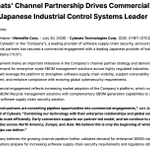
This February, Cybeats signed an OEM deal with Keysight Technologies ($KEYS, $55 billion market cap). Keysight will resell Cybeats' SBOM Studio and SBOM Consumer as the "Keysight SBOM Manager."
Through our channel checks we believe that Keysight is very selective with partnerships. For a $6 billion revenue company it doesn’t make much sense for Keysight to bother unless they believe revenue contribution can become material in 12-24 months. Last month the “Keysight SBOM Manager” won the grand prize in security assessment at Interop Tokyo 2026. This was a substantial achievement that resulted in an influx of interest from Japan.
Keysight sells testing equipment into industrial automation, aerospace and defense, automotive, telecom, and critical infrastructure. Every one of those industries is now legally required to produce and maintain SBOMs. Keysight already tests the hardware. Now they test the software inside the hardware, and instead of a one-time equipment sale, they add a recurring software subscription that renews every year.
Keysight is choosing an OEM partner (Cybeats) they'll be tied to for years. They don't want to pick the vendor with the shinier UI. They want the vendor whose data will still be the deepest in ten years. A five-year data lake tells Keysight's procurement team that Cybeats will still be the leader when the OEM deal is up for renewal. That's why the deal happened, and it's why the next big reseller will happen shortly for the same reason.
Keysight handles sales, deployment, and frontline support. Cybeats sits at fourth-level support. Each new customer takes about an hour of Cybeats' time to implement.
Our diligence suggests Keysight already has many customers in the pipeline (already more than Cybeats internal sales force). Sales cycles run six to twelve months, so the first contracts should start to land in Q4 2026.
Cybeats is working on additional resellers of Keysight's scale, targeting a couple more by year end. This just adds to the sales flywheel in 2027 and beyond.
The Upside
We don't have to guess what this business is worth. Someone just told us. In June 2026, Accenture acquired Netrise, one of two other credible SBOM platform providers, at 20x sales. That's a recent comp.
Cybeats trades at roughly $30 million CAD market cap. ARR is ~$5 million and breakeven is $6 million. The first Keysight-sourced contracts should start closing in Q4. As they compound through 2027, ARR could reach $10 million in H1 and $20 million by year-end 2027. This feels reasonable given the pipeline dynamics and the regulatory deadlines.
If we needed further proof of this cyber security area going mainstream, look no further than this J.P. Morgan report that came out this month (July 2026).
Google Search: "Patchmageddon - The race to patch software vulnerabilities before zero-day cyber-exploitations proliferate"
Cybeats isn’t cheap, but we believe the company could do well over the next 18 months. They have the right product at the right time.
The bet here is that sales traction will accelerate in Q4/Q1. The risk is it doesn't.
Disclosure: IFCM is long and wrong a lot.
