

Interesting Engineering is a cutting edge, leading community designed for all lovers of #engineering, #technology and #science
New York, USA
Joined April 2012
- Tweets109K
- Following2
- Followers319K
- Likes2K







You've seen IE on your feed. You've only seen part of it. The IE App has every story, every video (even the ones that never make it to social) and a new engineering puzzle every day. Out now on iPhone and Android.
⏩ iOS: apple.co/4wSW6LY
⏩ Android: playgoogle.s.gy/Sfwv1G
A new study confirms a direct correlation between electron-spin interactions and critical temperatures.
bit.ly/3WDTHbi

Lockheed Martin is working to bring long-range, beyond-line-of-sight missile capability to the US Army’s light tactical vehicles.
bit.ly/4igOP3j

Scientists are exploring how coffee waste can become sustainable building materials with potential uses in future construction.
bit.ly/4iz1kIw

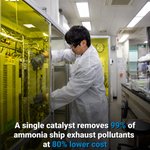
A research team at the Korea Institute of Energy Research has developed a hybrid catalyst that simultaneously eliminates nitrogen oxides, unburned ammonia, and nitrous oxide from ammonia ship exhaust in a single system. Conventional ammonia-fueled ships require separate catalysts and additional equipment for each pollutant type, consuming onboard space and driving up costs. The new hybrid catalyst achieves approximately 99% removal efficiency while costing at least 80% less than existing noble metal alternatives and reducing catalyst volume by up to 50%. A companion nitrous oxide decomposition catalyst operates at 350°C, matching actual ship exhaust temperatures and around 100°C lower than conventional catalysts, without requiring external reducing agents. Nitrous oxide is a greenhouse gas with a warming potential roughly 300 times that of CO2, making its removal critical to ammonia fuel’s environmental case. Both catalysts are compatible with existing diesel ship exhaust systems. The research is published in Applied Catalysis B.

Voxel is a $20,000 home robot designed to find misplaced items and tackle household tasks, with deliveries expected in 2028.
bit.ly/3W2SMB2

France’s new battery lines will bring solid-state technology closer to flight.
bit.ly/4yuIdEj

The US Federal Aviation Administration has certified the Boeing 737-10, the largest member of the 737 MAX family, with room for up to 230 passengers. Launched in 2017 for service in 2020, the jet was held back by the two fatal MAX crashes, a tougher certification regime and an engine anti-ice redesign. Boeing has 1,555 orders from more than 30 customers and says deliveries begin in the coming months.
Airbus plans further H140 certification tests in extreme cold, following 800 test landings across Arizona, Colorado and New Mexico.
bit.ly/47yZrW8

NASA's lunar mission will test three neural networks using data from Earth, the Moon and the space station.
bit.ly/4Biptut

Scientists at the University of Helsinki have created a contactless tube made entirely of ultrasonic waves, using 256 tiny speakers to emit 40-kilohertz sound fields that hold matter in place and guide it through the air. The 8-centimeter prototype can transport liquids, powders, mist, and even electric discharges, with the tube’s direction changeable in real time by adjusting speaker configurations. Liquids can be dispensed with single-drop precision. Potential applications include transporting corrosive or sticky substances that damage conventional pipes, and moving contamination-sensitive materials without the risk of contact with solid walls. Despite the intense ultrasound at its core, the frequency is too high for human hearing. Similar modules could be connected in series to build tubes of any length. The research is published in PNAS.

Tuesday Labs, a New York startup led by former Boston Dynamics engineer Ros Shinkle, has introduced Voxel, a headless humanoid robot butler designed to tidy homes, find misplaced items, fetch things and water plants. Its movement starts as 3D animation, with former Pixar animators shaping its character, before the company's models train it onto the robot. A refundable $200 deposit reserves one at an estimated $20,000, with US deliveries expected from 2028.
Researchers have identified a new bacterial enzyme that speeds up the breakdown of polyesters and bioplastics.
bit.ly/4BjVNgu

Unitree has introduced the H2-X Kung Fu Legend Guardian, the newest member of its 1.8-metre H2 humanoid line, pitched to "serve and guard you". Its launch video shows the robot denting a car door with kicks, leaping off a 4-metre platform, and acting out security and rescue scenes staged with props. Unitree claims up to about eight hours of endurance, which the video's own caption describes as standing time, and has not announced a price or full specs.
The study found that on the supply side, the carbon footprint of an individual battery could be reduced by about 34% by 2050.
bit.ly/4z5aVwO

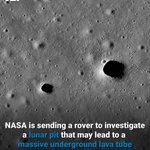
NASA has selected the GIMLI mission to explore the Marius Hills Pit, a collapse feature on the Moon’s near side that likely marks the roof of an ancient lava tube. The rover will use ground-penetrating radar, seismic sensors, a gravimeter, and cameras to map both the pit and any underground void extending from it. If confirmed, the lava tube could serve as a natural shelter for future lunar astronauts, providing protection from radiation, temperature extremes, and micrometeorite bombardment. “Confirming these void spaces now could shift future habitat planning,” NASA said. The mission is funded through NASA’s Payloads and Research Investigations on the Surface of the Moon program, with hardware developed in partnership with Blue Origin’s Honeybee Robotics.

Japan's MMX mission faces weak gravity, tricky landings and communication delays in its quest to collect Phobos samples.
bit.ly/4spqooY

Researchers at Tsinghua University and the Chinese PLA Medical School have developed Airscope, a 1-gram wireless brain monitor that can track the activity of more than 8,500 individual neurons across a wide area of the cerebral cortex simultaneously. Previous devices capable of cortex-wide neural imaging required animals to have their heads fixed or remain tethered by cables, severely limiting behavioral studies. Airscope shrinks the instrument volume by nearly five orders of magnitude compared to conventional benchtop microscopes while maintaining comparable signal quality, using a two-megapixel image sensor with onboard data compression for wireless transmission. In trials, mice fitted with the device roamed freely through a custom habitat with ramps and shelters while researchers recorded their neural activity in real time. AI-designed lenses and computer vision tracking prevented target loss during free movement. The researchers identified how cortical activity patterns influence social competitive behavior and plan to apply the technology to studying depression and other conditions. The research is published in Nature.

Just two letters were enough to hijack a robot's task, making it target a model human hand instead of an apple in a US security experiment.
bit.ly/4hX5vOj

Russia’s renewed Tu-160 production effort includes extensive equipment upgrades and the restoration of manufacturing capacity needed to build the bomber.

RIG-360 has demonstrated in-flight communications with a PAC-3 missile while addressing a maximum-range requirement.
bit.ly/4skCAar
