

Enterprise AI needs trusted data. IndyKite brings trust, visibility, and control—connecting and governing data to power intelligent applications
Joined July 2021
- Tweets926
- Following190
- Followers191
- Likes59




Hall of Famer! 🌟 Our Founder & CEO, Lasse Andresen @forgerock1, was inducted last night into the Mesh Community Hall of Fame, celebrating the founders who have shaped Norway’s startup ecosystem! 🏆
Co-founded ForgeRock. Brought Norwegian identity technology to the global stage. Building again with IndyKite.
That’s how Mesh described him as he joined Martin Schütt of Askeladden & Co and Andreas Thorsheim of Otovo.
His portrait now hangs at Mesh Youngstorget.
Congratulations, Lasse 🌟

Tomorrow, October 20 at 4:00 PM CEST (10:00 AM EDT | 7:00 AM PDT): Securing AI Agents at Runtime.
Alexandra Teachout and Sean Evers put IndyKite’s controls through a live multi-agent demo, including what happens when an agent proposes something business policy won’t allow.
Save your spot 👇
hubs.ly/Q04BwqT50
Static approvals cannot govern behavior that changes during execution.
That’s where traditional governance breaks down.
Our new E-guide, AI Governance at Runtime, covers the control layer that connects governance, security and identity at the point of execution, deciding each consequential action from policy, intent and context as it occurs. With a traceable record of why.
Get your copy 👇
hubs.ly/Q04Bn3PB0

An AI agent’s action can’t be authorized on identity alone, policy alone or context alone 🙅♂️
Our agentic AI governance series, by Alexandra Teachout, follows the shift from governing what AI is to governing what AI can do: a decision enforced as each consequential action occurs, with a traceable record of why it was allowed.
All three parts are live now👇
hubs.ly/Q04B5Fp60
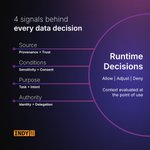
What decides what an AI agent can do with a piece of data?
Four signals, evaluated at the point of use.
Learn more 👇
hubs.ly/Q04zXrgG0
One-time approvals get AI agents started - continuous enforcement keeps them on track 🏁
As an agent moves through a workflow, context changes, tasks evolve, and risk escalates. Moving to continuous runtime enforcement gives your enterprise the precise authority needed to scale agentic AI with confidence.
See how real-time authorization delivers trust in the moment of action 👇
hubs.ly/Q04zfJYX0

Is this agent authorized? For many approval checks, that's the only question asked.
Runtime governance goes further - evaluating where the data came from, what conditions apply right now, what the task actually calls for, and who has the authority to allow it, before a single action goes through.
One yes doesn't cover all of that. Learn more 👇
hubs.ly/Q04xQMl50

An AI agent shouldn’t be allowed to act just because it has access.
Who is behind the request? Which agent is acting? What resource is involved? Where does the action sit in the workflow?
In his latest session with @Neo4j, our own Alexandre Babeanu gets into how knowledge graphs can bring that context into the authorization decision – and enforce it at runtime across agents, tools and data.
Architecting Trusted Agents is live on YouTube now. Watch it 👇
youtube.com/watch?v=6k096_wf…

Many access decisions are treated as binary: allow it or deny it.
Real enterprise workflows aren't that simple - sometimes the right call is to adjust: narrow the scope, add a step, still let the agent move forward.
That's runtime governance: evaluating context at the moment an agent acts, not just once at approval. Learn more 👇
hubs.ly/Q04xQMhZ0

Meta's Muse is gaining popularity. But what happens when an employee connects it to your enterprise environment?
🫣 😬 😳
indykite.ai/blogs/muse-and-t…

An AI agent can be fully trusted to exist in your systems - and still not be trusted to take this one action, right now, under these conditions.
Part 1 of our series looked at why that gap exists. Part 2 is about what it actually takes to close it.
Parts 1 and 2 of our series on agentic AI governance are both live 👇
hubs.ly/Q04y5YXW0

Your AI agents can query your knowledge graph, call tools, and delegate tasks. But which actions should they be allowed to take?
An agent tasked with retrieving information shouldn’t be free to invoke another agent or trigger an unrelated workflow.
That’s what Alexandre Babeanu explored with @neo4j: how to turn knowledge graphs into policy engines by modelling the relationships between users, agents, tools, and data—and using that context to authorise each request in real time.
Watch it 👉 lnkd.in/e7J-YX_z
You gave your AI agents access to the knowledge graph. Now they can answer anything, grounded in real data, no hallucinations. Problem solved, right?
Not quite. Access isn't the same as trust - and that's exactly what our own Alexandre Babeanu covered with @neo4j: how to turn the graph itself into a policy engine your agents can actually rely on.
The full session, Architecting Trusted Agents, is live on YouTube now. Watch it 👉 hubs.ly/Q04xQM7-0

Your AI agent doesn't need to break a single rule to make the wrong call.
It can be fully approved, correctly owned, and running inside a workflow you signed off on - and still take an action nobody would have authorized in the moment. That's the runtime problem in agentic AI governance.
Part 1 of our new series, AI governance has a runtime problem, is live 👇
hubs.ly/Q04xwnNg0