





Two roaring afterburners carve pure fire into the blackness as the Su-30MKI powers down the runway—a silent silhouette, a deafening force, an unstoppable presence.
I would like to express my gratitude to the @indianairforce for this opportunity.
.
.
#Su30MKI
#IndianAirForce
1
65
Indian aviator retweeted

Even as he prepared to retire, Air Chief Marshal AP Singh was fighting one last battle for the IAF—its control over prime land at the Race Course Air Force Station.
hindustantimes.com/india-new…


Indian aviator retweeted

The Concept of Ace Fighter Pilots is a Western Concept that became pervasive during the World War-I and Ace Fighter are those who have Shot down at least 5-6 Enemy Fighter Jets in Air Combat.
As Far as Air Chief Marshal Ashutosh Dixit is Concerned he has a Accomplished Fighter Pilot and Experimental Test Pilot Career. Air Chief Marshal Ashutosh Dixit is an Experimental Test Pilot and CAT-A QFI, as Commanding officer of No.9 Squadron he Converted and Operationalised the No.9 Squadron “Wolfpacks” with Mirage-2000 and later as Experimental Test Pilot he played instrumental Role in LCA Tejas Project and MMRCA Project (Rafale).
Act like a Responsible Media agency rather than using these Military Jargons Irresponsibly or else because of your loose Jingoistic news Drafting you will end up getting IAF’s Senior Leadership Trolled.
Indian aviator retweeted

How I wish the authorities would have known and understood IAF’s deep emotional connect with AF Stn Race Course..
But when you see the military establishments as commodities rather than proud history, nothing would stand to logic. We as Indians have utter disregard for our history and more so for Military History.
In recent times all military establishments are being seen as the sign of colonial regime but we forget that all these establishments were in highly undeveloped and very thinly populated areas and it has been brought to this shape after decades of improvement by the armed forces. The spic and span Cantonment would not be in this condition if it was not maintained and looked after by military units.
The race course would also become unrecognisable and dilapidated or at best concretised eyesore in no time..
Sad to lose this piece of History.
Wonderful articulation @AnchitGupta9 👏👏👏

Why did the Indian Air Force come to Race Course?
The closure of the Air Force golf course at Race Course in New Delhi has attracted considerable attention. But it also offers an opportunity to revisit a rather interesting question. Why does the IAF have a station in the very heart of Lutyens’ Delhi?
Long before golf was played here, the area hosted cricket, parachute training, and RAF operations. The reason the IAF eventually established a major administrative station here in 1947 has much to do with Hyderabad State's uncertain future and the reorganisation of the Air Force at Partition.
The story begins in 1941, at Willingdon Airport.
In Sep 1941, the RAF established an Air Landing School at Willingdon Airport, now Safdarjung Airport, to train personnel of the newly raised 50th Indian Parachute Brigade. The Brigade comprised British, Indian and Gurkha parachute battalions, and the school represented one of the earliest organised efforts to develop military parachuting in India. Its equipment was rudimentary. The RAF initially had to make do with obsolete Vickers Valentia biplanes, modified to allow parachutists to jump through an opening in the fuselage floor.
Some of the earliest parachute jumps took place over the racecourse adjoining Willingdon Airport. One contemporary account describes a company commander landing on the upper tier of the racecourse grandstand and bouncing his way down to the bottom! The Air Landing School was initially housed under canvas, with accommodation and other buildings coming up near the Race Course. The school was also experimenting with the equipment and techniques required for airborne operations and aerial resupply.
Then, in April 1942, RAF Station New Delhi was formally established. Until then, Willingdon had been a civilian aerodrome used by several RAF units. A Communication Flight detached from No. 31 Squadron, RAF at Lahore had been operating from the airfield for some months. The Air Landing School occupied buildings on one side of the aerodrome, while other small RAF detachments operated alongside it.
The formation of RAF Station New Delhi brought these activities under a common Station Headquarters. The new establishment assumed responsibility for running the aerodrome, although its physical upkeep remained with the Public Works Department. The Station also administered the Air Landing School, a small Parachute Repair Section comprising one senior NCO and seven airmen, and a ground staging and refuelling party responsible for transit aircraft.
It was still a shared airfield. Civil flying continued, including operations by Indian National Airways and the Delhi Flying Club. By October 1942, when the Air Landing School moved to Chaklala near Rawalpindi, it had recorded 9,231 live parachute descents and qualified 1,511 trainees during its stay in Delhi. The 50th Indian Parachute Brigade would later see fierce fighting against the Japanese at Sangshak in March 1944.The school at Chaklala would later move to Agra where it remains to this date.
RAF Station New Delhi continued to serve the wartime Air Force. The Air Headquarters communication organisation, which itself traced its origins to a flight raised at Lahore in 1928, operated from Willingdon before moving to Palam in 1946.
But how did this RAF establishment eventually become the administrative centre of the independent Indian Air Force?
For that, we need to move forward to 1946, when the Royal Indian Air Force was beginning to consider its post-war organisation. An Air Force broadly rests on four functions: operations, training, maintenance and administration. The first three would eventually develop into operational Commands, Training Command and Maintenance Command. Administration was a somewhat different problem.
It meant managing medical services, accounts, education, security, infrastructure, transport, accommodation and the movement and holding of personnel across the country. It also meant looking after the numerous establishments that came directly under Air Headquarters but did not belong to conventional formations.
One of the early ideas was to concentrate much of this activity in peninsular India, with Arkonam (today's Arakkonam, home to the naval air station INS Rajali) emerging as a possible administrative centre.
The RIAF established a depot at Arkonam, and several important establishments were located in the Madras region. The Air Force Record Office, responsible for personnel records and the administration of airmen, had moved to Red Hills Lake near Madras in 1946. The Central Accounts Office had similarly moved from Bombay to Madras. But Partition complicated these plans considerably.
At the time, southern India comprised territories with different political arrangements. Madras was a province of British India, while Mysore and Hyderabad were princely states. The uncertainty was particularly acute in Hyderabad, where the Nizam had not committed himself to joining the Indian Union. This presented a problem for the RIAF because several of its important training establishments were situated in and around Hyderabad and Secunderabad, including at Hakimpet.
The Air Force consequently began reorganising its training infrastructure, shifting establishments towards locations where their future within India was more secure. In February 1947, No. 2 Ground Training School moved from Secunderabad to Tambaram, near Madras. No. 1 Ground Training School, formed at Hakimpet, subsequently moved to Jalahalli near Bangalore in November 1947. The RIAF Depot at Arkonam (also training airmen) also moved to Jalahalli that November.
With the southern stations being reorganised to accommodate training requirements, the earlier idea of concentrating the principal administrative establishments there became less practical.
The administrative institutions were consequently reorganised towards northern India. New Delhi was the natural destination, not least because Air Headquarters was located there and exercised functional control over many of these units, but also because RAF was vacating the Willingdon premises.
The Record Office moved from Red Hills Lake to Delhi in October 1947, while the Central Accounts Office also moved to the capital that year. The medical and other administrative establishments serving Air Headquarters formed part of the wider arrangement.
What was needed was a single organisation to administer these establishments locally while leaving their professional responsibilities with Air Headquarters. And so, on 1 Sep 1947, just seventeen days after Independence, Air Headquarters Administrative Instruction No. 01/47 established No. 10 Administrative Wing, Royal Indian Air Force, at Race Course, New Delhi.
The Wing was built upon the existing RAF establishment in the Willingdon and Race Course area. Its responsibilities extended to Air Headquarters and the numerous associated units and establishments in the capital. And the man selected to command the new Wing was quite a character.
Group Captain Kanwar 'Tiger' Jaswant Singh had joined the Indian Army in 1936 before transferring to the Air Force in 1940. He had flown with Nos. 2 and 3 Squadrons, commanded No. 2 Squadron during operations in Burma in the Second World War, and earned a reputation as a demanding commander and exceptional sportsman.
Yet, on 1 Sep 1947, Tiger found himself commanding an administrative Wing in a capital torn apart by communal violence. It was hardly a quiet assignment. The new Wing was immediately called upon to patrol riot-affected areas of Central Delhi and assist in maintaining law and order.
At the same time, Partition had divided the Air Force itself. Hundreds of airmen and their families were arriving from former RIAF establishments at Kohat, Peshawar, Risalpur, Chaklala and Mauripur, all now in Pakistan.
The Station's history records that approximately 900 airmen and 150 families required immediate boarding, lodging and assistance. It also had to help personnel moving in the opposite direction, including escorting those proceeding to Pakistan through Palam for onward travel. Tiger, who lived at 1 Kushak Road, was frequently seen travelling around Delhi on his James motorcycle, attending to the Station's responsibilities during these difficult months.
On 24 December 1947, Prime Minister Jawaharlal Nehru addressed a gathering of nearly 2,000 officers and airmen. The Wing had already begun acquiring the ceremonial responsibilities that would eventually become one of the most visible features of Air Force Station New Delhi.
In May 1948, No. 10 Administrative Wing was redesignated as an RIAF Station. When India became a Republic on 26 January 1950, the 'Royal' prefix was dropped and the establishment became Air Force Station New Delhi. The sporting history of Race Course also continued alongside its military responsibilities.
The grounds that later became associated with golf had earlier been used for cricket, while the Station continued to host athletic meets and inter-unit competitions. The Station's photographic archives include images of athletic competitions in 1948, and sporting events continued to be held at Race Course over subsequent decades.
Meanwhile, the Station's military responsibilities continued to evolve. During the 1971 War, it housed fifteen Pakistan Air Force prisoners of war, including Flight Lieutenant Pervaiz Mehdi Qureshi, who would eventually become Chief of the Pakistan Air Force.
By the time Air Force Station New Delhi celebrated its Platinum Jubilee in 2022, it was providing administrative support to 46 IAF units apart from Air Headquarters, covering approximately 10,000 personnel. Its functions extended to medical services, accounts, transport, logistics, accommodation, schools, security, ceremonial duties and numerous other activities across Delhi-NCR.
The golf course became one of the more familiar features of Race Course in later decades, particularly to generations of serving and retired Air Force personnel. But the Air Force's presence here has a much older history.
#IAFHistory @IAF_MCC


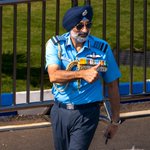
Air Chief Marshal AP Singh looking sharp and confident as always.
Born on this day in 1964, the 28th Chief of the Air Staff turns 62 today.
Once a fighter pilot, always a fighter pilot. Blue skies, Chief 🇮🇳
#APSingh #AirChiefMarshal #IAF #IndianAirForce #BlueSkies
84
Indian aviator retweeted

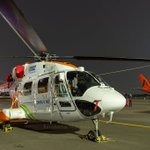
The Light Utility Helicopter (LUH) programme has entered a critical testing phase, reaffirming HAL’s rigorous approach to validating safety, reliability and performance across its indigenous helicopter programmes. @DefProdnIndia @SpokespersonMoD #LUH

Indian aviator retweeted

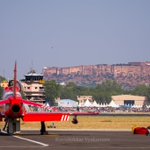
Breathtaking maneuvers by @Suryakiran_IAF take the spotlight at Varanasi Air Show!


Indian aviator retweeted

Leadership that inspires. Opportunities that empower. 🇮🇳🛩️
Air Chief Marshal AP Singh, PVSM, AVSM, Chief of the Air Staff, shares the cockpit with NCC Girl Cadet Jakkula Tejasvi Reddy, turning her dream of flying into an unforgettable learning experience.
From mentorship to hands-on flying experience, this sortie reflects the NCC’s commitment to empowering cadets, building confidence and inspiring the next generation of leaders. ✨
When experience inspires ambition, new possibilities take flight.
#NCCIndia #IndianAirForce #NCCCadets #NariShakti #IndianAviation @rajnathsingh @SethSanjayMP @SpokespersonMoD @adgpi @IAF_MCC @indiannavy @vatsvirendra1 @dprohyd @PRO_Vizag


Indian aviator retweeted

When the Flanker pulls the dump valve mid-formation... 💨
Unfiltered air-to-air vantage from Tarang Shakti 2026. Framing the sharp delta lines of our indigenous LCA Tejas tucked tightly alongside the heavyweight twin-engine Sukhoi-30 MKI as it vents fuel into the slipstream.
An incredible privilege flying inside the pattern and shooting alongside the IAF documentation crew. Pure airmanship from takeoff to RTB.
Drop your thoughts in the comments — which jet steals the frame for you?
#tarangshakti26
Indian aviator retweeted
Air Chief Marshal AP Singh set to fly the Tejas from Jodhpur airbase today, one last flight before he retires on Oct 31. His final salute to the skies will also turn the spotlight on the aircraft's delayed latest Mk-1A variant, the next chapter in India's homegrown fighter story.


Indian aviator retweeted

American stealth, French tech, Russian heavyweights, and homegrown fighters, all in one frame.
The F-35, F-16, Rafale, Su-30MKI, and Tejas flying wing-to-wing over Jodhpur.
This is the 'Tarang formation' flypast during Ex Tarang Shakti.
#TarangShakti #IAF
Indian aviator retweeted

Dec 1986 picture of NDA POP in which DCCs Dhiraj Seth and Asutosh Dixit are taking steps. None would be knowing that both would become Chief one day.
courtesy: @ColHunnyBakhshi

